

Diamond is celebrated as one of the hardest materials known, but new research shows that even its famously rigid structure can be dramatically altered by an impact travelling at hypersonic speed. Scientists have found that diamond particles embedded in a specially engineered ceramic composite can undergo a near-complete transformation into graphite during a collision lasting only microseconds. The research, led by Abhijit Biswas and Pulickel M. Ajayan at Rice University, involved collaborators from Texas A&M University, the University of Toronto, Karlsruhe Institute of Technology and other institutions. Published in Materials Today under the title ‘Diamond-to-graphite transformation under hypersonic impact,’ the study used projectiles travelling at up to Mach 8.45 to investigate how diamond responds to extreme mechanical shock. The findings reveal an unexpected energy-absorbing mechanism and could help scientists design tougher materials for technologies exposed to severe impacts and extreme conditions.
How did scientists make diamonds survive long enough for the extreme impact experiment?
Before testing diamond under hypersonic impact, the researchers first had to solve a different problem, how to incorporate diamond particles into a strong bulk material without destroying their structure during manufacturing. Diamond can transform into graphite when exposed to high temperatures, making conventional sintering methods particularly challenging. The team therefore developed a composite containing micrometre-sized diamond grains, cubic boron nitride (cBN) and cobalt. In the study ‘Diamond-to-graphite transformation under hypersonic impact,’ published in Materials Today, Biswas, Ajayan and their collaborators used spark-plasma sintering at 1,400°C and 90 MPa to consolidate the components. The cBN matrix and cobalt additive helped stabilise the diamond phase during processing. The resulting material was described as hard to machine but tough, creating a practical platform for studying what happens when diamond experiences violent mechanical shock rather than simply being heated.
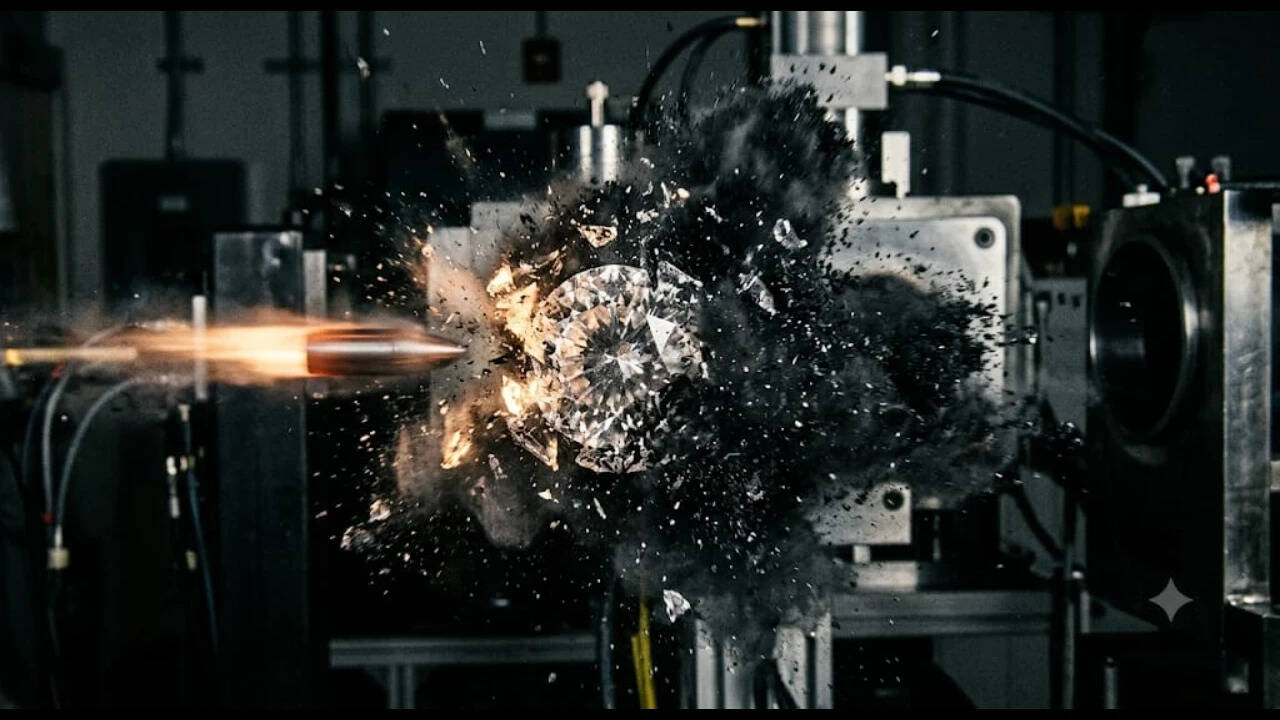
What happened when diamond was struck at Mach 8.45? (Image: AI Generated)
What happened when diamond was struck at Mach 8.45?
The researchers then subjected the composite to impacts using tiny metal projectiles travelling at hypersonic speeds. A 1-millimetre projectile travelling at Mach 7.5 struck the material without causing complete failure, while a larger 4-millimetre projectile travelling at Mach 8.45 caused the composite to fracture. The most surprising result appeared inside the fractured material, the embedded diamond grains had undergone a near-complete transformation into graphite. According to Rice University’s account of the research, the transformation occurred on a microsecond timescale, far faster than the slower heat-driven diamond-to-graphite conversion normally associated with changes in carbon structure. The researchers examined the damaged composite using detailed microstructural characterisation and found interfaces between diamond and newly formed graphite. They also used atomistic molecular-dynamics simulations to model how carbon atoms rearranged during the violent event.
Why can extreme impact turn diamond into graphite so quickly?
Diamond and graphite are both made entirely of carbon, but their atoms are connected and arranged in fundamentally different ways. Diamond has a three-dimensional sp³-bonded structure, which gives it exceptional hardness, whereas graphite has layered sp² bonding, producing a much softer material. Transforming one into the other therefore requires major rearrangement of carbon-carbon bonds. The new research shows that an extreme mechanical impact can drive this structural change extraordinarily rapidly. Rather than relying solely on heating, the shock generated by the hypersonic projectile supplies enough energy to trigger bond rearrangement and the formation of graphite. These molecular dynamics simulations confirmed what the experimental results had shown and also provided insights into the atomic scale changes that take place when the impact occurs. The scientists realized that the formation of these new diamond-to-graphite interfaces plays an important role in this transition process. Above all, this phase transition seems to consume a large amount of energy from the collision process.
Could diamond-to-graphite transformation help create tougher materials?
The discovery could change how researchers think about diamond-based materials designed for extreme environments. Instead of viewing the transformation into graphite simply as a failure mechanism, the Rice-led team found evidence that the phase change can help absorb impact energy. As the diamond structure breaks down and carbon atoms rearrange into graphite, part of the energy delivered by the collision is consumed by the structural transformation. That mechanism could eventually inform the design of protective materials for technologies exposed to intense mechanical shocks, including aerospace and other extreme-condition applications. The research is particularly valuable because it combines physical impact experiments with molecular-level simulations, allowing scientists to connect what happens to the material at visible fracture sites with changes occurring among individual atoms. The authors say that understanding how materials change their structure and phase under force, alongside their strength and hardness, could guide the development of future protective materials. For now, the study provides a new picture of how even diamond can respond when subjected to forces far beyond ordinary conditions.

