
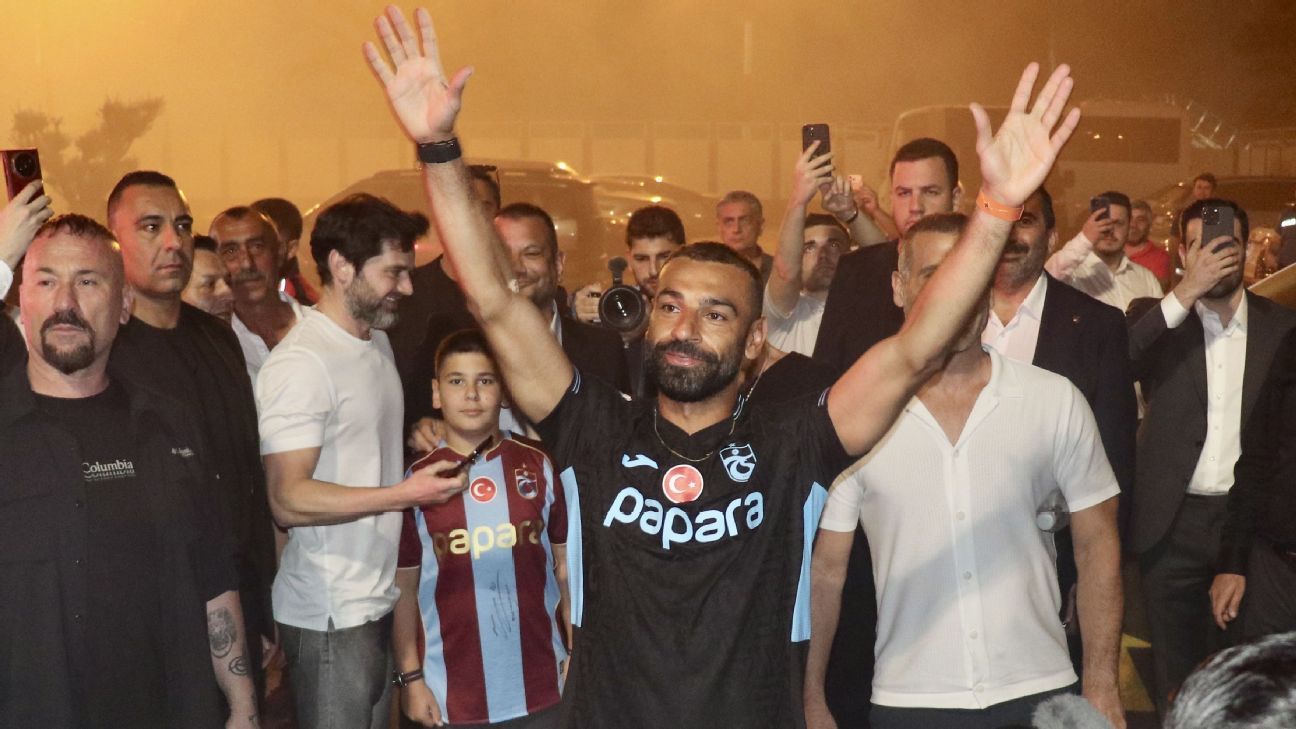
Mohamed Salah looked on, wide-eyed with astonishment, as Trabzonspor fans serenaded him, sung to him and even bowed to him as he joined the club on a free transfer on Aug. 6.
Fans had packed inside Papara Park, their 41,000-seater stadium situated on the banks of the Black Sea in northeastern Türkiye, and filled three of the four stands available to give him an unimaginable welcome. Chants echoed around the ground, flares burned bright red, and an old Turkish song — “Allah Allah Bu Nasil Sevmek” — was tweaked so that “Mohamed Salah” replaced the last three words, in perfect rhythm.
The 34-year-old Egypt international — a two-time Premier League title winner and champion of Europe with Liverpool — then ascended the steps in the single empty stand, where a stage, a contract and a microphone awaited him. Facing the raucous crowd and visibly struck by the atmosphere, he could barely speak; he opened by nervously muttering “marhaba” (hello/welcome), and then immediately apologized for not yet having learned to speak Turkish (in two days).
After a short speech, Salah walked back down to the pitch for a light show. Meanwhile, around the stadium on TV broadcasts, fans were screaming praise for him: “The King of Egypt!” “Trabzon’s new prince!” “Sultan!” were among the titles bestowed upon him.
“When the first rumors of Salah’s transfer started circulating, the reaction of the entire fanbase was ‘Oh, come on! There’s no way something that ridiculous could actually happen!'” NTV correspondent Veysel Mete Kılıç, who was on the pitch for the unveiling, tells ESPN.
“Until Salah actually set foot in Trabzon, it was as if everyone believed it was all a dream, and that someone was eventually going to splash cold water in their faces and wake them up. The signing ceremony was an unprecedented spectacle in Trabzonspor’s history.”
A well-trodden path
The transfer window in Türkiye is an entirely different animal.
Every year, the four biggest clubs — Galatasaray, Fenerbahçe, Besiktas, Trabzonspor — not only compete to make splashy, eye-catching signings (often from western Europe), but fight one another for those same targets. It drives the fans into a frenzy as their clubs compete for prestige through the transfer market.
For the players, the lucrative path to Türkiye is well carved. It began in the late 1980s with West Germany international goalkeeper Toni Schumacher, who wrote a book that got him fired by his club, FC Cologne. With nowhere else to turn, he joined Fenerbahçe and proved an immense success, captaining the team to the Turkish league title.
More followed. In the 1990s, legends like Gheorghe Hagi, Jay-Jay Okocha and Claudio Taffarel also made their way to Türkiye’s Super Lig. Then in the 2000s, a trickle became a flood; depending on how long you’ve been following soccer, you might remember Roberto Carlos (2007), Wesley Sneijder (2013), Radamel Falcao (2019) making the move, or more recently, Victor Osimhen (2024) and Leroy Sané (2025).
These players are lauded and treated like kings. For decades, tradition has dictated that tens of thousands of fans race to the local airport to greet their new heroes in style, draping them in scarves and forcing pens into their hand for signatures.
By this stage, Türkiye is no stranger to star names and big spending. The summer of 2026, though, took things to yet another level. Supporters watched, stunned, as all four Turkish giants laid siege to the market, directly competing for multiple players and splashing the cash.
“The names brought in made headlines all over the world,” says journalist Hasan Mor.
A summer of spending
In each of the last two years, Super Lig spending has breached €400 million, per Transfermarkt; before that, it had only hit €200 million once. This places the Turkish league seventh in the world in spending over that period, behind only Europe’s top five leagues and Saudi Arabia.
The summer of 2025 saw Osimhen join Galatasaray from Napoli for a record €75 million, roughly tripling the previous record set by Youssef En-Nesyri‘s move to Fenerbahçe in 2024. In 2026 the spending cranked up another notch, adding seven fresh names to the Super Lig’s top 15 most expensive transfers of all time.
Second in that list is now Mason Greenwood, signed from Marseille for a figure Fenerbahçe claim was €40 million, but the French club insist was €50 million. The club further bolstered their forward line with Romelu Lukaku (€6.5 million) from Napoli and Vedat Muriqi (€15.5 million) from Mallorca. Meanwhile, Nathan Aké (€7.5 million) arrived from Manchester City to shore up the defense.
The sheer level of name recognition now present in this Fener side led to a viral moment in the summer, as social media users realized they recognized the entire XI fielded for a UEFA Champions League qualifier against Lyon on Aug. 18.
📋 The starting XI tonight. #FBvOL pic.twitter.com/hMfrPgl9cV
— Fenerbahçe English (@Fenerbahce_EN) August 18, 2026
Usually, a handful of Turkish players largely unknown to a global audience would create some mystery in the team, but the only one present — Kerem Aktürkoglu — was already well known from eye-catching cameos at Euro 2024 and World Cup 2026. Otherwise it was an XI made up of big-name stars from across Europe: Éderson, Aké, Nélson Semedo, N’Golo Kanté, Milan Skriniar, Matteo Guendouzi, Greenwood and more. Lukaku would soon be added to that mix too.
Over the summer, reigning champions Galatasaray also made waves. They very publicly outbid Premier League outfit Aston Villa for the signing of Rafael Leão of AC Milan, spending €45 million and committing a huge salary package (reportedly €12.5 million per year) to landing the Portugal winger. Gala also spent €25 million to bring in Russia’s rising midfielder star Alexey Batrakov and €10 million to sign FC Porto forward Deniz Gül.
Across the city of Istanbul, rivals Besiktas signed winger Leandro Trossard from Premier League champions Arsenal (€18 million), goalkeeper Alexander Nübel from Bayern Munich (€6.5 million), former Juventus striker Dusan Vlahovic as a free agent, and his old teammate Fabio Miretti on loan.
Unfortunately for Besiktas, they were beaten to Salah’s signature by Trabzonspor, who also moved to bring in Fabinho, the Egyptian’s old Liverpool midfield colleague. They then did some smarter business in the younger age bracket, picking up two young players from Denmark — Aral Simsir (€15 million) and Franculino Djú (€17 million) — and signing Cape Verde full back Sidny Lopes Cabral (€10 million) before he shone at the World Cup.
A transfer that feels like winning a derby
It’s one thing for a Turkish giant to sign a big-name player; it’s another thing entirely to sign one that a rival was also in the hunt for. The one-upmanship at play between the four teams is perhaps unrivalled in world football.
“In Türkiye, we call it a transfer çalımı [transfer hijack],” Fenerbahce season ticket holder Hira Gizem Fidan tells ESPN. “When you manage to take a player that your rival really wanted, it is seen as a big success, because you stop them from getting what they wanted and make your own team stronger. These moments can almost feel like winning a derby.”
Salah is the latest high-profile example of this, as he was strongly linked to Besiktas for weeks before opting for Trabzonspor. The club triumphantly teased the news with a CGI video of the pyramids overlooking their stadium, which hit 18 million views. The comments section is full of fans not only celebrating his arrival, but also exulting in Besiktas’ perceived failure.
𝐀𝐥𝐰𝐚𝐲𝐬 𝐛𝐞𝐥𝐢𝐞𝐯𝐢𝐧𝐠 👑 pic.twitter.com/3csin4wD5I
— Trabzonspor (@Trabzonspor) August 4, 2026
Another example came in 2023, with Besiktas once again on the losing end of a deal. There was heavy expectation that former Southampton and Ajax striker Dusan Tadic would join the Black Eagles due to weeks of speculation, but very suddenly one night, the Serbia international pivoted to Fenerbahçe.
“He was one of Ajax’s most successful players and a big name in world football, so we obviously didn’t like the idea of him going there,” recalls Hira. “Besiktas fans had prepared a #ComeToBesiktasTadic hashtag on social media. They were making videos and edits for Tadic and sharing them on Twitter. They were waiting. We were just watching quietly.
“Then, the great moment: Suddenly, a photo of Tadic on a plane appeared, on his way to sign for Fenerbahçe. Once we realized it was real, the fans started sharing it like crazy, and thanked Besiktas fans for making those videos and preparing the transfer announcement for us!”
Futbolcu Dusan Tadic, kulübümüz ile transfer görüşmelerini gerçekleştirmek üzere İstanbul’a geliyor… 💛💙 pic.twitter.com/DaQrOHuCLZ
— Fenerbahçe SK (@Fenerbahce) July 15, 2023
How the deal shifted is extremely interesting, and it speaks to a wider point about how some of these deals are done.
“Besiktas approached Tadic through an intermediary agent, and the player was open to joining Besiktas,” Ali Can Peçenek, a former sporting director in the Super Lig and now a consultant on club management, explains. “However, the club moved rather slowly during the process and was also not fully prepared to meet the financial terms requested.”
“At that point, the situation was brought to the attention of Fenerbahçe President Ali Koç, a member of one of Türkiye’s most prominent business families. Koç then spoke directly with Tadic, who was impressed by the conversation, and an agreement was also reached on the financial terms.”
Fenerbahçe fans speak glowingly of the “special moment” of seeing Tadic in their shirt for the first time. When he scored against Besiktas in the derby, they were delirious with joy. And to top it off, Fener’s goal music (“Freed From Desire”) was easy to convert into a song for him when he scored (“Tadic on fire”), as his previous club, Ajax, had already started that trend.
0:50
What Mo Salah’s arrival from Liverpool means for Trabzonspor
Treated like kings
Star foreign players are treated very well in Türkiye. That tradition began with Schumacher in 1988, who was reportedly greeted by 50,000 fans at the airport, and has carried all the way through to present day as thousands greeted Leão at the airport, sung his name and eagerly awaited his first words as a Galatasaray player.
Osimhen’s arrival was similar, and he has gone on to form an intense bond with the fans. The Nigerian striker was even moved to tears in March, ahead of a Champions League match with Liverpool, as the north stand unfurled a giant tifo of him, his kids, and his deceased mother, with a message that read: “We are family, and family is everything.”
However, Salah’s arrival cranked things up another notch.
“When Salah landed, he saw tens of thousands of fans waiting for him, even in the darkness; there were smiles everywhere,” Veysel tells ESPN. “The sides of the main road outside the airport (10 minutes from the city center), the surrounding houses, and even the rooftops of those houses were all filled with people.
“Trabzon is a city of roughly 800,000 people, with a predominantly working-class population. Here, people are happy when Trabzonspor are successful. After a defeat, shopkeepers look as though they have just been told the worst possible news, and some shops do not even open. The people live and breathe their football club.
“The fact that Salah is Egyptian, while Türkiye is a country whose population is overwhelmingly Muslim, also created a certain degree of cultural harmony. After all, Salah’s iconic goal celebration [the sujud] is an image that Turkish fans are intimately familiar with.
“I am not sure how often you hear people earning €10,000 a year worrying about disappointing a player who is paid €17 million a year, but a large majority of Trabzonspor supporters genuinely believe that the entire city has to step up to make Salah happy. Some are asking ‘what if Salah plays incredibly well, but we as a team aren’t good enough to match his level? What if we let him down?'”
Recently, Salah visited a high-altitude plateau in Trabzon’s mountains and posted a photo on social media from it. That plateau was then swiftly named after him, with a sign erected to confirm the change.
He is probably the biggest name to have ever signed for a Turkish Super Lig club, and Trabzonspor fans are determined to revel in that glory for as long as possible. As the only one of the top-four clubs that is located outside of the capital city, Istanbul, there’s also a feeling in Trabzon that they need to shout a little louder about their stars, too.
Is it affordable? Is it sustainable?
As the decades-long, illustrious trail of star signings proves, spending big is hardly a new concept to Türkiye’s top teams. But compared to two years ago, the numbers have doubled; compared to five years ago, they have basically quadrupled. Inflation cannot account for such a massive jump.
This is despite broadcast revenue payouts in Türkiye not being particularly lucrative; Galatasaray earned just $17.1 million for winning the Super Lig in 2024-25, which pales in comparison to what the top-five leagues award and falls more in line with what Crystal Palace earned for winning the UEFA Conference League. Matchday tickets can get quite expensive, but standard seats can also run as cheap as $50.
It begs the question how sustainable this type of spending is, and whether the clubs are taking dangerous financial risks in order to one-up each other.
“The four major clubs generate significant revenues, but they also all carry substantial levels of debt,” Peçenek says. “But the key is not simply the amount of debt, it’s the nature and structure of that debt.
“One of the key developments behind this season’s transfer activity is that the clubs have been able to fulfil their obligations under their agreements with the Banks Association in Türkiye, reduce or settle parts of their debt, and therefore ease the interest burden. This has given them greater financial flexibility.”
It paints the impression of a bubble that might well burst in the future — Peçenek labels the market “extraordinary” — unless, perhaps, the Super Lig can capitalize on the momentum it has generated, as a stronger league can garner greater media attention, more lucrative sponsorship deals and better broadcasting revenue.
Salah has already provided a snapshot at what a player of his profile can bring to the league: Broadcaster beIN SPORTS’ highlights package of Trabzonspor’s 4-0 win over Galatasaray in September, in which the Egyptian scored a hat trick, is already the seventh-most watched video (7.1 million views) in the channel’s history. Every video above it was uploaded at least seven years ago.
But Istanbul-based journalist Hasan Mor is critical of the approach the big four have taken.
“I’m not a fan,” he says. “It is relatively easy for these clubs to attract a player by offering a high salary, as the clubs cover their tax obligations, making it really attractive financially, but it means Türkiye is sometimes seen as the ‘Saudi Arabia of Europe.’
“And the real problem comes when you want to move that player on.”
Through his spells as a sporting director at Ankaragucu, Peçenek has a first-hand understanding of how difficult it is to reach an agreement to sign players who are highly paid and suddenly not wanted.
“In many cases, signing them directly is difficult because their wages are too high for other Turkish clubs,” he says. “But deals can sometimes become possible through salary-sharing arrangements, particularly in loan agreements where the parent club continues to cover part of the player’s wages.”
Of course, it might be easier to shift these players if they were either young or in their mid-20s, or perhaps even homegrown Turkish talent. But the top clubs’ transfer strategy skews much older, targeting more experienced and more established names. That leaves youth development in the dust — although it should be noted Fenerbahce have done more than their rivals in this area, having recently produced Ferdi Kadioglu (Brighton) and Arda Güler (Real Madrid.)
It’s an approach shaped by culture, and that leaves little room for patience.
“In Türkiye, fans demand immediate success and visible, high-profile investment,” Peçenek says.
Mor agrees: “Those clubs have one absolute objective: winning the title. If you fail to achieve success in either Europe and the Super Lig, you will face serious criticism from the fans.”


