
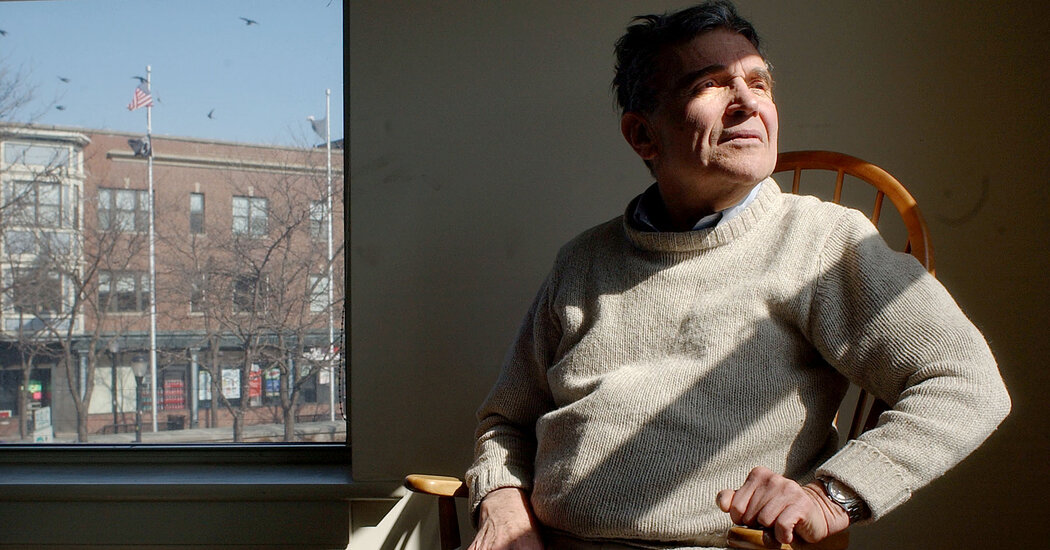
Robert Coles, a child psychiatrist by training and a storyteller by inclination whose scores of books and articles transported readers into the minds of children, opening new vistas on issues as varied as race relations and moral reasoning, died on Thursday in Lincoln, Mass. He was 97.
The death, at a hospice facility, was confirmed by his son Robert.
A longtime professor at Harvard, Dr. Coles eschewed ideologies and psychiatric orthodoxies, visiting the homes of children — first in the American South and then around the world — to listen intently to what they, their parents and others had to say. He returned again and again, sometimes for months or even years, building the trust that underpinned his work.
He told searing accounts illustrating illusive truths of a fast-changing society, beginning with the tale of Ruby Bridges, who as a 6-year-old walked through a screaming mob in 1960 as part of an effort to integrate a public school in New Orleans. From the households of poor Black families to those of rich white ones, from Appalachia to the Arctic, Dr. Coles visited children whose voices were not often heard. He once rode a bus for a whole year with Black youngsters being transported to schools in white neighborhoods.
Dr. Coles then wrote it all down, distilling the tape recordings of conversations, the children’s crayon drawings and his voluminous notes into compelling verbal snapshots of how children grapple with challenge. His five-volume book series “Children of Crisis” was published between 1967 and 1977; Volumes 2 and 3 won him a Pulitzer Prize in 1973.
Some criticized his approach as scattershot and unscientific, and Dr. Coles readily admitted he veered from exact transcriptions to tell what he considered greater truths.
But David Riesman, the eminent sociologist, said in an interview with Time magazine in 1972 that the effect of Dr. Cole’s work was to obliterate stereotypes, to demonstrate that “policemen are not pigs, white Southerners are not rednecks, and Blacks are not all suffering in exotic misery.”
“What he is saying is ‘People are more complicated, more varied, more interesting, have more resiliency and more survivability than you might think,’” Mr. Reisman said. “‘I listen to them! You listen to them! Please listen! Again and again!’”
Dr. Coles offered proof “that hope is alive,” Kenneth Clark, the psychologist whose insights contributed to the Supreme Court outlawing the racial segregation of schools in 1954, said in an interview with The New York Times Magazine in 1978 “I don’t know if he’s one of the 10 just men required to keep this world spinning around,” Mr. Clark said, adding: “You can’t judge him by normal standards any more than you could Martin Luther King; they are men possessed.”
Mr. Coles acknowledged a sense of “moral anxiety” as a white man writing about those with a less privileged existence.
“I work with very vulnerable people, and yet I’m not very vulnerable myself,” he said in an interview with The New York Times in 1997. “It makes me uncomfortable, seeing the disparities between the world I document and the world I inhabit.”
Dr. Coles was an exceedingly popular professor at Harvard, using great literature to stimulate debate in courses in its undergraduate college, as well as its schools of medicine, law, business and government. He wrote books on personalities as diverse as Bruce Springsteen and the novelist Walker Percy, and also found time to write novels, children’s books and poetry.
He was awarded a MacArthur Fellowship in 1981, the Presidential Medal of Freedom in 1998 and the National Humanities Medal in 2001.
So what was he? Dr. Coles variously described himself as a doctor, child psychiatrist, wanderer, oral historian, social anthropologist, teacher, friend, storyteller, busybody, nuisance and “idiosyncratic oddball.”
His friend Dr. Percy, himself a physician, once judged that the doctor designation, if broadly applied, might be most apt.
“He treads a narrow path between theorizing and novelizing and emerges as what in fact he is: physician, and a wise and gentle one,” Dr. Percy said. “He is doctor to the worst of our life.”
Robert Martin Coles was born on Oct. 12, 1928, in Boston, to Philip Coles, an engineer who immigrated from England, and Sandra (Young) Coles, the daughter of an Iowa Episcopal minister. A deeply affecting memory of his youth in the suburb of Milton was how his parents read Dickens, Eliot and other novelists aloud to each other.
He went to Boston Latin School, and graduated from Harvard in 1950. An essay he wrote on William Carlos Williams, the poet and pediatrician, led to him meeting Dr. Williams. After reading the essay, Dr. Williams replied on a prescription slip: “Not bad — for a Harvard student.”
Dr. Coles was inspired to become a doctor himself, and earned a medical degree from Columbia and interned at University of Chicago clinics.
He said in an interview with the journal Christianity and Literature in 2005 that he worked with polio patients as a resident at Massachusetts General Hospital, and became interested in addressing the psychological impacts of the disease. This, as well as a reluctance to inflict pain on children by giving them shots, persuaded him to switch his specialty from pediatrics to child psychiatry.
In 1958, he was drafted into the Air Force, given the rank of captain and sent to a psychiatric hospital in Biloxi, Miss. He became angered over the treatment of Black Southerners after he saw a “vicious” fight erupt when Black people tried to integrate a beach.
He began his study of children with Ruby Bridges, whose poise in the face of racism moved him deeply. The girl was threatened daily on her way to class. She was told her food was poisoned and she was kept isolated in a classroom without other students for a year.
Dr. Coles noticed that she seemed to be talking to the hostile white people, and asked her why. She said she was praying for them.
But why? “They need praying for,” the little girl said.
Ms. Bridges would be a central theme running through Dr. Coles’s career. She inspired him to write about children’s moral and spiritual lives, and the two wrote a children’s book together.
And when Ms. Bridges grew up, she told him that it was time for him to write “Women of Crisis” to accompany his earlier series.
Dr. Coles teamed up with his wife, Jane, to write that two-volume women’s study, which was published in 1978 and 1980. But that was hardly the greatest of her contributions to his work: It was she who had urged him to stop asking questions during an interview with children in New Orleans when they were responding with a long series of monosyllabic replies.
“Why don’t you just shut up and watch television with them?” she said, according to an oral history interview with Dr. Coles by the Southern Oral History Program in 1974.
In Volume 4 of “Children of Crisis,” Dr. Cole described the approach he finally developed. No questions — or at least, not many.
“I would tell the children I wasn’t interested in finding out anything in particular,” he said, “merely knowing, to a degree, how they lived and what they thought about — insofar as it was their inclination to tell me.”
One thing Dr. Coles learned about children was that they were absorbed in their daily environment, not focused on concerns like nuclear war. Even when they did talk about such issues, they grounded them in their daily lives. A Black child in Mississippi once told him that, “If the Ku Klux Klan ever get that bomb, it would be real bad for us.”
He noted that children of migrant workers saw everything as temporary. Or, rather, he let a migrant child make the point for himself: “I love the yo-yo, because it keeps going, up an down, and that’s what I do.”
Pictures often told more than words. A deprived child of a migrant worker depicted himself without arms, and gave the boss an ogre’s ugly teeth.
As Dr. Coles moved around the country to study groups as diverse as Alaska Natives, wealthy suburbanites and Hopi Indians, his wife and three sons moved with him.
Jane Hallowell, whom Dr. Coles married in 1960, died in 1993. In addition to Robert, he is survived by two more sons, Daniel and Michael, and four grandsons. He lived in Concord, Mass.
Dr. Coles helped start a magazine in 1989 called DoubleTake, which was dedicated to documentary photography and writing. It won a National Magazine Award for general excellence in 1998, but struggled financially. Even benefit concerts by Bruce Springsteen couldn’t prevent its closing in 2004.
Dr. Coles held a variety of professorial posts at Harvard, including the James Agee Professorship of Social Ethics, named for the writer whose many fields and forms of work, not least on migrant workers, had so beguiled him. Dr. Coles was also a visiting professor at Duke for many years.
He said he nonetheless preferred the company of a single youngster to that of the loftiest academics.
“I feel more at home sitting with a child in their home drawing pictures than I do in the Harvard Faculty Club,” Dr. Coles said. “That’s the truth.”
Alex Traub contributed reporting.

