
A dance by Lucinda Childs is easy to recognize. In work by this venerable choreographer, suddenly very busy in her mid-80s, upright bodies sample a small assortment of classical steps and positions, but the directional emphasis is almost exclusively horizontal and nearly uninflected, so much so that a tilted torso registers as incongruously comic. The arrangement of dancers is diagrammatic. Phrases are repeated and run through formal permutations — doubling, reversal, counterpoint — with a cool relentlessness. The effects are cumulative.
Childs’s first works, with Judson Dance Theater in the early 1960s, were different. They tended to use found objects, like colanders and hair curlers, and mock-lecture monologues. The effect was defamiliarizing, humorously surreal. But in the 1970s she settled into her mature mode and stuck with it.
That stylistic persistence is on display in “Momentary Reprise,” a career-spanning program presented at Bard SummerScape this weekend. It combines recent work with excerpts from some of Childs’s midcareer pieces with big-name collaborators. It even includes one of those early solos, performed by Childs herself. Or almost, since what Childs performs isn’t her 1960s solo “Geranium” but a 2024 reinterpretation, “Geranium ’64.”
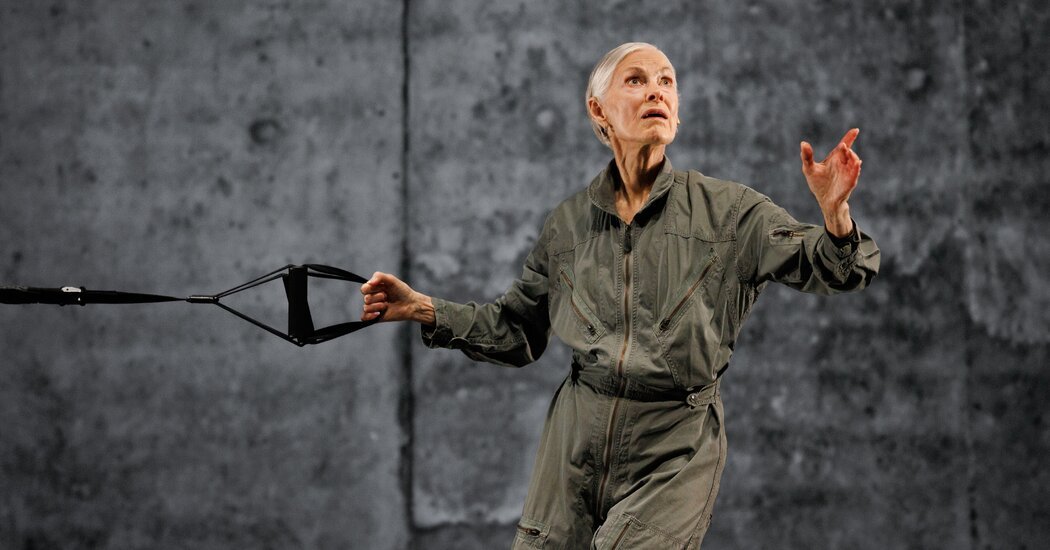
In the original, Childs responded to the audio play-by-play of the 1964 N.F.L. Championship game by falling in slow motion while attached to a hammock and registering the volume of crowd noise with a pole. The reinterpretation is much more grand, with video by Anri Sala projected onto an enormous screen. At first, the video image resembles mottled concrete, but then it begins to billow, like clouds of sand in the ocean, like motion beneath skin. Footage of the game fades in, ghostly.
Childs enters from one side, gripping the handle of a taut cord attached to something in the wings. Very, very slowly, she crosses the stage. The cord, which allows her to lean and almost float, could be a tether or a lifeline. Advancing with one arm in front, she might be Orpheus in the underworld or an Arctic explorer, an artist venturing into new territory or into the fog of memory. Because of her age, the cord also registers as physical support. At the end, she lowers herself to the floor, rotating perspective to walk along the screen before letting go of the rope.
At two points, she speaks, using an odd, over-excited voice to comment on the game and its measurement in yards and quarters. But mainly, her creeping progress stretches time. This mode, too, is easy to recognize. The glacial pacing, the elegant visual metaphor: It is the style of the avant-garde theater director Robert Wilson, who died last year.
Wilson was a pivotal influence on Childs, especially during their collaboration on Philip Glass’s opera “Einstein on the Beach” (1976). In “Geranium ’64,” she pays tribute to him by looking at her early work through a Wilsonian lens.
She honors him more directly with an excerpt from her choreography for the 1984 revival of “Einstein.” This is an ensemble piece in her familiar manner. Against Glass’s music and its church-choir dramatization of phase-shifting repetition, Childs arranges back-and-forth motion, pivoting, repetition on a diagonal: restrained suggestions of infinity on a finite stage. A horizontal line of light on the rear wall descends at a nearly imperceptible rate, a visual gauge of the work’s slow time.
In tribute to Frank Gehry, the architect who designed the set for Childs’s “Available Light” (1983) and who also died last year, an excerpt from that work is also on the program. It’s a pity that Gehry’s two-tiered set couldn’t be included — though the theater, Bard’s Fisher Center, is a Gehry creation. The single-toned unitards in red, white or black help the eye track Childs’s patterns and variations.
Those patterns and variations still concern her in her recent work. In “Actus” (2024), set to a piano transcription of part of Bach’s “Actus Tragicus” cantata (played live by Anton Batagov), a solo dancer, having performed a sequence facing away from the audience, repeats the sequence joined by a second dancer, who dances it facing front. The repetition makes the first iteration seem incomplete in retrospect, missing its complementary other half.
“Distant Figure,” set to a piano passacaglia of Glassian oscillations that Glass wrote for her, is unmistakably a Childs dance, but uncharacteristic elements stick out. At one point, the paired dancers indulge in acrobatics, one rolling over the other’s bent back. The work is, in an art-historical sense, a study of the human figure, and a few of its poses are, for Childs, shockingly angular.
More interesting is the outsize power of the moment the dancers do nothing more than change which way they’re facing. Switches of direction have long been fundamental to Childs’s compositional sense, but here they have a resonance closer to poses in certain Paul Taylor dances, stripped to pedestrian simplicity but nevertheless humanly dramatic. Especially in a program of stylistic consistency amid missing pieces and people, the effect isn’t cumulative. It’s a nice surprise.
Momentary Reprise
Performed June 26-28 at Bard SummerScape

