
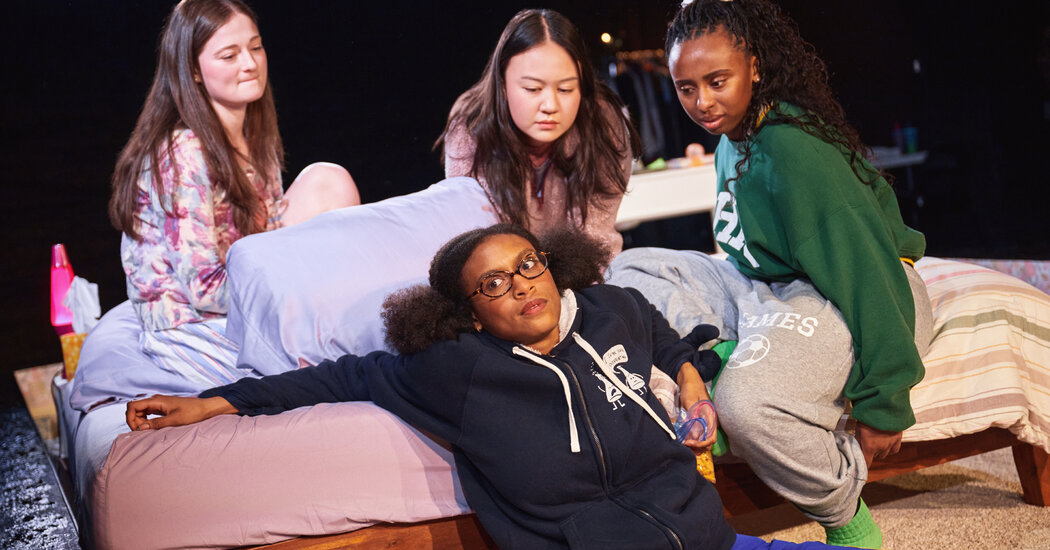
After the opening night performance of Eliya Smith’s unnerving “Dad Don’t Read This” in the scrappy basement venue below St. Luke’s Church, the lead producer thanked several people. She referred adoringly to the press representative as the show’s “dad” and also thanked her parents, who donated the Christmas lights hanging above us.
Parental figures are not so welcome inside the play itself, an eerie hangout dramedy about a 16-year-old, Mal (Amalia Yoo), hosting a series of rowdy sleepovers. Mal begins by reading us the first cautionary pages of the script, addressed to Mal’s own nosy-but-solicitous father: “If you are reading this page, it means you started to read it.” Once the action starts, we never actually see any grown-ups onstage, but we do hear them, fighting in another room; Mal’s coolest friend, Noelle (Renée-Nicole Powell) suspects her own mother hates her.
When Mal’s shy friend, Lida (the hilarious Kayta Thomas) balks at fetching a mango smoothie from the kitchen where parents might lurk, Mal mocks her. “Why are you so afraid of adults?” she asks, deadpan. Yeah, why? Age-inappropriate danger lurks everywhere: The group will soon be commiserating with their friend Sophie (Sophie Rossman), who has been sexually menaced by a creep who turns out to be her father’s work buddy.
Smith has written about young people in extremis before: Her “Grief Camp” at Atlantic Theater Company dealt with bereaved children having a good time, often in spite of their own fluctuating will. This play, though, feels like an advance. Her naturalistic dramatic voice — a still-sticky adolescent mixture of wild feeling and zoned-out alienation — comes into better focus here, thanks to the loose, swaggering realism generated by the director, Chloe Claudel.
The cast’s a miracle. I last saw Yoo on a New York stage in “John Proctor Is the Villain” on Broadway — she played Raelynn, a preacher’s daughter who laughs her way into an uninhibited moment of sisterhood. As Mal, she’s slipperier, a possibly depressed (certainly insomniac) girl prone to anomie whose own random cruelty to herself and others baffles her.
She and her suburban Ohio besties flop around on her bed, gossiping, re-ranking friendships, which exist in a haze of shifting loyalties, and sampling the liquor Mal has stolen for them: a little soda bottle filled, horribly, with “vodka and gin and tequila and wine and then a different wine and also a little bit of beer.” Only young stomachs could bear it, and theirs mostly don’t.
But drunkenness is not the preferred altered state here. It’s 2014, and the friends spend much of their time playing the Sims, designing the game’s virtual avatars on a shared laptop. “Sims get distressed when their needs aren’t fulfilled,” Mal explains to us, and then she imitates the little “wave thrust shrug” gesture that signals a Sim character is low on life.
What hand is steering Mal? She cannot tell, but she seems desperate for some outside direction. She clearly wants the others to pity her, even though she’s not sure for what. Mal’s inner blankness disturbs her, and she searches for ways to make herself feel something beyond a kind of sourceless anguish. Sophie is dealing with suicidal thoughts, and Mal shocks her, badly, by admitting that she is jealous of Sophie’s damage.
Reality in the play sometimes drifts into the Sims’ digital otherwhere: During one stunning coup de théâtre, one side of the theater becomes a wall of light, as if Mal’s room has booted up to a glowing screen. But most of “Dad Don’t Read This” is rambunctious and delightfully, kinetically familiar. The choreographer Lena Engelstein provides a dance break that includes Thomas executing a high-flying wrestling move onto a bean bag, and the characters affectionately tumble together like a pile of puppies.
It’s thrilling that a production about youth gathers strength from the authentic and ongoing experience of those making the show. (It goes for the audience too: Thanks to weird sightlines, I sat on a booster cushion, which made me feel about 3 years old.) And the title and one of Mal’s late monologues point to the way the wounds of not-quite-childhood might never heal, at least not for the playwright-identity hinted at in the script. The play gestures toward autobiography, though that implication, too, may be another layer of invention, like the fake families the girls make inside the Sims.
So why doesn’t Mal want her dad to read the play we’re watching? She could be speaking as a self-aware construct, or, somehow, as Smith herself. Perhaps there’s some leftover embarrassment about what really happened to that “vodka and gin and tequila.” Or perhaps the writer — the real one or her simulacrum — wishes to protect her dad from the knowledge that she was in pain. Could he live with what he missed when she was under his care? In a strange way, Mal’s instinct to protect him might be the first, sad sign that, whoever she is, she’s growing up.
Dad Don’t Read This
Through May 29 at St. Luke’s Theater, Manhattan; daddontreadthis.com. Running time: 1 hour 35 minutes.

