
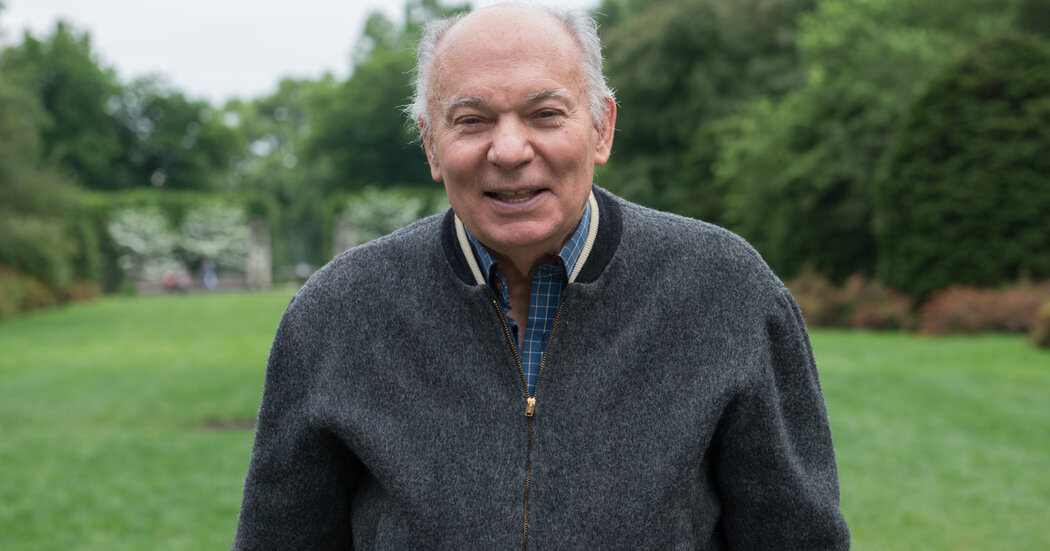
Renato Rosaldo, an anthropologist who helped dismantle the conventions of his discipline, notably through accounts of the accidental death of his first wife during their fieldwork in the Philippines, a shattering episode that Dr. Rosaldo revisited in scholarly papers, autobiography and even poetry, died on May 26 at his home in Manhattan. He was 85.
His death followed a stroke in April, his wife, Mary Louise Pratt, an emeritus professor of Latin American literature and languages at New York University, said.
Dr. Rosaldo’s career-making fieldwork was among the Ilongot people of the Philippines, mountain dwellers who were notorious for headhunting.
Living among them for nearly three years, the Harvard-trained Dr. Rosaldo was not so much fearful for his life as he was frustrated by the men’s terse explanations for why they would ambush another human being, chop off his head and toss it aside.
An Ilongot man told him they head-hunted while grieving the death of a loved one, and could add nothing more.
“To him,” Dr. Rosaldo wrote, “grief, rage and headhunting go together in a self-evident manner. Either you understand it or you don’t. And, in fact, for the longest time I simply did not.”
In 1980, after residing among the Ilongot from 1967 to 1969 and again in 1974, Dr. Rosaldo published “Ilongot Headhunting, 1883-1974,” which established his reputation in cultural anthropology. Having joined Stanford in 1970 as an assistant professor, he remained there for over three decades, rising to become chair of the anthropology department. He also served a term as president of the American Ethnological Society in the 1990s.
More than a decade after first living with the Ilongot — a sojourn he shared with his wife, Michelle Zimbalist Rosaldo, also an anthropologist — the couple returned for fieldwork with a nearby Indigenous community, this time with their sons, who were 1 and 5.
On Oct. 11, 1981, just a day after arriving in the village where they planned to work, Michelle Rosaldo slipped on a trail and fell about 65 feet to her death.
As Dr. Rosaldo later wrote, he felt something he had never known before: rage at the finality of death, and a violent impulse. In a journal, he wrote of his “wish for the Ilongot solution.”
Although he did not join a headhunting party — among other reasons, the practice had been banned by the Philippine government — Dr. Rosaldo felt that he understood how the Ilongots’ rage in bereavement might have led them to take a random human life to vent their grief.
“I experienced the deep cutting pain of sorrow almost beyond endurance,” he wrote in “Grief and a Headhunter’s Rage,” a 1989 academic paper that is his most famous work.
“Only then,” he added, “was I in a position to grasp the force of what Ilongots had repeatedly told me about grief, rage and headhunting.”
When Dr. Rosaldo delivered an early version of the paper — written in the first person, in a narrative pulsing with emotion — at Harvard, many of his listeners recoiled. Traditionally, authors of ethnographic studies edited out their own feelings and viewpoints, in the interest of scientific objectivity.
But Dr. Rosaldo insisted that he only arrived at a full understanding of headhunting when he shed the role of detached observer. “Grief and a Headhunter’s Rage,” he wrote, was not just a memoir. It was “a critical analysis of anthropological method.”
The paper has been likened to a tidal wave in anthropology.
“Renato demonstrated that anthropologists could write from an intimate and emotionally vulnerable perspective and in this way reveal in greater depth and with greater nuance the meaning that the people we study give to their lives,” Ruth Behar, an anthropology professor at the University of Michigan, said in an email.
Dr. Rosaldo contributed to an upheaval in cultural anthropology (the study of humanity’s cultural characteristics) that had begun in the 1960s, as scholars such as Clifford Geertz questioned the methods that had long been used for studying supposedly traditional peoples and interpreting the meaning of their rituals.
The discipline shifted away from claims that it was an objective science, or that other people’s beliefs and practices could be explained through universal truths about human behavior. Younger scholars — influenced by French literary and cultural theory, as well as movements such as feminism — maintained that understandings about a culture were influenced by the observer’s perspective.
In 2013, more than three decades after his wife’s death, Dr. Rosaldo published a book of poetry that revisited the event, “The Day of Shelly’s Death: The Poetry and Ethnography of Grief.”
It describes the accident from many perspectives, including those of Philippine villagers, a Catholic priest and a taxi driver. In a poem in which Dr. Rosaldo first learns of his wife’s death, he writes:
I put Sam on my shoulders, tell him his mom is dead.
He wants to know when he will get a new one.
Dr. Rosaldo linked his style of poetry, which was dense with details and included the voices of marginalized peoples, to the tradition of ethnographic prose writing.
Renato Ignacio Rosaldo was born on April 15, 1941 in Champaign, Ill., to Renato and Elizabeth (Potter) Rosaldo. His Mexican-born father was at the time earning a Ph.D. in Latin American and Mexican literature at the University of Illinois.
Renato spoke Spanish with his father and English with his mother. Years later, he described this code-switching as him doing anthropological field work without knowing it.
When he was 12, the family moved to Tucson, Ariz., where his father taught Latin American literature at the University of Arizona.
He attended Harvard, where he earned a bachelor’s degree in Spanish history and literature in 1963 and his Ph.D. in social anthropology in 1971.
He married Michelle Zimbalist in 1964, and the two did field research jointly in Chiapas, Mexico, and in the Philippines for their doctorates.
At Stanford in the 1970s, Dr. Rosaldo was active in campus politics, influenced by the Chicano movement. He later formed the Latino Cultural Studies Working Group on campus and did summer research among Latinos in San Jose, Calif. He helped develop the concept of “cultural citizenship” to describe how minority groups assert their identity by retaining a language and cultural differences.
“It’s hard to overstate Renato’s charisma in the Stanford department in the mid- to late 1980s,” Hugh Gusterson, a professor of anthropology at the University of British Columbia and a doctoral advisee of Dr. Rosaldo’s at Stanford, said in an email. “He seemed to be trailed by students everywhere he went (and, consequently, he was always late!).”
Dr. Rosaldo also wrote “Culture and Truth: The Remaking of Social Analysis,” which challenged the received wisdom that the cultures anthropologists study are static and unchanging.
Besides Dr. Pratt, whom he married in 1983, he is survived by his sons from his first marriage, Manuel and Samuel; a daughter from his second marriage, Olivia Rosaldo-Pratt; six grandchildren; and a brother, Robert.
In 2003, Dr. Rosaldo became a professor of cultural anthropology at New York University, which had hired his wife the previous year.
A few years earlier, while Dr. Rosaldo was the chair of anthropology at Stanford, another ideological division within the field had cantankerously played out. Professors of biological anthropology, who study human origins, struggled for resources with cultural anthropologists.
In an autobiographical essay, Dr. Rosaldo wrote that he suffered a stroke in 1996 “induced by severe stress from warfare” in the department. It was during his recovery that he became a poet.
“Poems began to appear to me,” he wrote. “I could see them, written longhand in purple ink with fine penmanship (not mine). After resisting the poems for a few days, I began to write them down. Poetry came in search of me. I did not choose it. I simply accepted.”

