
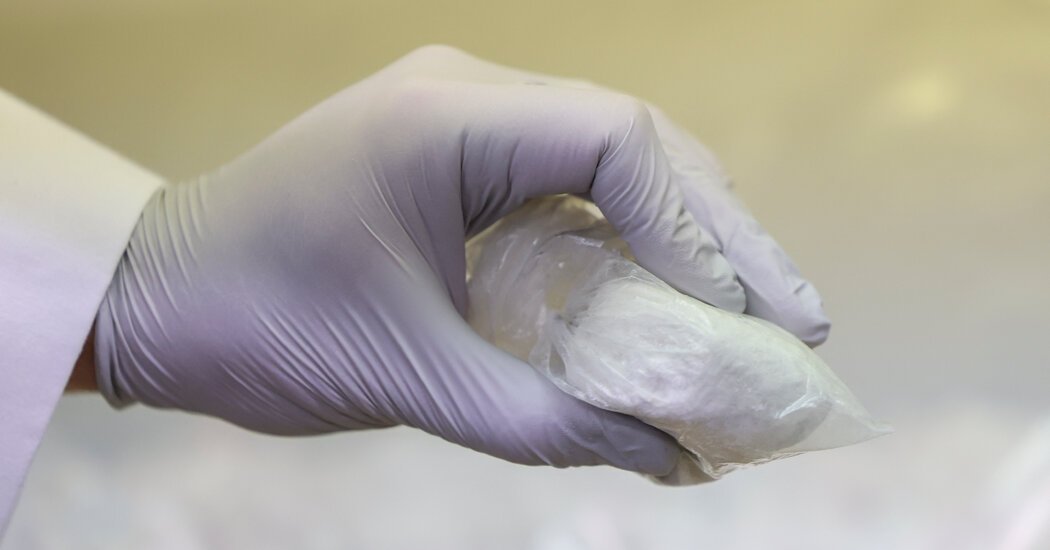
Habitual users of fentanyl have developed such a strong tolerance to the drug that standard doses of medications to manage withdrawal and initiate recovery are no longer working for many patients, a team of researchers in Los Angeles has found.
Their study, published in the journal Drug and Alcohol Dependence, presents a picture of the dangerous volatility of the city’s street supply and the capacity of users to tolerate ever greater amounts of pure fentanyl, which is at least 50 times more potent than heroin.
The researchers analyzed more than 500 samples of illicit fentanyl and surveyed users between September 2023 and January 2026 at sites for Drug Checking Los Angeles, a service that lets people have their drugs tested for adulterants. They interviewed 47 participants about their drug consumption habits and found they typically used a gram of product a day, or 125 milligrams of pure fentanyl.
In a summary of the findings, Morgan Godvin, one of the lead authors of the study and a health services researcher at the University of California, Los Angeles, said that a seasoned user’s daily street dose of fentanyl was roughly equivalent to 1,250 hospital doses of 100 micrograms of fentanyl given during and after surgery.
“In any other context, that would be unsurvivable,” she wrote. “Among people who use fentanyl every day, it is routine.”
Fentanyl Overdoses: What to Know
The study reinforces the belief among many addiction experts that, for high-tolerance patients, the standard treatment regimens for opioid addiction have become outdated. Doses of medications such as buprenorphine and methadone, opioids that help satisfy cravings without inducing a high, were calculated to treat addictions to heroin and prescription painkillers. The results of the new research, experts said, support a growing call by clinicians for treatment guidelines to be revised to keep pace with the convulsive drug market.
“When patients say their withdrawal is not being treated well, it’s important to listen,” said Chelsea L. Shover, an associate professor at U.C.L.A.’s medical school and an author of the study.
Dr. Melissa Weimer, the medical director of the addiction medicine consult service at Yale New Haven Hospital, said that when habitual fentanyl users arrive for an ailment, they may go into withdrawal so severe that they need to be treated in the intensive care unit.
“Some of our patients who come into the emergency department really require, essentially, horse- and elephant-sized doses of opioids in order to stabilize,” said Dr. Weimer, who is also an associate professor at the Yale School of Medicine and Public Health and a co-author of “The Hospital Addiction Medicine Handbook,” which includes treatment for high-tolerance patients.
“If you told me 10 years ago that I would be giving patients 40 milligrams of oxycodone,” she said, “my jaw would drop.”
The Los Angeles researchers also analyzed samples of supposed fentanyl to assess the percentage of the pure drug in them. The service’s participants provided the samples of their drugs, voluntarily and anonymously.
An analysis showed that the percentage of pure fentanyl contained in the powders varied so widely that the quantity of the powder a person reported consuming was almost meaningless. The actual fentanyl in a user’s daily gram ranged from less than one milligram to more than 650 milligrams.
That wild variation puts users at high risk for overdose, the authors of the study said. When people discovered that they had ended up with weak product, they would seek more fentanyl to avoid withdrawal. Then they could wind up with powder that was far too pure, said Dr. Shover, an epidemiologist.
The researchers and other addiction experts emphasized that drug markets and consumption behaviors are localized and always in flux. In Los Angeles, for example, where fentanyl arrived years later than on the East Coast, the drug is usually inhaled, which may modestly slow absorption and could help explain high tolerance. Injection is the more common mode on the East Coast; the drug is almost instantaneously absorbed into the blood stream.
Yet despite regional differences in the supply and means of use, addiction experts said they were seeing similar patterns across the country in the product unpredictability and the tolerance of seasoned users.
Dr. Itai Danovitch, the director of addiction psychiatry at Cedars-Sinai Medical Center in Los Angeles, also underscored the importance of doctors prescribing outside the confines of treatment guidelines when necessary, in part because standard induction doses of methadone are insufficiently robust for high-tolerance users.
Dr. Danovitch, who is also the chair of a council at the American Society of Addiction Medicine that works to improve addiction treatment, said the study also underscored the Russian roulette-like peril faced by people addicted to fentanyl.
Unlike counting shots of alcohol or glasses of wine, he said, “a small difference in the substance that somebody’s taking can have a profoundly significant impact in terms of their risk.”

