
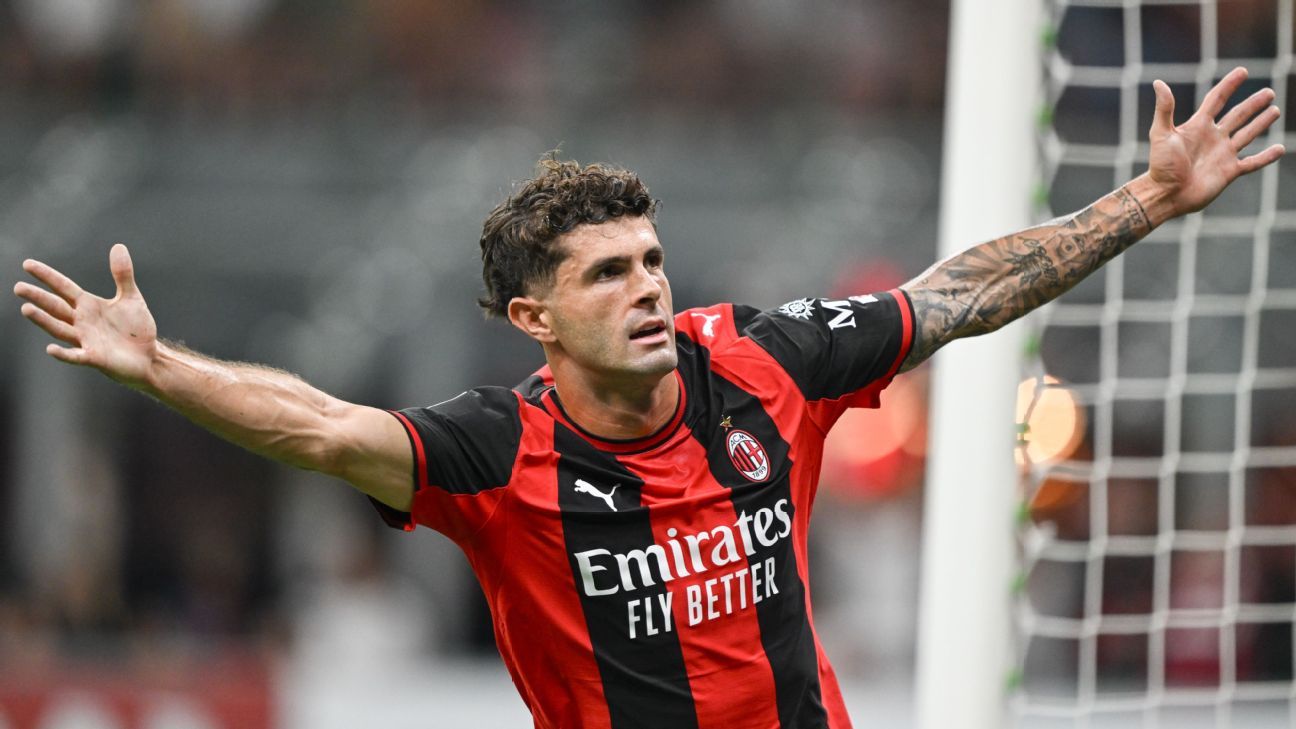
High expectations have accompanied Christian Pulisic ever since he crossed the Atlantic as a 16-year-old to join Borussia Dortmund in 2014. There have been stratospheric highs, like winning the UEFA Champions League with Chelsea. There has also been crushing disappointment, like last summer’s FIFA World Cup campaign with the United States men’s national team.
It’s only natural, then, that as Pulisic enters his late 20s, he might seek out some stability. That appears to be the case with his signing a new contract with AC Milan.
The deal was announced Friday, ahead of Saturday’s derby against city rivals Inter Milan, and less than a day after the two clubs announced a record naming rights deal for their new stadium. And Pulisic extending his stay at San Siro checks plenty of boxes for the Hershey, Pennsylvania, native.
The new contract is set to last through June 2031, and sources indicate he’ll get a sizable raise. He also will remain under the tutelage of a manager in Ruben Amorim who seems to value the dynamic attacking play Pulisic provides in his wingback system. Sources told ESPN that Milan view the USMNT international as a player who can drop deep in a pocket of space and be a playmaker, but who also has the aptitude to receive passes over the top and stretch teams and attack space the way a winger would.
Not many players can do that, and such appreciation from Amorim extends to the psychological aspect as well. One only has to recall how Pulisic struggled at Chelsea under Thomas Tuchel, and was then revitalized in Milan under Stefano Pioli, to understand how important belief from the manager is to the 28-year-old’s effectiveness. While some might point to Pulisic’s lack of playing time early on this season, Milan have been keen to not rush the player back from the leg injury he sustained at the World Cup.
Yet Pulisic’s decision to remain in Milan is something of a funhouse mirror: How it looks depends on where one stands.
To be clear, Pulisic should be lauded for staying with one of Europe’s top clubs. The USMNT standout could have easily decided to call it day in Europe and head back stateside. New York City FC were salivating at the prospect of Pulisic gracing its brand-new Etihad Park, which is set to open next summer. Now Pulisic will be staying in Milan for the next four seasons beyond the current campaign, and at a club that clearly values what he brings to the field.
However, looked at another way, Milan’s status as one of Europe’s top clubs is a generous reading of the situation.
The Rossoneri are currently trying to recapture past glory. This is by no means the Milan of Ruud Gullit, of Paolo Maldini, of Zlatan Ibrahimović. Milan have won the Scudetto just once in the past 15 years, and it’s been almost 20 years since the club claimed the Champions League. They missed out on European competition entirely following the 2024-25 campaign, and after a late-season meltdown last term, they failed to qualify for the Champions League this season, so it’s a campaign spent in the relative backwater that is the UEFA Europa League.
Italian soccer is at a low ebb as well. Not only has the national team failed to qualify for the past three World Cups, but Italian clubs seem far behind their competitors in England, Germany and Spain, with only Milan’s city rivals Inter making much headway in European competition, having been Champions League runners-up twice in the past four years.
What you have, then, is Pulisic throwing his lot in with a club that is accomplished, but a notch or two below the elite, despite the continued efforts of CEO Gerry Cardinale. This very much follows the arc — and current expectation level — of Pulisic’s career.
Back in his Dortmund days, a rise to the game’s highest echelons seems very much within reach, with Pulisic hitting multiple milestones for American players. His $73 million move to Chelsea in 2019 only raised those expectations. But Pulisic ran into the reality that being available for selection is often what separates the very good players from the absolute best. A series of muscle injuries meant he fell into the former category, even as he played a part in Chelsea’s Champions League triumph.
1:14
Keller: Pulisic needs to ‘reprove himself’ at AC Milan
In Milan, Pulisic has enjoyed more individual success. He has managed to hit double digits in goals across all competitions in each of his three full seasons with the Rossoneri, something he managed only once with the Blues. Since arriving in Italy ahead of the 2023-24 season, Pulisic has the third-most goal contributions in Serie A, behind only the Inter duo of Lautaro Martínez and Marcus Thuram. He hit 50 appearances with Milan twice as well, but the injury bug has never been far away, with another series of muscle injuries limiting his availability last season.
The injuries impacted his effectiveness as well, with a well-documented barren spell in front of goal lasting almost the entire back half of the 2025-26 campaign. The fact that then-manager Max Allegri opted to play Pulisic in more of a forward role as opposed out on the wing did the player no favors.
Last summer’s World Cup brought more of the same, health-wise. The U.S. attacker was poised for a massive role at a World Cup on home soil, but injuries meant that Pulisic logged just half of the available minutes over the USMNT’s five matches. The sight of him limping off the field in the round-of-16 exit at the hands of Belgium summed up his tournament in many respects.
That kind of track record is why teams at the very top ultimately look at players other than Pulisic for reinforcements. When he first moved to Milan, the hope was that some sparkling performances would hasten a return back to the Premier League. There have been stretches where that seemed possible.
But it’s clear now, going on four seasons in Italy, that Pulisic has found his level, and Milan are happy to have him. It’s one that isn’t the absolute highest in the game, but Pulisic has achieved much. Few, if any, American players can match Pulisic’s exploits at club level — productivity with the national team is another matter.
Now, the next four years will give Pulisic the chance to put an exclamation point on his time in Europe.


