
This article is part of Overlooked, a series of obituaries about remarkable people whose deaths, beginning in 1851, went unreported in The Times.
Nancy Sheung told stories about herself the way she composed her photographs: dramatically, and with careful attention to how she was framed.
She claimed to have worked at an opium den when she was 14 to pay for her education. She said she rode alone on horseback to school, carrying a gun for protection. She recalled long afternoons speeding through Hong Kong in a Fiat 124 Spider convertible in the 1960s.
Her family would later debate the details of some of these stories. But whether embroidered or exact, they spoke to the persona Sheung constructed: fearless, modern, impossible to contain.
In both her self-fashioning and in her photography, Sheung was deeply invested in crafting an image of female autonomy and audacity at a time when women’s lives were constrained by traditional expectations.
In “The Long Haired Girl,” a young woman stands with her back to the camera, her hands on her hips as she looks to the side with a defiant, steely expression. Her hair, braided into two pigtails, stretches down her back and sways to the side as she turns.
Long hair is seen in China as a sacred gift from one’s parents, representing health and devotion to family. Sheung often used hair as both texture and symbol. In “The Gaze,” a woman’s eye peers into the camera out of a nest of hair wrapped around her face.
“She was very intentional and artistic,” Tiffany Wai-Ying Beres, Sheung’s granddaughter and a curator in California, said in an interview. “These were not documentary photographs. They were art photographs of her own making.”
Sheung Wai Chun was born on Oct. 4, 1915, in Suzhou, China, near Shanghai. She later adopted the name Nancy, which she used in her travels and international photography submissions.
Details about her childhood are sparse. Records give her mother’s name as Kwok Chat; her father’s name is unknown. Girls had limited access to formal education, so Sheung funded her own schooling.
She later moved to Guangzhou, where she met Pong Koon Wah, a coal and gas merchant. The couple was married, and settled in Hong Kong in the mid-1930s.
Sheung had six children but seemed determined not to disappear into domestic life. Instead — aided by the privilege of having a household staff — she immersed herself in Hong Kong’s cosmopolitan social circles, throwing mahjong gatherings that stretched from sunrise to sundown and cultivating a glamorous, fast-moving life.
She saw opportunity in the city’s postwar building boom and started her own construction and architecture firm, Wai Foong Construction, despite having no formal education in the field; she ended up becoming the family’s breadwinner. But by the late 1950s, Hong Kong’s economy had slowed, and many construction projects were halted.
Around that time, Sheung attended a luncheon at the Hong Kong Club, where European art photography was on display. In those black-and-white prints, she saw how reality could be captured through the lens of a camera. She had to try it for herself.
In 1960, Sheung, well into her 40s, purchased her first camera, a Rolleiflex. She apprenticed with a local photographer and taught herself how to develop photos and master techniques like dodging and burning, which are used to manipulate select areas of a print. She later converted a bathroom in her home into a darkroom.
Her experience with architecture helped her identify striking frames.
She often photographed stairways, a defining feature of densely-built Hong Kong, where steep hills and cramped apartments pushed life upward. For many residents, especially children, the stairs became gathering places and playgrounds. In “Balloons,” a young boy and girl play against a sliver of open sky above the viewer. The image captures a fleeting moment of childhood wonder.
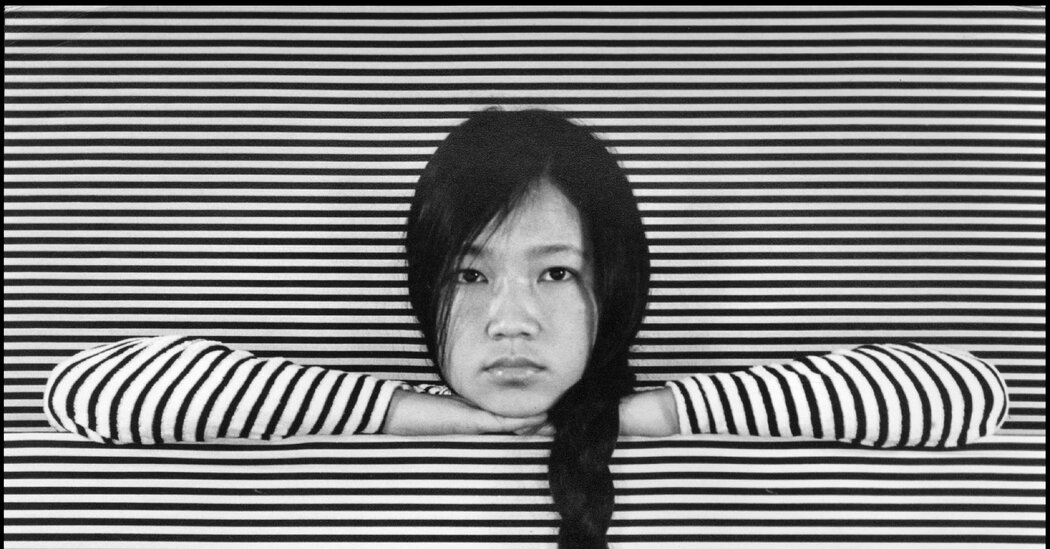
One of Sheung’s best-known works, “The Pigtail,” features her daughter Annie Pong, who was then 15. Annie poses, wearing a striped shirt, in front of a striped backdrop. A long, black braid tied with a bow is draped over a ledge (also striped), on which she rests her chin.
The photograph appears composed and serene, but the process behind it was anything but.
“I didn’t know what I got myself into,” Pong said in an interview. “It was a very long ordeal. I just remember being miserable because it was so hot. My mother said, ‘It will be over soon, then we’ll get lunch.’”
Sheung joined the Photographic Society of Hong Kong in 1965 and became its vice president in 1970. She took photographs across East Asia; a number of them won prizes and were exhibited around the world, including at the Royal Photographic Society in England.
As her artistic career expanded, she relied on live-in workers like nannies, a housekeeper and a chef to free up time for photography. In 1971, when she won an award for one of her photos, a newspaper reporter asked her if she felt like she was neglecting her family in her travels.
“I don’t think so,” she responded. “Household chores are usually taken care of by others, so I don’t need to be involved. I can say that none of my daughters were ever embraced more than 10 times when they were young.”
Sheung died of a heart attack on Jan. 17, 1979, while working in her darkroom in her Hong Kong home. She was 64.
Her photographs have achieved new prominence in recent years as curators have increasingly recognized underappreciated female artists. In 2015, Lumenvisum, a nonprofit in Hong Kong, organized the retrospective “Rare Encounters: Nancy Sheung’s Portraits of Women in the 1960s.”
“Nancy Sheung was an absolute perfectionist, which can be easily discerned from the selections of subjects, the compositions and tonal controls in her photographs,” the exhibition’s curator, Edwin K. Lai, wrote. “She was always meticulous and articulate, and strived hard to obtain the best and most beautiful results.”
Much of the renewed attention to Sheung’s work can be traced to Beres, her granddaughter, who has helped preserve and reintroduce her photographs to curators and institutions.
“There really aren’t many heroines in Chinese art,” Beres said in an interview. “Even though she didn’t get the notoriety I think she desired when she was living, to be able to come back and give her a place in this pantheon of great photographers is humbling.”

