
A few years ago, the playwright and TV writer Megan Mostyn-Brown had an idea for a series about people who suffer from a rare genetic disorder that drives them to consume human flesh. Her manager was wary, warning that network executives might balk at the grisly premise.
Mostyn-Brown was perplexed by the squeamishness over what to her was such an obviously rich metaphor.
“I’ve always loved cannibalism,” she said. “It’s the shame and the taboo of it all that I find really fascinating. How do you make your way through the world holding on to such a dark secret?”
So she pivoted, and turned the idea into a novel, “The Need,” which comes out this September. Part horror, part intergenerational family drama, it features a cannibal named Talia, whose genetic makeup requires her to eat human flesh to stay healthy. A job as a mortician allows her to get the cannibal’s equivalent of ethically sourced meat, but Talia struggles to control her teenage son, who inherited the genetic condition and occasionally acts out by eating a classmate.
Talia and her son aren’t diabolical serial killers, in the vein of Hannibal Lecter, or starving shipwreck or plane crash survivors. For the most part, they’re regular people with irregular dietary needs. Talia, an overworked single mother, just wants to put food on the table for her family without having to kill too many people.
To Mostyn-Brown, cannibalism felt like the perfect expression of female rage — a visceral form of protest against the pressure women face to repress their appetites and not be gross or messy or greedy or needy.
“American culture is not super welcoming to the idea of women being angry, and right now, a lot of women are very, very angry” she said. “I was interested in what it means to be a woman and have to do something so ugly, like eat another person.”
Stories of people-eating have captivated audiences for centuries, even millenniums, dating back to the Greek myths. Explorations of human flesh eating appear in Homer’s “Odyssey,” the epic “Beowulf” and Shakespeare’s plays, and in works by Voltaire, Jonathan Swift and Charles Dickens. Cannibalism looms large in our collective imagination: It’s the most extreme form of violence, the ultimate taboo. It’s animalistic, unhinged and grotesque.
Lately, cannibalism has become a popular and potent trope in contemporary fiction, where it has cropped up as a metaphor for contentious issues: misogyny, social inequality, our cultural obsession with body image, rampant consumerism and the ways social media drives overconsumption and, in turn, consumes us.
Tricia Narwani, the editor in chief of Del Rey Books, which is publishing “The Need,” said she was immediately hooked by the novel’s concept.
“Cannibalism is really hot right now,” she said.
The ascendence of horror has fueled the rise of cannibalism as a narrative device, both in traditional horror stories and across media and genres. It was a theme in the hit television series “Yellowjackets,” the coming-of-age romance movie “Bones and All,” and in true-crime dramas like “Dahmer,” about the serial killer Jeffrey Dahmer.
In novels, it has emerged as a plot point in horror, of course, but also in literary fiction (Ottessa Moshfegh’s “Lapvona”), biting (literally) social satire (“Girl Dinner,” by Olivie Blake), historical fiction (Maria Tureaud’s “This House Will Feed”), young adult novels (“The Summer I Ate the Rich,” by Maika Moulite and Maritza Moulite), and dystopian fiction (“Tender is the Flesh,” by the Argentine author Agustina Bazterrica).
This new breed of fictional cannibals feels different from its predecessors, less monstrous and more sympathetic. Often, these cannibals eat people to protest or weather systemic injustice or in response to trauma, violence and discrimination.
In “Nothing Tastes as Good,” Luke Dumas uses cannibalism to skewer our cultural obsession with fitness and physical appearance, and the ways weight gain and medically induced weight loss are often treated as moral failings. The story’s protagonist, Emmett, longs to be thinner, and finds his life dramatically altered when a new weight loss drug he takes radically transforms him.
At first, Emmett is horrified when he starts to crave human flesh as a side effect from the drug. But as he kills and eats people who have slighted or hurt him, he begins to see it as a way to reclaim his agency and sense of self. For someone who was belittled for his size, cannibalism becomes the ultimate form of overconsumption, catharsis and payback.
“Cannibalism is such a malleable metaphor,” Dumas said. “You can project so many different things onto the image of consumption or eating, devouring another person.”
Dumas drew on his own experience as a gay man who has struggled with his weight and body image for most of his life, facing discrimination, bullying and microaggressions that left him feeling angry and ashamed. But, as he noted, “Obviously, I have not murdered or eaten anybody.”
Many recent fictional cannibals are fed-up women who eat people (mostly men) out of rage at the way society has made them feel powerless and small. Often, these stories subvert the feminine ideal of self-sacrifice, dismantling stereotypes of women as nurturing caretakers. Cannibalism becomes the ultimate rebellion against male supremacy. (New slogan: Eat the patriarchy?) What’s more transgressive than a woman eating others to satisfy her own hunger?
In Catherine Dang’s coming-of-age novel “What Hunger,” the protagonist, a young Vietnamese American woman named Ronny, develops an undeniable craving for human flesh after she is sexually assaulted at a party and bites her attacker’s ear. What starts as a response to trauma becomes a way to reclaim power rather than living like a victim, as well as a form of revenge.
“Greedy,” by Callie Kazumi, a psychological thriller about wealth, privilege and culinary obsession, follows a private chef working for a reclusive female Japanese billionaire with a very particular palate who represents everything women are discouraged from being — she’s rich, powerful and voracious.
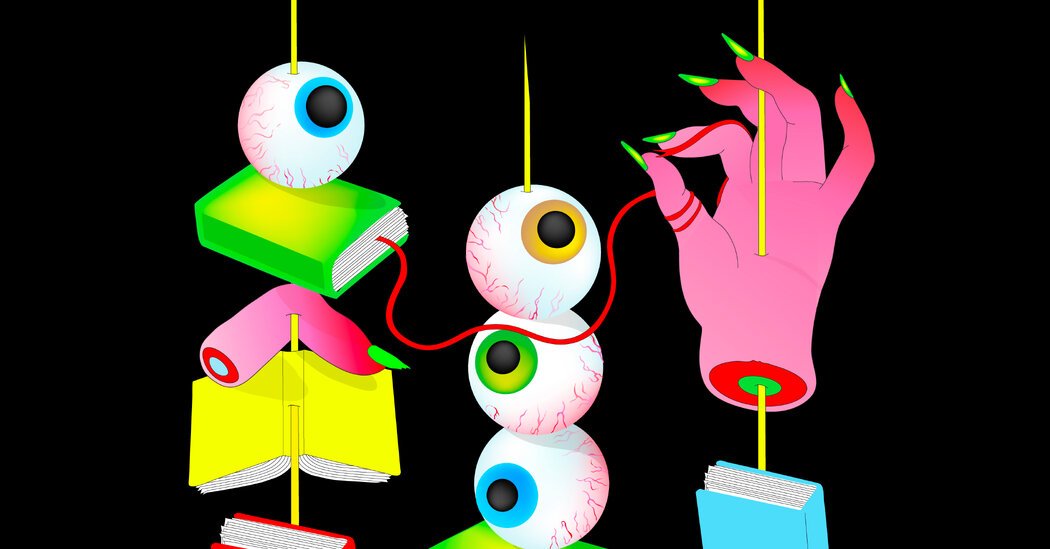
The main character in Monika Kim’s novel “The Eyes Are the Best Part,” a young Korean American woman, develops a taste for human eyeballs, particularly those of the blue-eyed men she kills and disfigures in gruesome acts of protest against Asian fetishization and the male gaze.
Female cannibals are resonating right now in part because so many women are angry and scared about the erosion of women’s rights, said Olivie Blake, whose 2025 novel “Girl Dinner” took the “girl dinner” meme from social media in a horrifying new direction. Rather than a dainty meal of chardonnay, olives and cheese, Blake’s version of girl dinner finds members of a campus sorority taking part in secret rites that involve killing and eating men.
“A lot of the cannibal novels are happening in response to Roe v. Wade being struck down, and the politicization of a woman’s body,” Blake said. “If we’re being denied essential humanity, why should we care if we’re driven to consume humans?”
Bill Schutt, the author of “Cannibalism: A Perfectly Natural History,” said that while cannibalism has long been a symbol of “the worst behavior a human could undertake,” it’s become more palatable to readers of fiction as writers depict cannibals as heroes or underdogs.
“This is clearly a shift, and I believe it relates to these authors placing characters who might be perceived as weak or marginalized into positions of power and dominance,” Schutt said. “Current writers are using this expanded view of cannibalism as a way to explore the behavior in new and inventive ways.”
Some critics have had enough of all the human flesh consumption. In an essay in The Discordia Review, a reviewer cited around 20 new novels featuring cannibals and argued that the trend has become so ubiquitous and derivative that the books “are shamelessly eating each other.”
Readers, however, seem to have quite the appetite for all the people eating. In a Reddit thread that noted how thoroughly cannibalism has overtaken horror fiction, many commenters said they couldn’t get enough.
“Give me all of the cannibalism books, especially using it as a metaphor for capitalism,” one enthusiast wrote.
“I feel the same,” another replied. “I see cannibalism in the trigger warnings, I add to cart.”

