
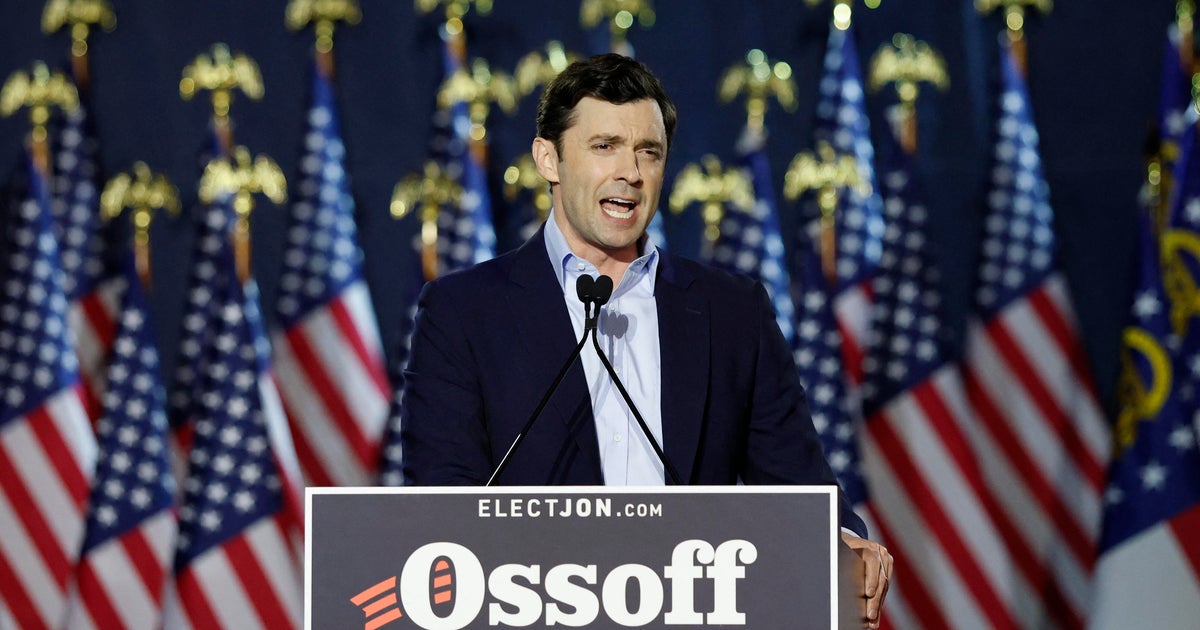
Washington — Democratic Sen. Jon Ossoff’s commanding reelection victory in Georgia is drawing renewed attention to his potential as a 2028 presidential contender, as election data shows how he assembled a broad coalition of voters in the pivotal presidential battleground state.
Despite the growing speculation, Ossoff, 39, is for now dismissing the possibility of a White House bid. During a debate in October, Ossoff said he had “zero interest in running for president” in 2028.
Some early polls place him at the top of a hypothetical 2028 primary field. A post-election Emerson College survey showed Ossoff with the support of 17% of respondents — narrowly ahead of former Vice President Kamala Harris and New York Rep. Alexandria Ocasio-Cortez, with former Transportation Secretary Pete Buttigieg and California Gov. Gavin Newsom rounding out the top five.
Ossoff has attracted interest from both centrists and progressives while delivering a decisive victory in a closely divided presidential battleground state. At Crooked Con, a primarily progressive gathering in Washington after the midterms, Ossoff received 38% of first-choice votes in its straw poll, ahead of Ocasio-Cortez and Buttigieg.
“I think he would make an attractive presidential contender on the Democratic side,” said Jerry Gonzalez, CEO of GALEO Impact Fund PAC, a Georgia-based Latino political action committee that endorsed Ossoff in his Senate race. “He is not afraid, he won’t shy away from holding the Trump administration accountable, but in a way that works towards actually building coalitions to get something done.”
Democrats who can win statewide in conservative or swing states tend to be moderate, and that’s true of Ossoff, too.
“He comes across, and tries to present himself, as a moderate, and he talks about issues which moderate conservatives could get behind,” said Charles Bullock, a longtime political science professor at the University of Georgia. “The issues he stresses are things which are within the broad mainstream of ‘These would be good things.'”
It’s unclear how well a moderate would fare in the early nominating states. What is effective in a Georgia general election may be a tougher sell in a Democratic primary, where voters often reward ideological purity over swing-state caution.
“Obviously, he’s successful here in Georgia,” Bullock said. “How would he play elsewhere?
“I think what we will be seeing is preparation, maybe for a later run,” Bullock speculated.
Ossoff’s record gives rivals on both flanks openings to attack: progressives have criticized his vote for the Republican-backed Laken Riley Act and his reluctance to embrace “Medicare for All,” while his votes to restrict certain weapons sales to Israel and his criticism of its military conduct in Gaza have drawn objections from some pro-Israel Democrats and donors.
All of those issues are certain to be part of the 2028 primary contest. For example, Rep. Ro Khanna, another potential 2028 candidate, last week tried to restart the debate over universal healthcare.
“Medicare for All means healthcare for everyone, like public school is free for every kid,” Khanna wrote on X, arguing, “‘Medicare for All who want it’ is pablum. It’s telling parents they have to pay for public school.”
In his reelection this month, Ossoff defeated GOP opponent Mike Collins by around 18 points, two years after President Trump defeated Harris by around two points in 2024. It was a much wider margin than his last Senate election, which he won by just over one percentage point.
Powering Ossoff’s win this year was a broad coalition of voters, including some swing constituencies that Democrats have struggled with in recent years, CBS News’ exit polling shows.
Ossoff maintained strong support among Black voters, winning 93% of the group, which make up almost one-third of the state’s eligible voters according to Pew Research Center.
He did not win the White voters who make up just over half of Georgia’s electorate, but he did make significant inroads, winning 40% — after Harris had won just 28% two years earlier. He also notched some improvement in groups that have shifted hard against Democrats: He won 29% of White voters without college degrees (compared to Harris’ 18%) and 19% of White evangelical or born-again Christian voters (compared to less than 10% for Harris).
Ossoff also won men by nine points after Harris lost them by 13 points.
Both Ossoff and Harris won younger Georgians, but Ossoff won them by a larger margin, securing 85% of voters ages 29 and under. Ossoff also split the 45-and-older vote roughly in half, while Harris lost that age group by a 15-point margin.
And Ossoff made gains with Hispanics — a group that makes up less than 10% of Georgia’s eligible voters but which has grown rapidly and has become a swing demographic that could decide a close race in the perennial battleground. In his reelection victory, he won around two-thirds of Latino voters, up seven points from Harris’ performance two years earlier.
A comparison of 19 Georgia precincts where at least 30% of active registered voters identify as Hispanic or Latino shows substantial Democratic improvement.
Ossoff won those precincts by a combined 49 points in the two-candidate vote, compared with an eight-point advantage for Harris in the 2024 presidential election and an 18-point margin for fellow Democratic Sen. Raphael Warnock in 2022.
The changes were significant in areas that had supported Mr. Trump just two years earlier.
In six heavily Latino precincts in Whitfield County, the combined results shifted from a 12-point Trump advantage in 2024 to a 37-point Ossoff victory in 2026. Three similar precincts in Hall County shifted from an 11-point Trump edge to a 33-point Ossoff victory.
Those figures reflect the voting behavior of entire precincts rather than individual Latino voters, and comparisons between presidential and midterm electorates are not exact. Still, they underscore how dramatically the environment changed in places with large Latino populations.
Gonzalez attributed the shift in part to concerns over affordability and immigration enforcement, two issues he said weighed heavily on Latino voters in Georgia.
“Things are really expensive,” Gonzalez told CBS News. “The price and affordability were a big driving issue.” He also pointed to the Trump administration’s immigration crackdown and its impact on Latino communities in Georgia. Ossoff has investigated allegations of abuses in federal immigration detention facilities as part of his Senate oversight work.
Gonzalez also credited Ossoff’s success among voters across the political spectrum to his accessibility and constituent outreach.
“His office is accessible to all Georgians, and that’s part of the reason why he won.”
In this wave election, Ossoff wasn’t the only Democrat to pick up ground in the midterms. Latino and Black voters, men, voters without college degrees and younger voters moved back toward Democratic candidates nationwide, a reversal after all four groups had shifted rightward in 2024.
In 2028, those groups could once again play a central role in both the Democratic Party’s nominating process and the general election.
States with large Black and Latino populations will lead the Democratic primary calendar after the party rearranged its schedule, and Ossoff, with his strong support from both groups, would likely stand to benefit if he were to decide to run. South Carolina — where Black Democratic voters have long played an influential role in choosing the party’s presidential nominee — will go first, followed by Nevada, New Hampshire, New Mexico, Michigan and Virginia.
The DNC says approximately 4.2 million Latinos live across the six early nominating states, a major increase from the party’s previous early-state lineup.
In the general election, maintaining a strong lead with Black, Latino and younger voters — and preventing too much slippage among White and non-college-educated voters — will also be a core task for Democrats, as they seek to prevent the GOP’s first non-Trump presidential candidate in over a decade from reassembling the Trump coalition.
Though Ossoff says he doesn’t plan a White House bid in 2028, his performance in Georgia has provided an early measure of what an electoral coalition for him could look like.
“He has mentioned that he was focused on winning reelection, which he has done, so I think that gives him a little bit of latitude to think about it a little more seriously,” Gonzalez said.


