
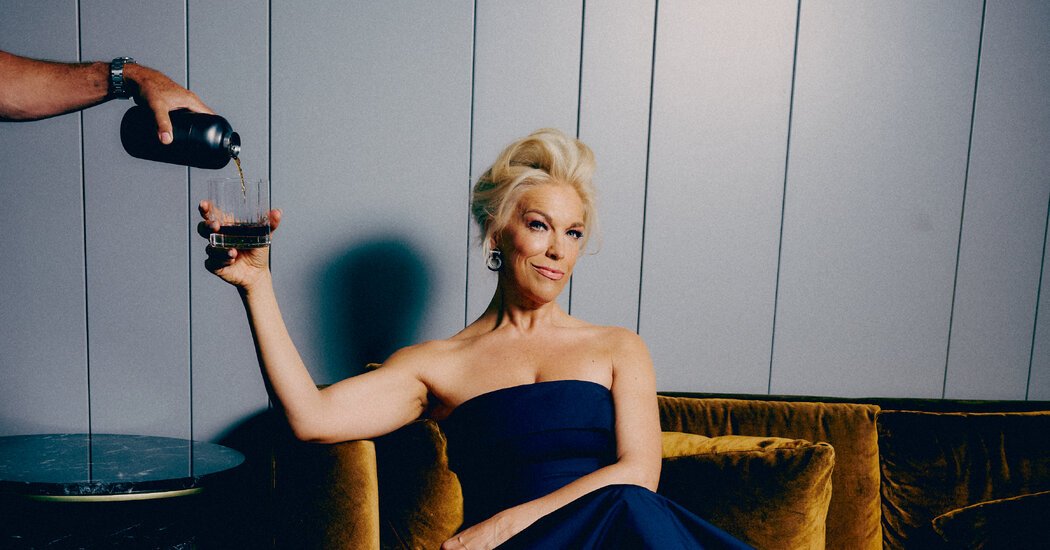
Hannah Waddingham stopped in her tracks when she heard a busker singing “Kansas City” by Leiber and Stoller.
It was a busy summer afternoon on the south bank of the Thames in London, and a swarm of tourists and school children mostly streamed past without looking at the man strumming on a guitar.
But the actress, resplendent in a billowing maxi dress as the breeze also rippled through her blonde bob, started dancing to the rolling rhythm and singing along, “I’m going to Kansas City, Kansas City here I come.”
“I just want to get involved,” she laughed. “I’m like, ‘Budge up on the mic, budge up!’”
Standing 6 feet 2 inches in heels, Waddingham, 52, is used to turning heads: Cynthia Erivo, a friend for more than a decade, described her as “Amazonian in stature and in spirit and proud of it,” adding, “It’s a thrill to watch her in action.”
The passers-by who were giving her impromptu riverbank singalong curious glances seemed to agree. They might have recognized her from TV shows like “Sex Education” and “Ted Lasso,” but Waddingham also has a four-octave vocal range and is a rare British screen star who started out in musical theater.
“How funny, of all the songs he could have been playing,” she said after giving the musician a tip and continuing on along the river.
Not only is the 1952 blues track one of her favorites, the upcoming season of “Ted Lasso,” in which Waddingham plays the soccer club owner Rebecca Welton, opens in Kansas City.
After three seasons coaching A.F.C. Richmond, Ted (Jason Sudeikis) is now back in his home state. That is, until Rebecca visits to convince him to return to London and take on a new coaching challenge: Richmond’s women’s team.
Rebecca is “so fun to write,” according to Brendan Hunt, a “Ted Lasso” co-creator, “because she’s at a nexus of poshness and don’t give a [expletive]-ness.” Starting out as the show’s “bad guy,” Rebecca was also “the biggest role to cast,” he said. And when they found Waddingham, Hunt recalled thinking: “‘Oh, finally. OK, this is great,’ because she could go toe to toe with it.”
The third season of the gently philosophical show was 2023’s most watched streaming original show, according to data from Nielsen. Many thought it would be the show’s last, but the fourth season — which comes to Apple TV+ on Aug. 5 — kicks off a new team of characters’ stories.
The female players and especially their assistant coach, Alice, also bring out something in Rebecca, Waddingham said earlier that day over a breakfast of coffee, pressed juice and chorizo hash. Alice, played by Tanya Reynolds, navigates the male-dominated soccer world with much less glamour and charm than Rebecca, and initially “there’s a friction and frostiness” between the pair, Waddingham explained.
But as always on “Ted Lasso,” there is also growth, and after being a “taut rope” in Season One, Waddingham said, Rebecca continues loosening up in Season Four.
Waddingham, who won an Emmy for the show in 2021, said she had loved the ruthless Rebecca since reading the pilot script, where her character imagines torturing her ex-husband with “a splintered cricket bat.”
“This girl,” Waddingham remembered thinking, “you’re delicious.”
Waddingham’s approach to the role is “all gut,” she said, and she doesn’t read scenes from the script if they don’t feature Rebecca, so she never knows more than her character does. Still, “I think it’s funny that anyone thinks I’m remotely like Rebecca,” Waddingham said, holding her hands out wide to signal her confusion. “I’m the wayward sister of Rebecca.”
Juno Temple — a close friend who plays Rebecca’s onscreen bestie, Keeley — agreed with that description. Although Waddingham has “this whip-smart brain, this huge heart and then this presence that is absolutely jaw-droppingly beautiful,” she is also “quite a goofy nugget.”
Over breakfast, Waddingham could indeed be charmingly goofy, peppering the conversation with more expressive hand gestures, silly voices and liberal swearing. Her voice was hoarse after giving her all on set for a Jason Statham action movie.
The last few years have been busy. Last month was the premiere of her show “Ride or Die,” a buddy action series with Octavia Spencer that the two also executive produced. In 2023, Waddingham filmed what she called a “totally old-school” holiday stage special for Apple TV+. And in Britain, she has had breakout moments hosting the Olivier Awards and the Eurovision Song Contest.
“I like using every part of myself,” Waddingham said, “because it could have been very different. I could have not had any success.” But since “Ted Lasso” premiered in 2020, playing Rebecca “has let everyone know what I knew I was capable of in the first place,” Waddingham said.
She grew up in South London, the daughter of a river police officer, who patrolled the Thames by boat, and an opera singer. Theater is “100 percent in my bloodstream,” Waddingham said. As a child she would roam the London Coliseum, the home of the English National Opera, where her mom performed.
After drama school, she started auditioning, but her height was an issue. “I would constantly get, ‘We’d love to use her, but we’ve already cast the man,’” Waddingham said. “Why can’t a woman who’s 6 feet 2 inches have all the same vulnerabilities and misgivings about herself, wobble as much, as somebody who’s 5 feet 2 inches?” (For Rebecca, “‘tall’ was not part of the character description, per se,” said Hunt, the co-creator, but “‘tall’ and, in certain shoes, often ‘taller than the male lead’ is like — That’s awesome.”)
Two (metaphorical) giants of British theater also didn’t consider her height an issue: Trevor Nunn and Andrew Lloyd Webber. When Lloyd Webber first saw a 25-year-old Waddingham perform in 2000, he was immediately impressed by how she could “hold the stage” and her “very rare” star quality, he said recently by phone.
He soon cast her in “The Beautiful Game,” a show he wrote with Ben Elton, and again in 2011 as the Wicked Witch of the West in a production of “The Wizard of Oz.”
Waddingham was nominated for three Olivier Awards, Britain’s equivalent of the Tonys, by 2015, when she performed alongside Cynthia Erivo in a concert performance of the musical “How to Succeed in Business Without Really Trying.”
By email, Erivo called Waddingham a “superstar. Not just because of her work, but because of the way she has constantly shown up for me and encouraged me.”
Waddingham fought hard for all her success while also refusing to compromise on who she is, Erivo added. “I think it’s what makes her special. She is herself through and through, and who she is is magnetic.”
Waddingham has also resisted cosmetic surgery, wanting “full control of my face,” she said, and “to look like I’m 52, because I’m actually more confident, more settled.” She added, “So why would I want to make myself look like I’m 30, when I wasn’t as happy at 30?”
Her principled determination was also clear when, at 38, Waddingham finally became pregnant. She realized that the rigors of a theater run wouldn’t align with the demands of parenthood. But onscreen work, which she’d always dabbled in, could provide more flexibility.
The path from the Shakespearean stage to screen stardom is well-trodden by British actors, including Jonathan Bailey, Benedict Cumberbatch and Judi Dench. But “very, very few musical theater stars really cross over to the film medium or anything like that,” Lloyd Webber said.
Waddingham said that her British agent at the time had been confused about whether to promote her as a singer or an actor, and had described her varied skill set as “muddying the waters.” (Such a conversation wouldn’t happen in the United States, Waddingham added.)
But nine weeks after giving birth to a daughter, Waddingham started shooting Season Five of “Game of Thrones,” in which she played Septa Unella, whose face was framed by a nun’s habit as she shouted “Shame!” at a disgraced Cersei Lannister.
“If all I had done in my career is prove that you can take someone out of musical theater and put them in a tight close-up,” Waddingham said, “I would love that to be my lasting legacy.”
Nevertheless, she added, whatever screens and stages she’s appeared on in the last decade or so, there is “just something about theater, the visceral, muscular nature of theater.” Waddingham was about a mile and a half from the South Bank busker by now, passing by Shakespeare’s Globe. She would love to return to stage work, she said, and recently she has been considering opportunities, including one she was “champing at the bit” to do next year.
But Waddingham has been a single parent for many years now — “I’m a mummy first,” she said — so she turned that role down after realizing that her daughter, now 12, wasn’t ready for her to be so tied up with work.
“Something has to give, and the thing that’s had to give is theater,” Waddingham said. But, she added, “I will come back, and I will do it how I do it.”

