
If mythic gardens, from the Garden of Eden to China’s Mount Penglai, with its jewel-bearing trees, have long been symbols of immortality and pleasure, their real-life counterparts possess a more grounded beauty, marking the passage of time and cycles of life and death. They also demonstrate the ways that human artifice combines with nature to create artworks at once timeless and ephemeral. It’s no wonder, then, that artists of all types seek out these spaces to nourish their creative practices. For our springtime T Gardens package, we asked nine of them to share the garden or landscape that’s most inspired them.
Malibu, Calif.
Point Dume Nature Preserve
Irene Neuwirth, 50, jewelry designer, Los Angeles
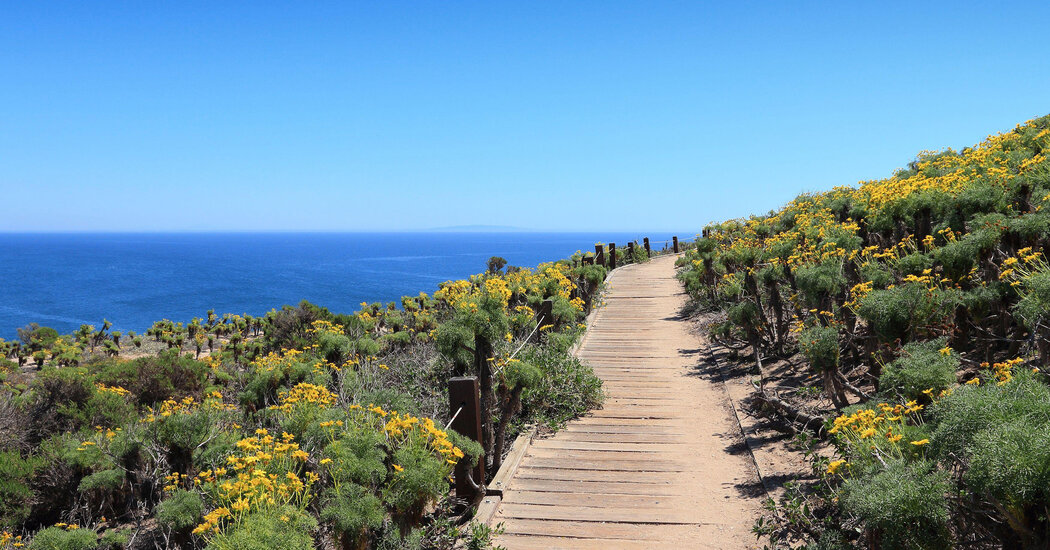
Growing up in California, I was always outside — up in the mountains, out in the desert — and when I was little, my mom took me to parks nonstop. Whenever I doodled, I was doodling flowers. I went to Point Dume for the first time when I was in high school. It’s this magical place with its own microclimate, so you feel strangely like you’re in the tropics. At certain times of year, the whole landscape is covered with yellow blossoms. That’s how you can perceive seasonal change here, through flowers blooming. During Covid, my boyfriend and I rented a house there, and we were given a key to a path down to the beach. The path was overgrown with wildflowers, and frogs and bunny rabbits were jumping everywhere. We ended up buying a house there that year. It sits on an orchard, so we have access to every type of fruit you can imagine — avocados and kumquats and pomegranates and nectarines — and our own garden is full of vegetables. I take solace in being in nature and in this more rugged California, where the land just drops off into the sea.
Kyoto
Katsura Imperial Villa Garden
Isabel Duprat, 71, landscape architect, São Paulo, Brazil
When I visited Kyoto in 2015, Katsura, a 17th-century imperial villa, was a great surprise. The gardens cover 6.9 hectares [about 17 acres] and I went in the autumn, so the color of the vegetation was especially lovely. There’s a powerful link between the landscape and the simple beauty of the villa, the teahouses, the structure built to watch the moon rise, all of them with white walls and thatched roofs. The paths through the garden are laid with different stones and shades of gravel and you change the way you walk according to how the stones are carved and set. The whole garden is elegant and both cheerful and solemn, somehow — it’s a very delicate thing. In Brazil, lots of landscape designers try to make miniature forests and, to me, that’s not the point. You should aim to understand nature, not copy it. Reforestation can be an important part of it, but ultimately a garden is a place to feel, to think, to walk, to look at the sky — a place to contemplate silence. Katsura encapsulates that approach. When I arrived, I was overcome with emotion.
Beruwala, Sri Lanka
Brief Garden
Amesh Wijesekera, 34, the designer and creative director of the fashion label Amesh, Colombo, Sri Lanka
I’m from a family of architects and interior designers, so gardens were always important for us. In college, and even as a child, I heard a lot about the Sri Lankan architect Geoffrey Bawa and Tropical Modernism, but I found out about his older brother, Bevis, the designer of Brief Garden, quite late. To get to Brief, you pass through a village surrounded by paddy fields, and I love to imagine Bevis — a queer man, 6-foot-7 — who was such an unlikely presence in this tiny town. The property was originally a rubber plantation and, starting in the 1920s, he turned it into this secret garden with dense plantings of single species, erotic sculptures everywhere, his house filled with art. The grounds aren’t one massive thing, but many gardens in one. Over the years, Colombo’s landscape has become so polished. All the old houses, which had big, beautiful trees, are being torn down and replaced with soulless towers. But Brief has built up a patina. When I work with artisans, I tell them to look at their environment and let that rawness come through. I give them a pattern, but it’s not exactly defined. It’s moving and evolving — and that comes from nature.
The Konso Zone, Ethiopia
Konso Cultural Landscape
Elias Sime, 58, artist, Addis Ababa, Ethiopia
When I started working with Meskerem [Assegued, an anthropologist and Sime’s longtime curator and collaborator], we traveled around Ethiopia to do research, and my whole concept of landscapes changed. The challenge is not to draw the landscape, as I was taught in art school — it’s how to work the land itself. The way that people in villages manipulate the land to harmonize with their houses amazes me. In the Konso region [in the southern part of the country], the landscape is rocky and mountainous, and the communities use terraces to prevent erosion and collect water for farming. Between the terraces, they cultivate beautiful greenery. The whole lifestyle is a reflection of the landscape. For our work at Entoto [a massive landscape project on a hillside in Addis Ababa], Meskerem and I have worked with people from Raya and Gojjam in northern Ethiopia, and various parts of the Oromia region, to build terraces. They’re not thinking about designing the landscape. When you feel the land, when you touch it every day, it becomes a part of you, and that knowledge comes down through the generations.
Montecito, Calif.
Lotusland
Stephen Orr, 60, garden author, Cape Cod
In Montecito, there’s this very eccentric garden. Its creator, Madame Ganna Walska, was a failed opera singer who married six times, the last time to a young yogi named Theos Bernard, who she met in 1940. Walska bought the 37-acre property in Montecito a year later to turn into a spiritual retreat for monks called Tibetland. She and Bernard divorced in 1946 and, after that, she renamed the garden Lotusland. The garden is surreal and Dr. Seuss-like, with Spanish revival architecture, a huge number of cactuses and a shallow moon pool [an artificial pond, painted white] ringed with abalone shells. I enjoy her sense of theatricality. I also like that she came to gardening later in life — that the thing she’s famous for is something she retired into. I visited Lotusland for the first time in my 20s and try to go every time I’m in Los Angeles, especially in winter, when all the candelabras of orange, yellow and red aloes are in bloom. In Cape Cod, where my husband and I live, I can’t grow 90 percent of what’s there, but I’m so drawn to the shapes and forms. I’ve always photographed gardens, so I think in terms of images. Madame Walksa showed me how to create a scene.
Kyoto
Shikunshi-en Garden at the Kitamura Museum
Hiroshi Sugimoto, 78, artist, architect and garden designer, Tokyo and New York
There’s a hidden, intimate villa and teahouse, Shikunshi-en, at Kyoto’s Kitamura Museum that only opens for a few days twice a year. The original owner made the garden for his tea practice and finished it in 1944, a year before the end of the Second World War. Kyoto was spared from bombing but, after the war, occupying forces took over the teahouse and fully Americanized it. They ruined the tatami rooms and put up stucco walls. The tearoom became a bar. But they left the garden alone — they didn’t pay attention to that. It’s still nicely preserved, with 60 stone artifacts collected from ancient gardens and abandoned temples. I visited Kitamura for the first time 30 years ago, and this small space had a powerful impact on me. I thought, “One day, I want to design something of this quality.” It influenced what I did at the Hirshhorn Museum and Sculpture Garden in Washington, D.C., my biggest garden project, which is finally coming to completion in October after nearly a decade. But in these smaller gardens, you can really purify your mind and be calm.
Kashan, Iran
Fin Garden
Bahar Behbahani, 53, interdisciplinary artist, Brooklyn
In Iran, we learn to crawl on carpets, and many of our carpet designs are modeled on Persian gardens. Gardens are in our DNA. If you’re from Tehran, one of the first places you go for a field trip is the Fin Garden in Kashan. You drive for hours through an arid landscape, and then you get to this green space with blue fountains, tall cypress trees and shade everywhere. Just a magical beauty. This garden also has an infamous history: In the 1800s, the progressive minister Amir Kabir was exiled there and assassinated in his bathhouse. You learn early on that there can be a harsh side to beauty. Persian gardens aren’t about a particular layout or design. They’re about how you manage water, how you control temperature, how you direct the wind. It’s the most intricate way of making an ecosystem; it’s the identity of a people and the whole notion of how we lived. Today, when [U.S. and Israeli forces] strike a garden, the headline might say “historical garden bombed,” but that garden is not only a garden. It’s rooted way deeper than that.
Mexico City
Espacio Escultórico at the National Autonomous University of Mexico
Andrea Soto Morfín, 39, architect and founding partner of Atelier Ars, Guadalajara, Mexico
The Trans-Mexican Volcanic Belt — this topography of volcanoes — crosses our entire country, and the Espacio Escultórico, which is a monumental sculpture garden located on the campus of the National Autonomous University of Mexico (or la UNAM) in Mexico City encapsulates, for me, that particular Mexican landscape. In the 1970s, a group of six artists, all associated with UNAM’s academic community, assembled a group of collaborators in the arts and hard sciences (like botanists and chemists) to create the Espacio Escultórico. They designed this ring, 120 meters across [almost 400 feet], made of geometric stone modules that encircle what was, well over a thousand years ago, a vortex of lava. The landscape inside the ring was left untouched. It was a form of land art, placing something totally artificial within a natural habitat, a synthesis of the human and the natural, the beautiful and the sublime. And even though it was built in the 20th century, the idea of nonintervention is very contemporary. Other people, like the architect Luis Barragán, also revealed that geological layer in their gardens and understood that it gave this place its identity. But the Espacio Escultórico was singular: a cross-disciplinary laboratory for understanding our habitat.
Gaeta, Italy
Giardino Botanico di Gaeta
Umberto Pasti, 69, writer, garden designer and conservationist, Milan and Tangier, Morocco
Two years ago, I visited Nicola Del Roscio’s botanical garden in Gaeta for the first time and found it absolutely moving. The garden is near the sea, between Rome and Naples, and holds a collection of 140 species of palms, all grown from seed. Since then, I’ve been back six or seven times, and every time it’s like a miracle — but a miracle that anyone with a little passion and good sense, with room and water and a few seeds, could realize. We’re living in a terrible moment of plants disappearing so, for the last 30 years, my main interest has been preserving as many plants as I can from northern Morocco, which are threatened by urban development and the human mania to build. I’m getting old, and one gets lazy and wants immediate results, so I mostly work with transplants. But since meeting Nicola, I’ve become optimistic. I’ve planted masses of things from seed at Rohuna [Pasti’s garden, open to the public outside Tangier] and nearly everything has germinated. The idea that you could just pick up seeds by the highway and do something so wonderful — that should be an example for us all.
These interviews have been edited and condensed.

