
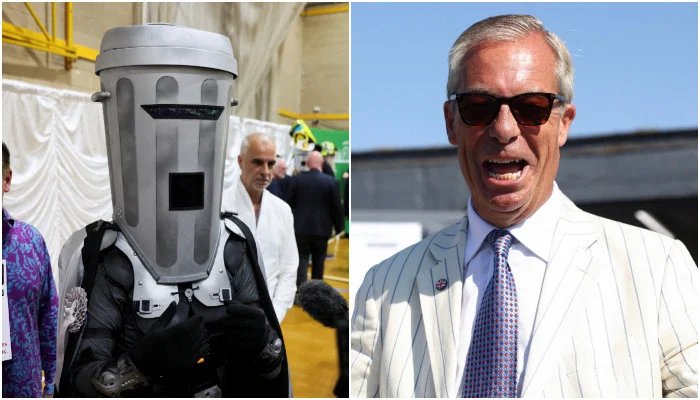
- Farage skips vote count following police advisory.
- Count Binface takes more than quarter of the vote.
- Poll result underscores political risks of Farage’s gamble.
Reform UK leader Nigel Farage won his self-triggered by-election in Clacton on Friday but saw his strategy to silence critics backfire when his main rival Count Binface, a comedian dressed as a trash can, took more than a quarter of the vote.
Farage, one of Britain’s leading Brexit campaigners, in a highly unusual move, did not turn up at the vote count in the southern English seaside resort of Clacton because he said the police had advised him there was a campaign to disrupt the result. He also cancelled a victory speech planned for later on Friday.
“I am damned if I am going to stand on a stage, having won a resounding victory … and be demeaned and humiliated by nobodies,” Farage told supporters at a party before the result was announced.
The election was triggered after Farage resigned from parliament last month to seek a fresh mandate from voters in what he described as a war against an establishment bent on discrediting him over taking undeclared gifts from donors.
The result, while a victory, underscored the political risks of Farage’s gamble. With a parliamentary investigation into his finances set to resume, the vote may have done little to remove a threat he wanted to sideline.
Reform’s momentum shows signs of slowing
After Britain’s main parties pulled out of the race, calling it a self-serving stunt, Farage’s main challenger ended up being Count Binface, a figure created by comedian Jonathan Harvey, who has become a fixture of fun at British elections.
While Farage took 62.8% of the vote, Count Binface, whose policies included capping the price of ice cream cones and conscripting anyone using a speakerphone on public transport, secured 26.7%. The turnout was 44%.
After enjoying a lengthy lead in national opinion polls, Reform has seen its popularity wane. That has been driven partly by the funding accusations made against Farage, who is under investigation in parliament over whether he should have declared a £5 million ($6.75 million) gift from a cryptocurrency billionaire investor.
Laura Richards-Gray, a politics lecturer at Birkbeck University in London, said the absence of major-party opponents undermined Farage’s attempt to turn it into what he called a “people versus the establishment” contest.
“This has backfired, particularly nationally, as Farage lost control of the narrative,” she said.
A rise in support for the governing Labour Party has also weakened Farage’s position.
Since Andy Burnham became prime minister last month, Labour has been enjoying a bounce in ratings, with the party leading Reform 28% to 25%.
Burnham has dominated the airwaves and social media in his first few weeks in office, and while the next national election is expected in three years’ time, he appears to be consolidating a left-leaning bloc around Labour.
Reform, on the other hand, is competing for a divided right-wing vote with the Conservative Party and the anti-immigration party Restore Britain gaining in support.
Gift from billionaire crypto investor
While Farage was always expected to win the election, his share of the vote was lower than forecast by a Survation poll conducted last month, which predicted he would secure 73% of the vote, with Count Binface on 20%.
The parliamentary watchdog is expected to continue its investigation into his financial declarations once he returns to parliament.
At the heart of the investigation is whether he should have declared the gift from a Thailand-based billionaire before the 2024 national election. Under parliamentary rules, members of parliament must declare any donations received in the year preceding an election within one month of taking office.
Farage has admitted receiving the money, but not declaring it, saying he has done nothing wrong because it was a personal gift.
If the parliamentary authorities conclude that Farage breached declaration rules, he could face suspension from parliament, and another vote to retain his seat, when the main parties would most probably field candidates.

