Seth Walder
Close
Seth Walder
ESPN Analytics
- Seth Walder is an analytics writer at ESPN, specializing in quantitative analysis. He is also a regular on “ESPN Bet Live” and helps cover sports betting. Seth has been at ESPN since 2017. He previously worked at the New York Daily News covering the Jets and Giants. You can follow Seth on X via @SethWalder.

Multiple Authors
NFL analysts Ben Solak and Seth Walder are grading deals ahead of the 2026 trade deadline, which will pass on Tuesday, Nov. 10, at 4 p.m. ET.
When grading trades, we evaluate them for each team based on on-field impact, cap implications, draft compensation and effects within the context of a team’s overall short- and long-term outlooks. How confident are we in knowing if this is a good or bad decision? And how big is the impact of this decision? Both questions play a role in our grades, though a low-impact decision can still receive a strong or poor grade. Even with lower stakes, clear-cut wins or losses still matter.
Here are our evaluations for the first four deals of trading season: J.J. McCarthy to the Giants, Joey Porter Jr. to the Cowboys, Cam Jurgens to the Ravens and Marvin Harrison Jr. to the Texans. Check back right through the deadline for grades on the biggest moves.



Texans get: Wr Marvin Harrison Jr., 2027 seventh-round pick
Cardinals get: 2027 second-round pick, 2027 sixth-round pick
Texans grade: C+
Cardinals: A-
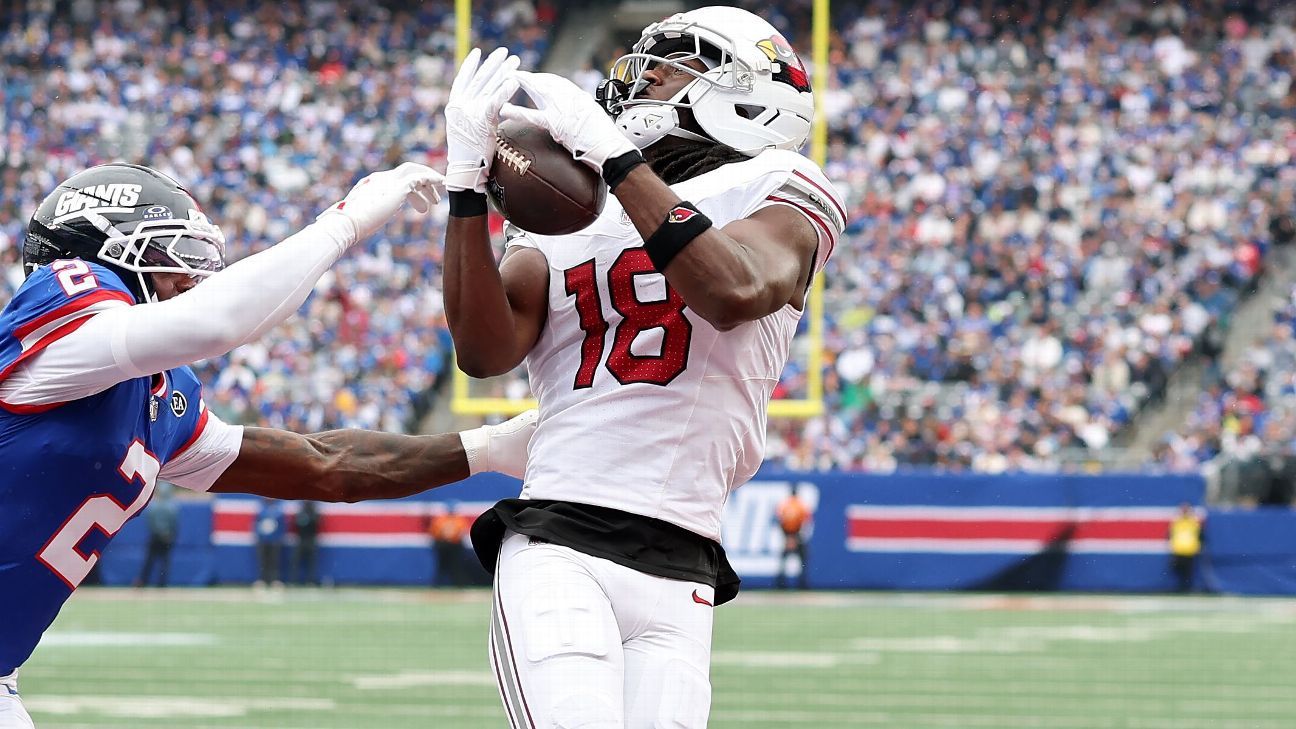
Minutes after the Texans completed their 26-3 blowout win over the Titans, news broke that the rumored trade of Harrison — which we already knew was keeping the receiver inactive Sunday — would be completed, sending him to Houston in exchange for a second-rounder and a late-round pick swap.
Like a lot of trades for young players, there are two simple questions. How much of our opinion of Harrison should be shaped by the league’s pre-draft opinion of him? And how much of it should be based on what we’ve seen from him in the NFL so far?
Harrison was considered a premiere wide receiver prospect and was the first non-quarterback off the board in the 2024 draft, going No. 4 overall. But his production has fallen well short of those expectations to date, with Harrison amassing 1,578 receiving yards over 33 career games.
That equates to 1.5 yards per route run, a 46th percentile number among wide receivers who have run at least 15 routes per team game in that span. That number has been even worse in a small sample this season: just 0.6 yards per route run with a much higher percentage of deep fades and go routes (24%) than the previous two seasons (13%). Harrison’s player-tracking metrics have been mediocre but not awful his first two seasons, too — 47 and 54 overall in ESPN’s receiver scores (with slightly better open scores) in 2024 and 2025, respectively.
Despite a rough start, the 1-4 Texans probably still believe they have a Super Bowl-caliber defense and a chance for a postseason run if they can get more talent around quarterback C.J. Stroud, who has been playing well. I don’t think that’s completely far-fetched despite their ugly record. This is not the Texans’ first attempt to upgrade at wide receiver. After second-year man Jayden Higgins suffered a torn ACL in August, Houston traded to get Kayshon Boutte from the Patriots. But Boutte has managed only 1.1 yards per route run despite Nico Collins missing two games.
The Texans will get Harrison for cheap the rest of this season and next year, and they will have a fifth-year option on him for 2028. But this move is not worth it if Harrison is remains the same player he has been with the Cardinals, because second-round picks have real value. Receivers who average 1.5 yards per route run can be found quite easily. The Texans are betting that Harrison can reach the upside he showed at Ohio State, which includes a breakout season in 2022 when Stroud was his quarterback. With two-plus NFL seasons already under Harrison’s belt, the chances of a breakout aren’t great, but they exist.
I think this trade makes sense for Arizona. The Cardinals didn’t have to trade Harrison yet, but he will be worth more to a contending team than he is to them. It’s likely his price would sink if they waited until the offseason to deal him. And Michael Wilson already had established himself as Arizona’s No. 1 receiver, anyway.
Ultimately, I would not have made this trade if I were the Texans, because the odds of Harrison breaking out immediately feel too low to justify the compensation. But I at least understand the thought process and desire to maximize a loaded roster’s chances of making a real run to make the playoffs and win postseason games. — Walder


Ravens get: C Cam Jurgens, 2027 seventh-round pick
Eagles get: 2027 fifth-round pick, 2028 second-round pick
Ravens grade: D+
Eagles grade: A
First, Tyler Linderbaum walked in free agency. Then the Ravens lost Jovaughn Gwyn and Ethan Pocic to injury, suddenly leaving them without a center. Last week, Baltimore moved first-round rookie guard Olaivavega Ioane to center but evidently doesn’t see that as a long-term option.
So Baltimore turned to the trade market and dealt for Jurgens. It’s an interesting and unusual move, because Jurgens is no stopgap. He’s only 27 years old and is already on a long-term deal after signing an extension with the Eagles in 2025.
Jurgens moved from center to left guard in Week 2 after the Eagles placed guard Landon Dickerson on injured reserve. It has not gone well. Jurgens ranks in the bottom three in both pass block and run block win rate at guard. But the Ravens are trading for Jurgens to have him play center.
In 2024, Jurgens was a Pro Bowl center who recorded pass block and run block win rates in the 80th and 50th percentiles, respectively. He made the Pro Bowl again in 2025, but his numbers slipped to the 65th and 39th percentile, respectively. He should be a stabilizing force for the Ravens — perhaps an average to above-average center — at what has suddenly become a position of need. But the cost is exorbitant.
The Ravens are surrendering a second-round pick (plus a swap of fifth- and seventh-round picks) for the right to pay a non-premium position player market price after this season. Jurgens is due a fully guaranteed $16 million next year. He’s due $17 million (non-guaranteed) in 2028 and 2029. Jurgens’ $17 million average per year for the duration of his contract makes him the fourth-highest-paid center in the league, behind only Linderbaum, Creed Humphrey and Aaron Brewer, per OverTheCap.com. By comparison, Connor McGovern, who had better numbers than Jurgens last season, makes a little over $13 million per year.
One saving grace for Baltimore is that Jurgens’ salary is cheap this season. The Eagles have already paid Jurgens’ option bonus, so the Ravens should be on the hook for only the remaining portion of his $1.2 million base salary.
For the Eagles, the loss of Jurgens is the latest blow to an offensive line that is already down Dickerson and recently retired tackle Lane Johnson. Jurgens hadn’t played well at guard, but surely they saw him as their long-term center. Drew Kendall, who has played center after Jurgens’ shift, has been below average in both pass and run block win rate this season. But the Eagles seemed to believe this was a price too good to pass up.
I understand that the Ravens rightfully believe they are Super Bowl contenders, probably want Ioane to stay and develop at guard and thought they needed to fill their gap at center. Making a trade before the deadline to fix that issue makes sense. But almost certainly there would have been cheaper options out there than this. And the timing is odd, considering that Jurgens is currently in concussion protocol and not expected to play Sunday.
So it seems like the Eagles sensed Baltimore’s desperation and squeezed an overpay out of the Ravens. — Walder


Cowboys get: CB Joey Porter Jr.
Steelers get: 2027 sixth-round pick, 2028 second-round pick
Cowboys grade: B
Steelers grade: C+
This is the Cowboys’ third trade with the Steelers in the past 18 months (George Pickens and Broderick Jones), and it’s their third trade involving a star defensive player after acquiring Quinnen Williams at the trade deadline last season and shipping Micah Parsons to Green Bay last offseason.
It’s easy to see what the Cowboys are doing here. DaRon Bland, who first broke onto the scene as a slot corner, was playing on the outside given Dallas’ lack of depth. By acquiring Porter, Bland can move back inside, which will allow the Cowboys to relocate 2026 first-round defensive back Caleb Downs, as well. He has been playing the slot, but his natural position is at safety. These are options, not guarantees. Bland might stay outside as the Cowboys instead pursue a strong 1-2 punch at outside corner, with Porter shadowing WR1s.
The salient point is this: Porter can have a rising tide impact on the Cowboys secondary, clarifying the roles of other players and enhancing the whole unit in the process.
Porter is not as tricky of a scheme fit in Dallas as people think, too. His strengths are certainly his length and physicality, such that he can line up in press — but he has been in press alignments on only 30.6% of his snaps over his career, just above the league average for cornerbacks (24.1%). Porter is a much better man coverage defender than he is in zone, as his passer rating allowed in man coverage over the past four seasons is better than all but Derek Stingley Jr. But the Cowboys are actually running more man coverage (24.8%) under first-year defensive coordinator Christian Parker than the league average (23.2%) over the first three weeks.
1:55
How Stephen A. believes Joey Porter Jr. can help Cowboys’ defense
Of course, early-season rate stats can be noisy. Parker’s Vic Fangio-inspired defense will require Porter to play from greater depth than he did in Pittsburgh, and the communication and keys required in that match-heavy system will take some getting used to. But Porter has a valuable and rare skill set in his press-man ability, and premium picks should be spent on players with premium traits. The Cowboys got much, much better in the secondary — though the move is not without risk.
Acquiring Porter does not solve all their deficiencies; linebacker is still a big problem for this team, and the edge rush isn’t far behind. But if the secondary needs less schematic help now that Porter is in play, more coaching tools can be used to hide those other weak spots.
For the Steelers, Porter’s recurring back ailments seemed incurable without an extension or a relocation — what can you do? It’s frustrating that GM Omar Khan invested more in third-contract players like Jalen Ramsey and T.J. Watt over a younger, second-contract player like Porter — Ramsey and Watt will hit their athletic wall far sooner than Porter. Jamel Dean, another third-contract player signed to play corner opposite Porter, now has to cover WR1s alongside Asante Samuel Jr. and 2026 third-round pick Daylen Everette. Corner is no longer a strong position on Pittsburgh’s depth chart.
Porter reportedly had contract demands up at the top of the cornerback market, where Devon Witherspoon and Christian Gonzalez recently reset elite deals to clear $33 million annually. I’m not sold that Porter is a top-tier corner deserving of that top money. But because the Steelers let this go on for so long and bleed into the regular season, they were only able to acquire a 2027 sixth-round pick and a 2028 second-round pick for a young, ascendent cover corner. They could have — and should have — gotten at least a first-round pick by playing this differently and dealing Porter in the spring or earlier in the summer. — Solak


Giants get: QB J.J. McCarthy
Vikings get: 2027 fifth-round pick
Giants grade: C
Vikings grade: B+
A mere 22 days after the Giants signed Jameis Winston to a two-year, $13 million extension, New York decided it needed to trade a fifth-round pick for an alternative at quarterback. Of course, a lot has happened in three weeks.
Starting quarterback Jaxson Dart suffered a knee injury in Week 2 that is expected to keep him out for at least the regular season. And Winston has delivered two poor performances in Dart’s stead, with a 19.0 QBR in relief in Week 2 against the Rams and a 27.9 in Sunday’s 12-7 win over the Titans. So in comes McCarthy, the No. 10 pick in the 2024 draft.
McCarthy’s pro career has gone poorly so far, which is putting it mildly. He suffered a season-ending knee injury in August 2024, which helped Sam Darnold become Minnesota’s starting quarterback. McCarthy was named the starter last season after Darnold departed in free agency but started only 10 games after a series of injuries cost him time. And when he was on the field, the results were not good.
McCarthy posted a 36.1 QBR in 2025 (which ranked 38th out of 45 quarterbacks with at least 100 pass attempts) and recorded a minus-5% pass rate over expected, per NFL Next Gen Stats (43rd out of 45). He threw interceptions at a 4.2% clip (44th), took sacks on 9.4% of dropbacks (40th) and had a 1.8% fumble rate (41st). More alarming is that he did all that while playing for Kevin O’Connell, who has seemingly elevated most of the non-McCarthy quarterbacks he has called plays for.
2:32
Rich Eisen reflects on J.J. McCarthy’s Vikings tenure after trade to Giants
During training camp, not only did McCarthy lose the Vikings’ starting quarterback competition to Kyler Murray, but he then lost the backup competition to Carson Wentz, too. That is a telling red flag.
So why would the Giants trade for him? McCarthy presumably still has some upside based on his draft pedigree, and the Giants are hoping they can profit from him realizing it. But it’s hard not to notice the fact that this is John Harbaugh trading for the quarterback his brother, Jim Harbaugh, coached in college at Michigan.
It is difficult to know from the outside which other backup quarterbacks would have been available, but McCarthy still does not seem like an ideal choice. Mac Jones and Spencer Rattler ought to have been the team’s first calls (maybe they were). Kirk Cousins probably is off the board with the Raiders sitting at 3-0. Mitchell Trubisky might have been available, considering this already looks like a lost season for Tennessee. And I’m assuming Gardner Minshew II surely must be available, considering he sits in veteran no-man’s land between Jacoby Brissett and rookie Carson Beck in Arizona. Stetson Bennett IV could have been an option, too, after the Rams selected Ty Simpson in the first round of this year’s draft. I’ll grant that some of those options have less upside than McCarthy.
But the Giants’ front office should look in the mirror over its bungling of the Winston situation. It’s not unreasonable for the Giants to be aggressive in finding a better replacement given how much time is left in the season. But they clearly shouldn’t have signed Winston to an extension right before the season if this is how they feel about him!
Even though Murray is a free agent at the end of this season, McCarthy’s ship had already sailed in Minnesota after he couldn’t beat out Wentz. If he wasn’t going to be the Vikings’ backup quarterback, his value would likely have continued to drop. To get a fifth-round pick while saving a few million across his remaining 2026 and 2027 compensation (not nothing!) makes sense. They have uncertainty at quarterback in 2027, yes. But that was true whether McCarthy was there or not. — Walder