
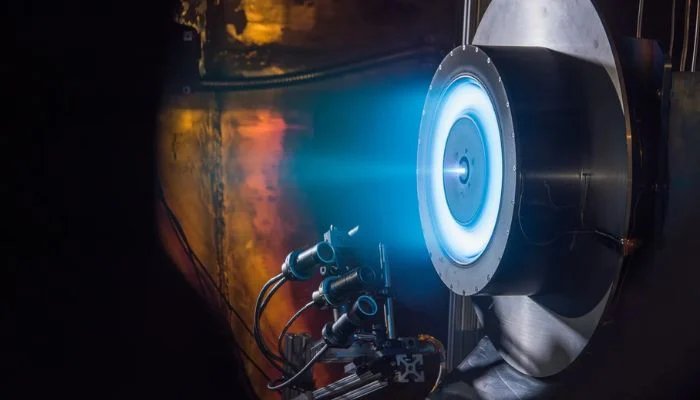
According to the National Aeronautics and Space Administration (NASA), a high-powered lithium-fed thruster, which will likely be used in the near-future to propel astronauts to Mars more quickly, has recently undergone successful testing.
This marks significant advancement in the effort to create quicker means of space travel in deep space.
On February 24th, the lithium-fed MPD thruster was fired at the NASA Jet Propulsion Laboratory (JPL) located in southern California. NASA stated that during this firing event, the electromagnetic engine achieved approximately 120 kW of power.
This is over 25 times greater than the maximum power output from electric thrusters utilized on NASA’s Psyche spacecraft.
As previously reported, NASA is developing lithium-fed magnetoplasmadynamic (MPD) thrusters. These are different from traditional chemical rockets, as they do not utilize chemical reactions. Instead, the system utilizes electrical energy to convert lithium into plasma, which is then accelerated using electric currents and magnetic fields.
NASA Administrator Jared Isaacman described the recent test as an “important milestone toward sending American astronauts to Mars.” He further emphasized that NASA has “not lost sight” of Mars and that this success indicates real strides are being made in achieving access to the Red Planet.
The lithium thruster was ignited on five occasions. During each ignition, the temperature of the center electrode of the thruster reached over 5,000 degrees F.
The lithium-fed MPD thruster was operated within an 8-meter-long water-cooled vacuum chamber, specifically engineered to test extremely powerful electric thrusters utilizing metallic vapor.
One of the primary advantages of electric propulsion is that it achieves better fuel efficiency than traditional high-thrust chemical rocket propulsion.
According to NASA, electric propulsion may achieve anywhere from 70-90% better propellant usage compared to high-thrust chemical rockets; however, this comes with the tradeoff of producing much lower thrust rates.
The lithium thruster may provide some solution to the lower thrust rate issue faced by many electric propulsion systems today. It is capable of operating at power levels significantly higher than those currently available in most commercial or government-developed electric propulsion systems.
In order to advance this technology to meet NASA’s needs for long duration space flight, researchers plan to increase the power of their next generation of lithium-fed MPD thrusters to between 500 kw and 1 mw.
However, there is still a significant number of technical hurdles to overcome prior to astronauts being able to utilize lithium-fed MPD thrusters for actual trips to Mars.
To accomplish this goal, NASA estimates that a single human mission to Mars will require a minimum of 2 mw of power, thus requiring multiple thrusters to be operated simultaneously.
Additionally, these multiple thrusters would need to continue functioning for periods exceeding 23,000 hr, thereby necessitating that researchers demonstrate through experimentation that all components are durable enough to withstand long-term operation in environments where extreme heat is produced.
At present time, researchers believe that nuclear electric propulsion could ultimately serve as a complement to the lithium-fed MPD thrusters. They envision pairing them together so that both systems provide sufficient amounts of power for extended duration deep space travel.
Development of this technology is being conducted by researchers at JPL in collaboration with Princeton University and NASA’s Glenn Research Center as part of NASA’s Space Nuclear Propulsion Project.
For almost three years, research and development for this lithium-fed MPD thruster has been underway. Prior to the most recent test results, this technology had not ever been demonstrated operatively in-flight.
Currently, this most recent test result only provides confirmation that the prototype can produce the required power level.

