
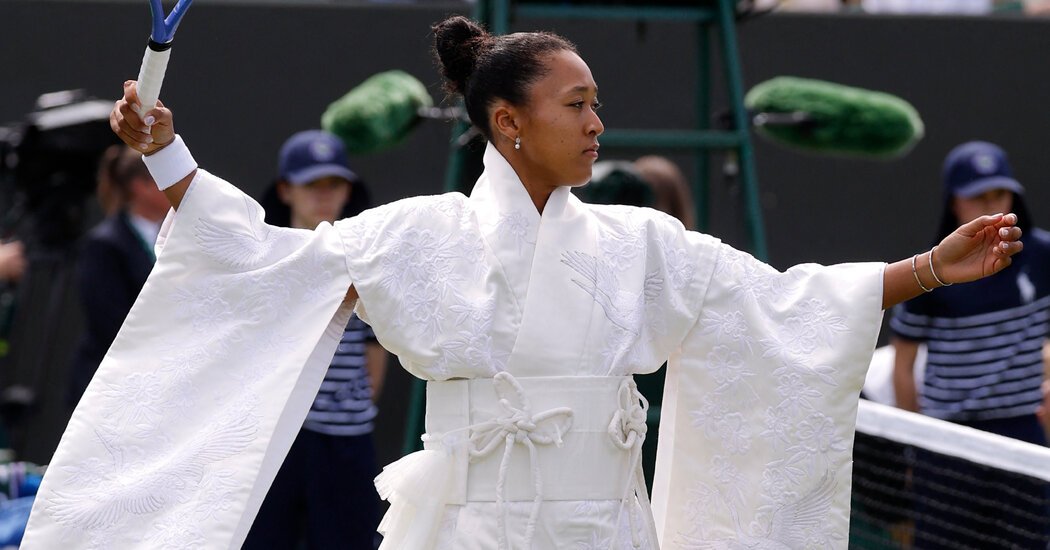
Forget Grand Slams — these are grand entrances. On Monday, Day 1 of Wimbledon, Naomi Osaka made the case yet again that, when it comes to on-court fashion, she is, if nothing else, completely changing her game.
This time around — and even though there was a last-minute kerfuffle about whether she would even be able to appear, given a foot injury — Osaka, the 14th-seeded player (and former world No. 1), did her walk-on in an all-white look by Hana Yagi, an independent Japanese designer, entitled “Evolving Ceremony.” Modeled on a traditional kimono as well the junihitoe, or 12-layer dress worn by noblewomen in the Heian period from 794 to 1185, the gown was made from seven different textiles upcycled from vintage kimonos, a traditional shiromuku wedding dress and a deconstructed wedding dress.
Like the Nike performance dress Osaka wore underneath, which alluded to Japanese kirigami with its floral appliqués and micro-pleated and curving hem (and which sold out even before the tournament began), the design of the walk-on dress and the choice of designer were conscious nods to her Japanese heritage. She was even wearing jewelry from Mikimoto, the Japanese jeweler famous for its pearls.
“Working with Hana allowed us to celebrate Japanese history and craftsmanship while creating something that feels entirely modern,” Osaka said in a statement. “I love that it feels both powerful and delicate at the same time.” And, she added, it is “designed around movement.”
The look is effectively Act 3 of an ongoing story that began with the Australian Open earlier this year. Fashion has always been a part of Osaka’s competition appearances, as it was (and is) for Serena Williams, who has used her competition looks to express her personality more overtly than anyone else in tennis, and Jannik Sinner, a Gucci ambassador. But something else was going on with Osaka.
It was in Melbourne in January that Osaka emerged from the tunnel onto center court in a Robert Wun gown made to resemble a jellyfish. Her butterfly hat hinted at the birth of something new and her status as a young mother. She shed the formal outer layer when it was time to start the match.
Next up was a black corset and ball gown skirt by Kevin Germanier for the French Open, created as a nod to the Eiffel Tower and upcycled from Osaka’s old Nike kits. And now there is the Yagi look.
When all three are considered together, certain themes begin to emerge.
First, Osaka is focusing on sustainability. Second, she is using her moment in the spotlight to support small and independent designers or, as her stylist Marty Harper said, “give voices to new kids on the block.” Yagi is still in her 20s and started her company in Tokyo after becoming a finalist in the International Talent Support competition in Italy in 2019.
And third, even by the standards of today’s sports world, where fashion and the tunnel walk are an increasingly important part of every player’s arsenal, Osaka is using her clothes more effectively than any other competitor to create a potent personal brand.
The logistics of doing so are more complicated than they may appear. Each tournament demands not only a couture-level, custom-made look that can be seen from the highest reaches of a stadium but also a couture-level, custom-made look that can be removed in the time it takes other players to unzip their warm-up jackets.
“We really only have three minutes to dress her, and she has less than one minute to undress” before the match, Harper said.
Yagi made each of the nine segments of the dress detachable so they could be shed in the required time as well as recombined in different ways as the tournament went on.
“One of the key concepts was that the look would evolve as Naomi progresses,” Yagi said in the statement. “I experimented many times to make sure it could happen naturally.” (Her ingenious solution: Velcro.) The dress also comes with, for example, an almost 10-foot train that can be adjusted depending on what court Osaka is playing on. That matters because the outer courts at Wimbledon are far enough from the players’ lounge that the trek could ruin the material.
The work is worth it, though, given the results. No matter what happens in the tournament itself, Osaka’s approach to the walk-on means she has won the attention championship, even before the first serve.

