
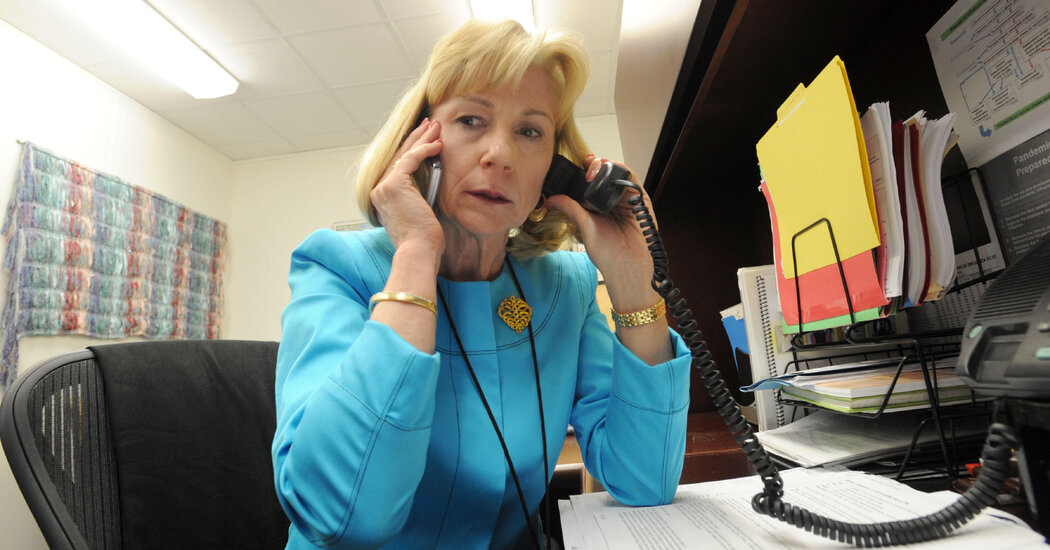
Nancy J. Cox, who as the longtime leader of the influenza program at the Centers for Disease Control and Prevention oversaw the development of a global network of forecasting and prevention, in the process earning a reputation as one of the world’s foremost experts on the flu and the constantly mutating viruses that cause it, died on April 24 at her home in Atlanta. She was 77.
Her husband, Evan Lindsay, said the cause was glioblastoma, an aggressive form of brain cancer.
Tracking influenza outbreaks is part detective work, part Olympic sprint, part guessing game. Flu viruses constantly change their genetic makeup, and every year virologists must scramble to develop new protocols and vaccines.
“When you work with an organism like influenza that’s ever-changing, you learn something new every year,” Dr. Cox told Time in 2006, when the magazine named her one of the world’s 100 most influential people. “So it never gets dull.”
Keeping up with such a wily opponent requires a globe-spanning infrastructure of scientists, forecasters and policymakers. Over her nearly 40 years at the C.D.C., Dr. Cox led the way in building that network.
“She was clearly one of the most influential people in the field of influenza and global public health for the past few decades,” Richard Webby, who leads influenza research at St. Jude Children’s Research Hospital in Memphis, said in an interview.
When Dr. Cox arrived at the C.D.C. headquarters in Atlanta as a postdoctoral scholar in 1975, officials had limited tools for catching outbreaks of flu and other illnesses early, forcing them to rush to respond once the trouble was well underway.
It was a pivotal time in public health. In January 1976, a deadly outbreak of swine flu was worsened by an ill-advised immunization rush using a vaccine that was later associated with increased rates of Guillain-Barré syndrome, a nervous system disorder.
Six months later, an outbreak of pneumonia killed 34 people at an American Legion convention in Philadelphia. The cause of what came to be known as Legionnaires’ disease was a previously unknown bacterium.
The two incidents underlined the need for a rigorous institutional framework to track and respond to outbreaks, a task that became Dr. Cox’s lifework.
She combined deep scientific knowledge — she wrote or contributed to 278 academic papers — with sharp policy instincts and a knack for institution building. When she joined the C.D.C., the influenza branch had about a dozen people. By the time she retired, in 2014, it had grown to become its own division, with about 350 employees and contractors.
“She understood everything from the micro to the macro,” Walter Orenstein, an emeritus professor of medicine at Emory University who worked with Dr. Cox at the C.D.C., said in an interview.
The real challenge for public health officials is not identifying influenza strains — it’s deciding which ones present the most imminent threat of outbreak, and therefore where to allocate limited resources.
To help make those decisions, Dr. Cox developed a set of criteria based on advances in genetic sequencing technology. She also worked to create a standardized approach to designing each year’s flu vaccine.
And she led the way in focusing on the zoonotic, or animal-borne, varieties of influenza, an approach that has enabled officials to respond to major outbreaks of swine and avian flu over the last 30 years.
Dr. Cox was especially active in building up other countries’ resources. In China, she helped establish a world-class flu-monitoring network almost from scratch. From 1992 to 2014, she led the C.D.C.’s arm of the World Health Organization’s influenza tracking and response network.
“She was someone who understood that viruses know no bounds,” Julie Gerberding, the C.D.C. director from 2002 to 2009, said in an interview. “If you want to answer it, you have to have a global response.”
The work was herculean, but also Sisyphean. No matter how well the network responded to one year’s flu, the next year presented an entirely different set of challenges.
“I find the organism fascinating because of its ability to change and replicate in multiple different forms,” she told Government Executive magazine in 2006. “I haven’t gotten tired of influenza because there’s always something new.”
Nancy Jane Cox was born on July 21, 1948, in Emmetsburg, Iowa, where her parents, Emmett and Verna (Olson) Cox, were farmers.
As an undergraduate at Iowa State University, she studied bacteriology. After graduating at the top of her class in 1970, she received a Marshall Scholarship to study at the University of Cambridge in England, earning a doctorate in virology in 1974.
She then began a postdoctoral program at the University of Maryland, Baltimore County. When her supervisor there transferred to the C.D.C., she followed.
Dr. Cox married Mr. Lindsay in 1981. Along with him, she is survived by their daughter, Julia Lindsay; a stepson, Mark Lindsay; a granddaughter; three step-grandchildren; her sister, Sherilyn Fuoss; and her brothers, Randolph, Richard, Robert and Regan Cox.
After retiring from the C.D.C., Dr. Cox continued to consult with the W.H.O. and other global flu response efforts. She was widely respected for her precise, careful thinking, leavened by a sardonic wit.
When a reporter for Science magazine asked her in 2009 about the latest flu mutation, she responded, “I want to make sure, before I give you an answer, that I go through the latest data I have, and I’ve been working on other emergent issues.”
The reporter said, “I understand, I can’t imagine what those would be.”
Dr. Cox replied: “You wouldn’t want to know.”

