
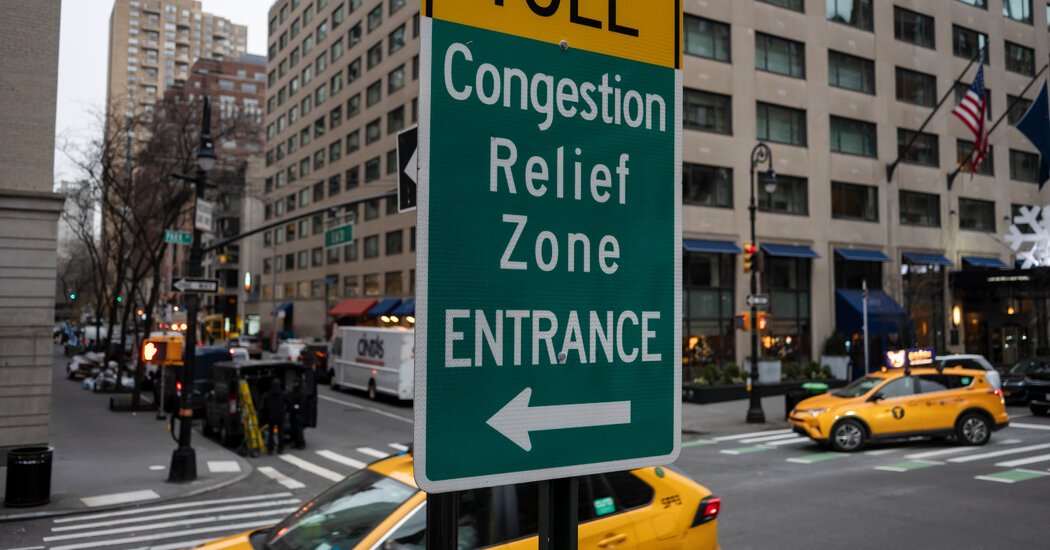
Since New York introduced congestion pricing on its streets last year, the divisive tolling program has had little effect on air pollution anywhere in the city, according to a report that provides the first snapshot of the initiative’s environmental consequences.
The study, from the city’s Health Department, noted that pollution within Manhattan’s congestion pricing zone had, at most, slightly improved. Perhaps most notably, the tolling program didn’t lead to dirtier air in neighborhoods where drivers may have headed to circumvent the tolling zone, such as the South Bronx and parts of Staten Island.
“There was concern about the potential for increased pollution caused by drivers looking to avoid the toll,” said Janno Lieber, chief executive of the Metropolitan Transportation Authority, which oversees congestion pricing. “As this study confirms, that didn’t happen, and congestion pricing is already funding additional investments to further improve air quality.”
Congestion pricing started in early 2025 and charges most drivers up to $9 to enter Manhattan below 60th Street during peak traffic hours.
The program has resulted in fewer cars moving at a faster pace, more people riding the subway and hundreds of millions of dollars heading toward the coffers of public transit. To reach their findings, researchers needed a full year of data plus several months to compile and analyze it.
Measuring air quality is difficult, scientists say, because of variability in atmospheric conditions. At least one year of data tracking weather fluctuations across four seasons is necessary to get an idea of air quality shifts. Even then, every year is unique, which makes it challenging to compare one year with another.
For the city’s report, the Health Department compared data from 2024, the year before congestion pricing started, with readings from 2025. To determine the effect of congestion pricing on air quality, the researchers studied estimates of what pollution levels could have been if there had been no tolling program, along with pollution levels after congestion pricing.
They also zoomed in on six areas that might experience increased traffic and, with it, more pollution because of drivers wanting to avoid paying the tolls: two highways in the South Bronx, an expressway in Washington Heights, a thoroughfare on Manhattan’s Lower East Side, and expressways in Brooklyn and on Staten Island.
Data was collected from these six locations monthly. Researchers found lower amounts of black carbon and nitric oxide, two harmful byproducts of fuel combustion. Levels of fine particulate matter — tiny, toxic particles also produced by burning fossil fuels — had remained the same. They said these changes could not be attributed to congestion pricing and were due to other factors, such as fluctuating weather conditions, including high temperatures and wildfire smoke.
The Health Department will continue to monitor these six locations monthly through the end of 2026. After that, monitoring will happen four times a year through the Health Department’s New York City Community Air Survey, which has existed since 2009 and tracks pollution levels at 86 locations throughout the city.
The findings are consistent with what experts predicted during the planning of congestion pricing: that the initiative would not have a significant effect on air quality. In New York City, traffic produces only 10 percent of fine particulate matter, among the most deadly of pollutants. In most of the United States, cars and trucks are the biggest source of air pollution. But because of New York’s density, its fuel-guzzling buildings, including its many restaurants, are the main culprit.
The report did not measure greenhouse gas emissions, which drive global warming. For now, it is unclear how much the program will contribute to New York State’s ambitious goal of reducing greenhouse emissions by 85 percent by 2050. Buildings, in addition to producing more fine particulate matter than vehicles, are also responsible for about 70 percent of the city’s greenhouse gas emissions.
Many environmentalists viewed the report’s findings, and the congestion pricing program overall, as a major climate victory.
“Over the long term, the infusion of funds from congestion pricing will keep more commuters on public transit and out of cars, and that’s a lasting air quality benefit that shouldn’t be discounted,” said Eric A. Goldstein, a senior attorney and New York City environment director at the Natural Resources Defense Council.
Mr. Goldstein added that there is no “magic fix” for the climate crisis, but “energy-efficient transit must be part of the tool kit.”
Another 2025 report that was updated this month and published by the National Bureau of Economic Research, a nonpartisan nonprofit, also found that congestion pricing had had “little effect on air quality.” It has yet to be peer-reviewed.
But not all reports have reached such a conclusion. In May, a Columbia University study, relying on data from 19 sensors across the South Bronx, detected an overall fine particulate matter increase of 2 percent between 2024 and 2025 in the dense and heavily congested neighborhood that is bisected by major highways. The study, which accounted for weather fluctuations such as wildfire smoke, has not yet been peer-reviewed, but is scheduled to publish soon, its authors said.
William Fowler, a Health Department spokesman, said that the methodology for the Columbia study had not been made public yet and reiterated that the city’s new study found that congestion pricing had not made the air dirtier in the South Bronx.
Representatives from South Bronx Unite, a nonprofit that worked with Columbia to place the sensors in the neighborhood, welcomed the positive news from the city report about air quality in the borough, though they cautioned that it was important to watch what hyperlocal data reveals, too.
“Although it may look like all communities are benefiting from the overall reduction in pollution, some communities, such as some in the South Bronx, have experienced an increased burden,” said Micaela Martinez, the director of environmental justice and research for the group.
Transit and health officials have designated $105 million to address pollution issues in areas that are at risk of getting more traffic from congestion pricing. The bulk of the money is dedicated to initiatives in the South Bronx, which has some of the highest asthma rates in the United States. Programs include building charging stations for electric vehicles, replacing refrigerated diesel trucks that carry perishables with cleaner versions and expanding community asthma services.

