
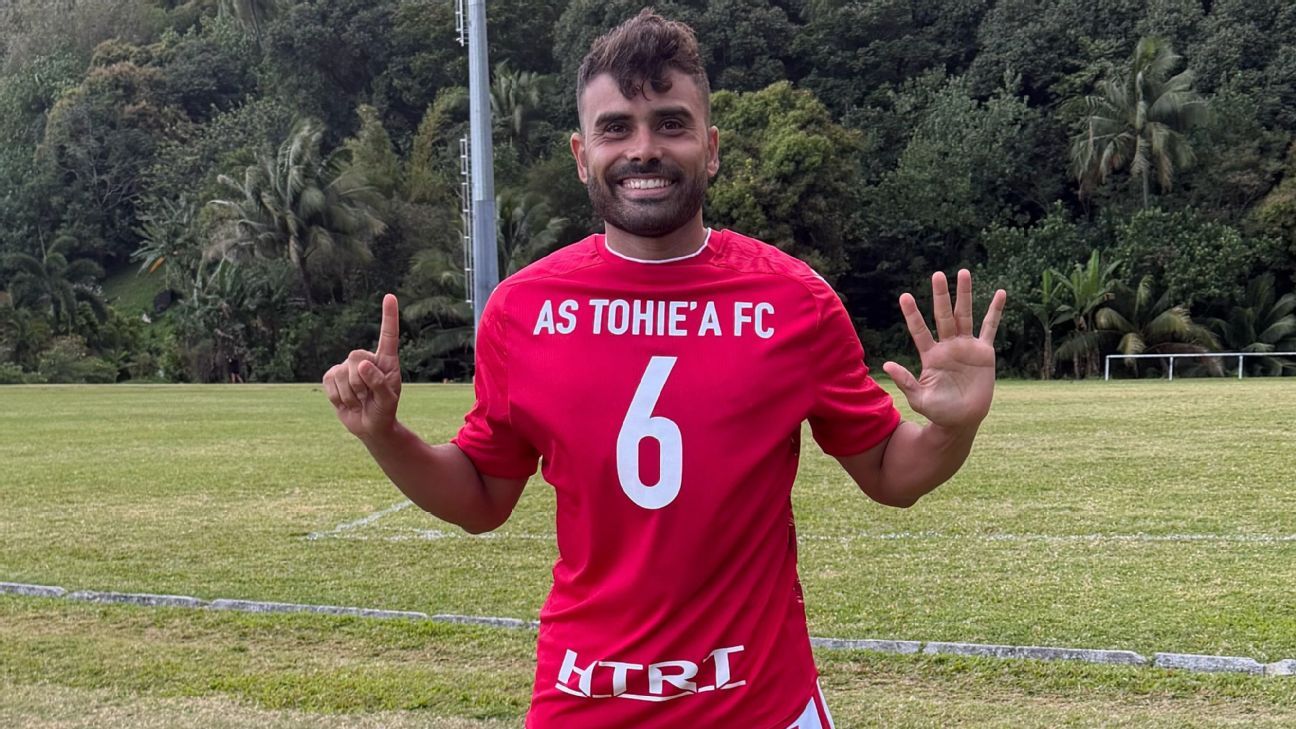
It was 7 a.m. on Sept. 21 when Sérgio Barboza landed in Tahiti, having traveled for three days from his native Brazil on the cheapest flights he could find. Carrying only a backpack, the 33-year-old winger had no club — and only days to find one before the transfer window closed. But that afternoon, he was collected from his hostel by a local player and played his first friendly on the island.
That whirlwind start to life in Oceania was largely down to Barboza’s 300 ‘agents’: social media followers who pay $6 a month to be part of a special WhatsApp group where decisions over his professional soccer journey are made.
– How world record for longest unbeaten streak in world soccer was broken
– The Somali ref barred from World Cup who made it to UEFA Super Cup
– Meet Tahiti United, the soccer team that plays all of its games tomorrow
“The FIFA video game [now called EA Sports FC] on the PlayStation has a Career Mode where you control just one player. I’m doing that — but in real life,” the 33-year-old tells ESPN from a beach in Tahiti. “My subscribers decide everything with me. They decide the club, the number on the back of my shirt. They went for No. 6 because this is my sixth confederation.”
By playing in Tahiti, Barboza joined an exclusive group of soccer players who have plied their trade in every continental confederation around the world: AFC (Asia), CAF (Africa), Concacaf (North and Central America), CONMEBOL (South America), OFC (Oceania) and UEFA (Europe). Lutz Pfannenstiel — a German goalkeeper famous for his uniquely eventful career — is the best-known example. But as a young player, Barboza had no intention of becoming a globe-trotting journeyman.
Dreams of the big time in Brazil
“When I was at youth level, playing for the biggest club in Brazil, I was thinking: ‘In a few years, I will have a big car, a big house, I will play on TV,'” Barboza recalls.
However, he struggled to make the step up to senior level in a Flamengo squad stacked with talented players — former Barcelona star and Ballon d’Or winner Ronaldinho among them. In 2011, he left and began to drop down the national divisions before having to try his luck in Brazil’s various state championships.
“I moved to a team in Serie C,” he says. “But I didn’t have a chance to play there because they had a lot of experienced players and I had never played at senior level in my life.
“I realized [playing at regional level] was not the same thing I dreamt of as a young player. I was playing for a small salary, like $200 a month, and sometimes I didn’t even receive it. I said to myself: ‘This is not football! This is not the sport I saw on TV!’
“By the time I was 21, I decided: ‘Let’s go back to school. Let’s combine football with studies.'”
He would head to the training ground in the morning, study in the afternoon and evening, and go to work at night. “It was my way to survive.”
But then, in 2015, came the opportunity to go to Costa Rica. “I didn’t ask how much the salary was, I just got on the plane,” says Barboza, who started out in Central America at then-Primera División club Limón before playing for the reserves of Guatemalan side Comunicaciones and later joining Juticalpa in Honduras. He has not played for a Brazilian team since.
Highs and lows across Asia and Africa
Having caught the travel bug, Barboza next moved to Asia with clubs in Laos, Cambodia and India, before ticking off his fourth confederation: UEFA. But he played only nine games for Maltese side Żejtun Corinthians, scoring one goal, before heading back to Asia.
“My best memories were in India,” Barboza says. “I think I played for five clubs, and I played well there. My coach always hugged me, and it was the country where I made the most friends.”
Following spells in the United States with USL League Two side Nona FC and at Dhangadhi in Nepal — his fourth Concacaf and AFC countries — Barboza appeared on a podcast in Brazil last year and explained that he had only two continents left to play in: Africa and Oceania. If he managed both, he told the hosts, he could make history. That statement sparked plenty of curiosity among the listeners and planted a seed in his mind.
“Years ago, I received a lot of offers to go to Angola and Libya,” Barboza says. “I was in India at the time and I didn’t want to go, but I still saved the contacts. I messaged them. And I didn’t get a contract in Angola, but I saw the flight was very cheap.”
Barboza sent his video to an agent and traveled to Angola, where he joined Bravos do Maquis on his first day in the country. It was then that disaster struck.
“We went to South Africa in preseason and I broke my leg,” he says. “I came back after six months. But the mentality to fight for the ball, to get my confidence back, it took me a year [to recover].”
Social media stuntman
Barboza ultimately managed only one appearance in Angola, but that was enough to tick the CAF box and leave OFC as the sixth and final step on his journey to completing the confederations. The timing was not ideal, however.
“I got married and also discovered that my wife was pregnant,” he says. “By the time I was able to go, I had only four countries where the window was open: Samoa, Tahiti, Tonga and Vanuatu. And the cheapest flight was to Tahiti. It’s a tourist country, so I thought: I can speak English there. But when I got here, nobody spoke English!”
With time running out to find a club, Barboza’s army of WhatsApp agents sprang into action before he had touched down, messaging local teams on his behalf and even downloading Facebook — a platform widely used in Tahiti, but no longer in Brazil — to do so. Their willingness to go to such extreme lengths for a globetrotting footballer they have never met lies, at least partly, in Barboza’s refreshing honesty about the game.
“I only ever saw players talking about the good things in football. I never saw them saying the reality,” he says. “So last year I started to say the things in football that really happen to most players. Because the players you see on TV account for about 5% of footballers.”
That approach struck a chord: Barboza now has 250,000 Instagram followers and launched a YouTube channel under the name “Jogador Dublê” (Stuntman Player) this year.
Deadline day in Tahiti
But even with his remote helpers, there was one thing Barboza could not work out. Having begun talks with a club from the neighboring island of Moorea, he was unsure whether its league — the confusingly named Moorea Ligue 2 — was part of the Tahitian national pyramid. If it was not, his time there might not be recognized.
“Maybe in the future, I will want to be in the Guinness Book of Records, so it has to be valid,” he says. “A friend of mine works for the CBF [Brazilian Football Federation]. He has all the contacts in FIFA. He searched for me and sent me a document confirming the club was a member of the [Tahitian] federation, which in turn is a member of FIFA.”
The name was simply a misnomer. Barboza discovered it was a top-flight league, with Tahiti and Moorea each running their own group and the winners and runners-up progressing to a final tournament to decide the national champion. The stress was not over, however.
“I signed the contract, but it was on the last day,” he says. “And the club had not signed a foreigner before. I didn’t know if they knew what to do. And maybe if the paperwork was rejected, I would not be able to play because I had only one chance to send it.”
Fortunately, the deal went through and Barboza was cleared to play.
A debut to remember
Barboza made his debut for AS Tohie’a in a 5-1 thrashing of Tamarii Tapuhute at the start of October, providing an assist and scoring twice — once from a free kick. In doing so, he became the first outfield player to indisputably feature for teams in FIFA-affiliated leagues in all six continental confederations. Peruvian forward Augusto Palacios played on all six continents in the 1980s, but his CAF spell came in South Africa during the country’s expulsion from FIFA, while his OFC stint was in Australia, which has since switched to the AFC.
With his new club not paying him a salary and only covering his accommodation costs, Barboza’s stay in Oceania had to be a short one — for the sake of both his bank balance and his pregnant wife back home.
“Tahiti is a very expensive country,” he says. “If you try to eat rice, chicken and salad, basic food, it’s $20. And if you take a Coca-Cola, you are gonna spend $30. When my wife saw the bills, she said: ‘No, you have to come back!'”
But after he had completed his pre-agreed run of five matches — returning four goals and four assists — his journey home was delayed by extreme weather. When a cyclone hit the island, the cost of his plane ticket home doubled to $3,000. And with his WhatsApp group money only covering his outbound flight, no sponsors and no earnings from YouTube or TikTok, it was a sum he could ill afford.
So will finances and fatherhood bring an end to his journeyman career? Not while there is unfinished business.
“I’ve scored and assisted in every confederation, except CAF. I will go back to Africa one day to complete my mission,” says Barboza, whose achievements have gained little traction with Brazil’s biggest media outlets. “I don’t know if it’s because they know one player already did it, a goalkeeper from Germany. But when I score and assist in Africa, I will be the first player to score and assist in all six. Then maybe they will talk about it.”


