
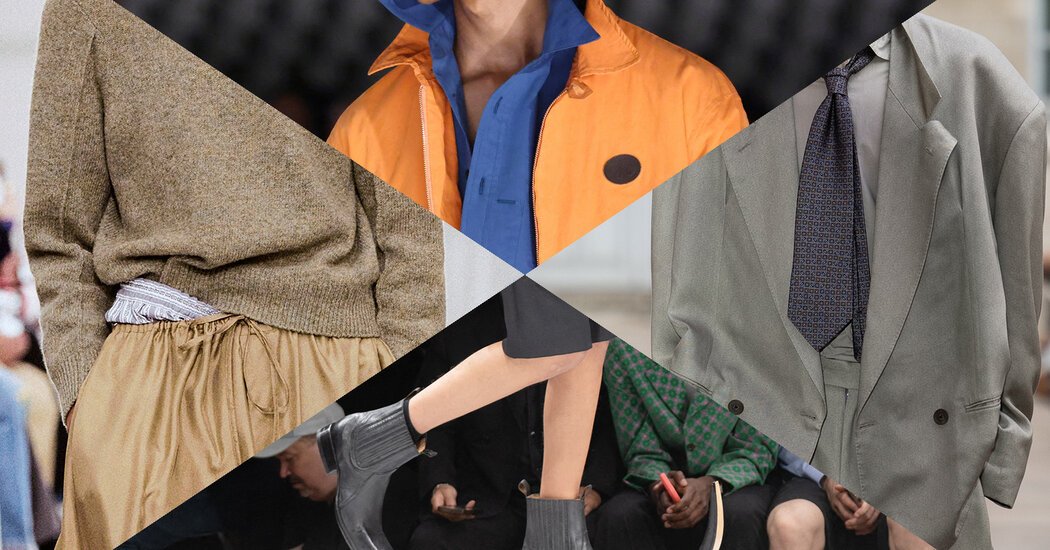
For the past week, our fashion reporter Jacob Gallagher has been in Paris for the men’s fashion shows. Here, a recap of his reviews, previously published in The Fashions newsletter. Subscribe now so you never miss a dispatch.
Celine thrills
You wait and you wait and you wait, and then, if you’re lucky, you see a collection like the Celine men’s show on Sunday afternoon. It was, finally, something radical.
Creative director Michael Rider likened the design process to a jam session. Based on that description, I could imagine Rider and his team in the studio, splicing a blazer sleeve until it landed at the forearm or plastering some leather ID tags to the shoulder of a racing jacket or tie-dying just the top of a pair of harem pants. Why? Because they wanted to. Because they could.
The collection was risky, but rich with ideas. If I had a crystal ball, I’d say the lithe loafers and dress shirts in colors out of a macaron box and will sell well.
“We make the things we want, and we make the characters we want to be,” Rider said backstage. “I dream about and hope to be part of building something that has legs but that also can turn the page, from a moment that some of us felt had gotten flattened, or maybe prewritten.”
Some may find the collectiontoo costumey, too feminine, too beyond. But Rider’s experimentation is needed. Men’s wear, for the most part, has been idling in the land of good-taste for too long. The things we get excited about are often upscale remakes of the familiar and the digestible. I am tired of being told “This collection is amazing, you have to see it,” and it’s just a well-made cotton sweater and some single-pleated pants.
We seem to have forgotten that fashion can be challenging. It didn’t feel like an accident that some looks in the show — the buckled pirate boots, the plunging parachute pants, the kooky hats wrapped around models’ heads — made me think of Vivienne Westwood, who, in her lifetime, generated collections that were form-busting and riotous. She cultivated her clique, but her work also reverberated into the mainstream.
I see Rider as doing something similar. He’ll have his fans. But I also think, ‘Heck, I hope he’ll nudge us out of men’s wear’s square box.’ It’s time to mess up those edges.
A Japanese suiting master wows
The latest collection from Soshiotsuki, presented Saturday night, put into focus what I think has been missing at Giorgio Armani. The designer, Soshi Otsuki, has been honest in the past about how much the louche work of Armani has inspired his line, but Otsuki doesn’t treat the oeuvre of the Italian soft-suiting maestro like some sacred text that can’t be futzed with. He toys with his suits instead of trying to keep them plastic perfect.
He lets lapels wilt like flowers in the heat, he shows suits that are wrinkled and rumpled. I admired how he sent models out with their belts undone, winking at a sexiness that you just don’t get from Armani anymore. These suits look lived-in, as if they’d been subjected to a week at sweaty clubs in St.-Tropez before hitting the runway. The last ensemble in particular left an impression: a sweeping three-piece black suit with an undone shirt. Yet the vest was buttoned, as if in a last-ditch effort to tidy up. That’s a guy you can picture out in the world, not a guy who you just stare at on the runway.
Willy Chavarria levels up
Up to this point, I have been slightly skeptical of Willy Chavarria’s brand. Last season’s show, a live-action staging of a 30-minute telenovela, left me cold. The artifice overwhelmed the clothes.
After his latest show in Paris on Friday, though, I’m a believer. It was about as strong a showing as I can remember from an American label here in the fashion capital.
Liberated from a convoluted concept, this was Chavarria at his clearest and most convincing. He delivered optimistic American sportswear: blush-colored ribbed knits, a denim barn coat with a debt to Mr. Lauren, a zip work jacket in an unexpected pumpkin hue and structured dress shirts of mint and pale pink. The women’s wear in particular was a step up and a reach from Chavarria at the red carpet: double-layered floral gowns, a sleeveless pink dress with a ginormous ribbon tie at the waist, a confetti skirt that was plain fun.
Were these the most original ideas? No. But they were done with aplomb.
That was, ultimately, the difference here from past collections. Chavarria’s latest felt luxe, expensive, elevated. Wherever he is getting his money — his Adidas collab? his Zara one? Don Julio, which was a sponsor of the show? plain old sales? — Chavarria appears to be pumping it into his fabrications, which included inky leathers and creaseless satins. In this show, you could also detect Chavarria’s commercial acumen. Putting items as elemental as up-and-down bluejeans and a tan polo out there reflected the scale of his line.
I’ve sat through many sophomoric efforts from American designers trying to make an impression in Paris. Their clothes mostly wither under the spotlight. The fabrics are too chintzy, the ideas superfluous and off the path from where fashion is marching. They retreat after a season or two. With this show, I left convinced that Chavarria didn’t only belong in Paris, but that he was in for the long haul.
I believe I took a video of every single outfit at Comme des Garçons Homme. There was just so much in this show that I wanted to remember: the flow and sway of the garments, the return of the curved toe guarachero dancing boots from 2015, the prints, some like a cross between camo and melted ice cream, others like wheat-pasted advertisements. I don’t have much patience for the “Who would ever wear that!” complaints about Comme’s runway shows. Well, someone would. (Looking at you, David Sedaris.)
But such gripes also miss the point, which is that Rei Kawakubo, at 83, remains so curious. She’s searching for new ways to orient how a man’s legs could look in a pair of trousers or thinking about whether that blazer would be better with a peplum. Or exploring if this neon yellow will brighten our days or if our shoes should be flat or curved like a wild grin.
It’s a relentless rethinking that should be lauded and learned from. It certainly was in the room. When the show was over, the audience clapped for longer than I can remember at any Comme show I’ve been to.

