

Want to bookmark your favourite articles and stories to read or reference later? Start your Independent Membership today.
Already a member?
Log in
A letter lives beyond us, outside of time and space; it’s like a time capsule.” This is one of multiple pearls of wisdom I furtively note down mid-conversation with Frish Brandt, a self-titled “letter midwife” and author of a new book, Unfinished Business: How to Write the Five Essential Letters of Your Life.
What, you may well ask, is a letter midwife? “Someone who helps you give birth to your letter, helps you find the words, find the shape – because the truth is many of us are reluctant to put our thoughts on paper and to share them with someone else,” explains Brandt.
A teacher of essential letter writing at Stanford University’s School of Medicine, and to individuals and institutions around the world, she first developed her practice while working in hospices and palliative care. It was here that the unparalleled power of letter writing first became apparent; so many of her clients had things they wanted to say before the end, whether it be an “I’m sorry” or “I miss you”, “Thank you” or “I love you”. Specifically in end-of-life care, the message was often “Goodbye”. Letters felt like the natural medium for this process of letting things go, making things right and tying up loose ends.
Brandt’s book is a practical and sensitive guide, giving helpful prompts for each type of letter – though they often end up morphing from one to another, “I’m sorry” naturally evolving into “I miss you”, for example – and outlining how to structure them while accessing your own unique voice.
The aim is to be authentic, rather than slick. “This is not about writing a perfect letter; this is about writing your letter,” emphasises Brandt. For those who struggle with the form, she suggests finding a quote, poem or song lyric as a way in, or recording a voice memo stream of consciousness detailing what you want to say first.
Is using AI cheating? “You can use AI as a thought partner – it’s great for looking for quotes.” But writing a letter involves exercising a specific intellectual and emotional muscle that using AI completely bypasses, says Brandt: “You can’t just watch a fitness YouTube video and get fit. You can’t watch a cooking show and taste the food. You have to do the work.”
A letter is completely distinct from other forms of communication – the way it endures, forever preserving a moment, a feeling, a relationship, in amber. Unlike our myriad modern digital comms, “letters linger”, says Brandt.
I remember flicking through albums of memories with my granny towards the end of her life: photos from different eras alongside, much more compellingly, letters from my late grandad. Whenever he went away for work, he would write to her – missives that were mainly practical but always included a line of affection hidden among the logistics. Physical proof of a marriage underpinned by quiet devotion and abiding love, decades after the fact.
Modern life has given us a multitude of mediums through which to talk, but they have none of the sticking power or gravitas of a letter. WhatsApp, emails, social media DMs – all offer a quick dopamine hit but no real substance. “It’s like the difference between fast food and nutritious food,” says Brandt. “A meal made with kindness and intention and shared with friends is just… different.”
This is not about writing a perfect letter; this is about writing your letter
Think about the last time you received a letter – a genuine, heartfelt piece of mail from a loved one – and the distinction rings true. The feeling of excitement it evokes, the capacity to move us, the realisation that somebody cared enough to source pen and paper, sit down, arrange their scrambled thoughts – heck, even pay for a stamp and go to the trouble of finding a letter box – is a world away from someone pinging over an emoji. “It’s really about love,” says Brandt.
It is also the perfect antidote to loneliness, the current stats on which are bleak. People feel more disconnected than ever; according to the ONS’s public opinions and social trends survey in January, almost a quarter (23 per cent) of adults reported feeling lonely often, always or some of the time. Young people are particularly susceptible, with the AXA Mind Health Report finding that Brits under the age of 34 were twice as likely to experience loneliness as the over 55s.
Brandt has time and time again witnessed the transformative power of the written word, and its capacity to foster connection in ways that previously seemed impossible.

She tells me about a dying woman whose dearest wish was to reconcile with her estranged parents. They had previously ignored the woman’s every attempt to make contact, including a surprise visit to their New York home at Christmastime.
A letter was the last-chance saloon. “She heard about my work and asked me to help her write to them,” says Brandt. “By chance, I was travelling to New York a few weeks later and asked if I could deliver it for her.” Forty minutes later, the woman received a loving email from her parents; it was, she said, the happiest day of her life.
Even if they hadn’t responded, the letter had already worked its own internal miracle. “She told me that just by writing it, she felt complete,” recalls Brandt. “She had said what she wanted to say.”
In fact, that’s a common theme in the book: we might initially think that a letter is for the recipient, and it is, “but by engaging in this process, we have just experienced the secret truth that the letter is, in fact, first for us, the letter writer,” Brandt concludes.
The book, she’s keen to stress, is just as much for the living as for the dying – and you shouldn’t wait till the end is nigh to share what’s important with those who mean the most (least of all because we may not be given the luxury of time for final words if we pass suddenly and unexpectedly).
The letter is, in fact, first for us, the letter writer
“There’s no time like the present – and there’s no present like a letter,” as Brandt puts it. In fact, just a few minutes into our chat, she asks if I have anyone in mind to write to. Flustered, I garble about having to think about it.
In response, she gently prompts me: “The way the game goes is, you’re on a plane with severe turbulence or you’re crossing the street and a taxi comes really close to you and you think, ‘Oh God, why didn’t I tell my mother/my brother/my friend/my uncle that I really love them, or I’m really sorry about that thing? That’s the essence of it.”
The game works – someone does pop into my head, a good friend who I let down earlier this year by not being present during a dark time. The shame I felt slowly ballooned as the months passed until it became simply too big to address. I left it too long to acknowledge my behaviour in the “normal” fashion – a paltry text feeling far too lightweight to convey the depth of feeling that’s accumulated by this point. A letter, though – that feels intentional, vulnerable enough, to perforate my shame balloon.
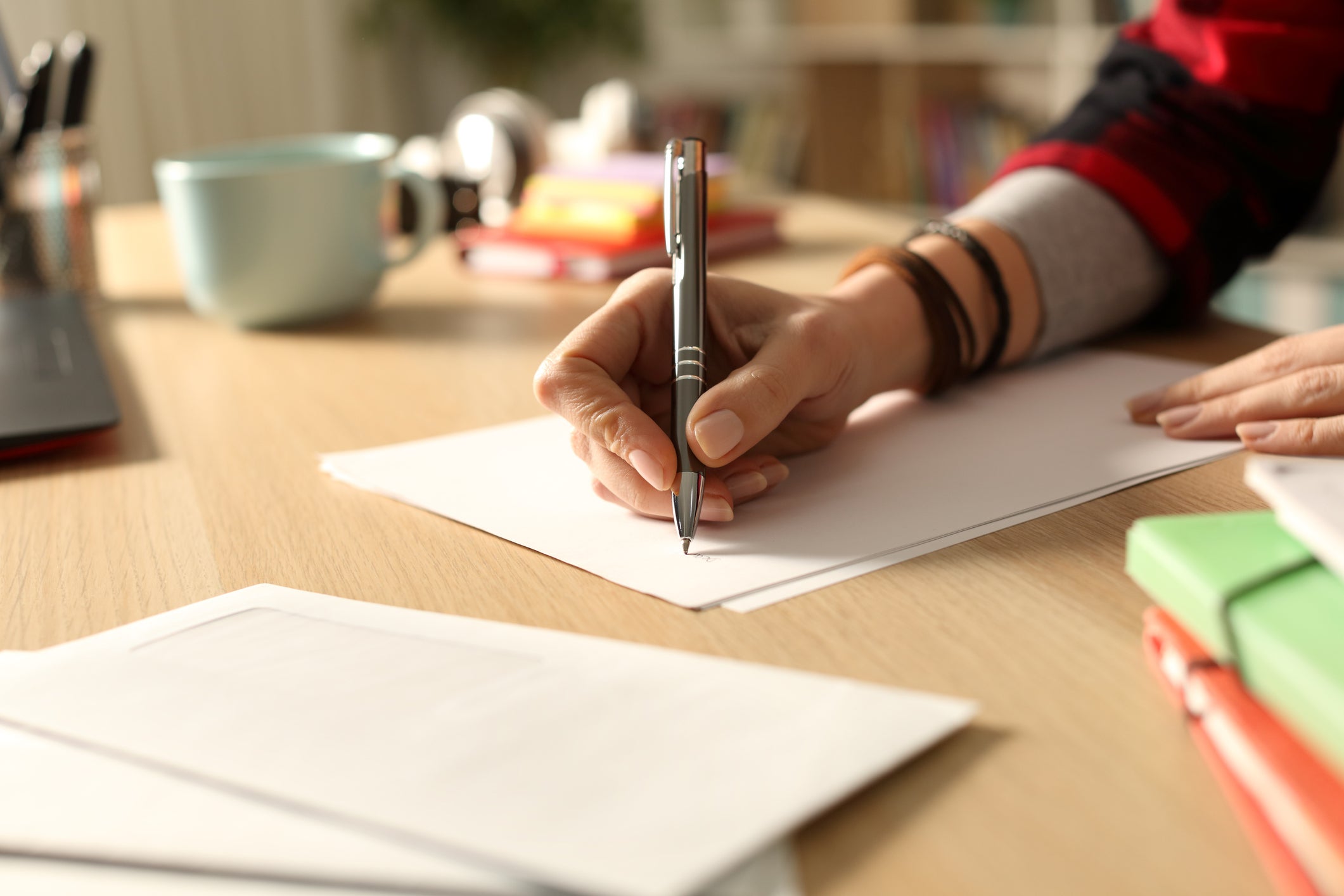
I feel a spark of childlike glee as I buy letter-writing paper, read Brandt’s chapter on apologies for inspiration, and set about inking my thoughts quick-sharp before I have time to second-guess myself. I try not to overthink it; I aim for honesty over excuses. Reading back, it’s not a perfect letter – but it is my letter.
There’s a lightness after I’ve finished. Brandt is right – as much as the letter is for my friend, the process was equally transformative for me. It’s as if I’ve finally put down a boulder I just spent the last six months needlessly yanking around after me. It makes me start thinking about other people I could write to: people I’ve lost touch with, acquaintances whose acts of kindness deserved a thank you, loved ones to whom I rarely explicitly express that love.
But before all of them, it’s only right that my second letter is to the letter midwife herself: a quick thank you, for quite possibly changing my life for the better.
‘Unfinished Business: How to Write the Five Essential Letters of Your Life’ by Frish Brandt is published by Particular Books on 27 October 2026 at £20.


