

The story of the falling apple is perhaps the most famous account of how Isaac Newton’s curiosity led to a scientific discovery that would go on to shape our understanding of the world and influence everyday life for centuries. From the telephone invented by Alexander Graham Bell to penicillin discovered by Alexander Fleming, science has always evolved because someone, somewhere got curious about a phenomenon they noticed. One such curiosity led 15-year-old Rodion Zaichikov to build an arc-jet wind tunnel to test a scramjet. In September 2026, Rodion Zaichikov, a student at the International School Luxembourg, won the Ellison Scholars Prize at the 37th European Union Contest for Young Scientists (EUCYS) in Kiel, Germany.His award-winning project is titled ‘Expanding low-cost hypersonic wind tunnel with arc jet capabilities’. The project explores how to recreate extreme flight conditions to test a scramjet using intricate equipment that he constructed himself. His attempt at recreating this technology by himself also led to the questions around accessibility of such complex technologies. Rodion Zaichikov’s story is one that reflects what happens when a teenager decides to move beyond the usual school science projects to pursue ideas that seem impossible.
The YouTube spark
Zaichikov’s interest took shape after he watched a video of an arc jet in operation. Rather than simply admiring the technology, he wondered whether he could build one himself.An arc jet uses electrical energy to heat a gas to extremely high temperatures, helping researchers simulate some of the extreme conditions encountered during high-speed flight. Zaichikov combined this technology with a specially shaped nozzle which allowed him to create a test device designed to test hypersonic airflow and a model of a scramjet engine.The idea is significant because equipment capable of reproducing such conditions is generally expensive and relatively rare. As the project’s description on the University of Kiel’s EUCYS website explains, the limited availability of arc-jet facilities can make it difficult for smaller research groups and start-ups to investigate hypersonic technology. Zaichikov’s ambition was to explore a more affordable alternative.
What exactly is a scramjet, anyway?
A scramjet, short for supersonic combustion ramjet, is an air-breathing engine designed to operate at extremely high speeds. Unlike conventional jet engines, it relies on the vehicle’s forward motion to compress incoming air, rather than using a compressor driven by rotating machinery. Crucially, the air continues moving at supersonic speeds through the engine’s combustion chamber.
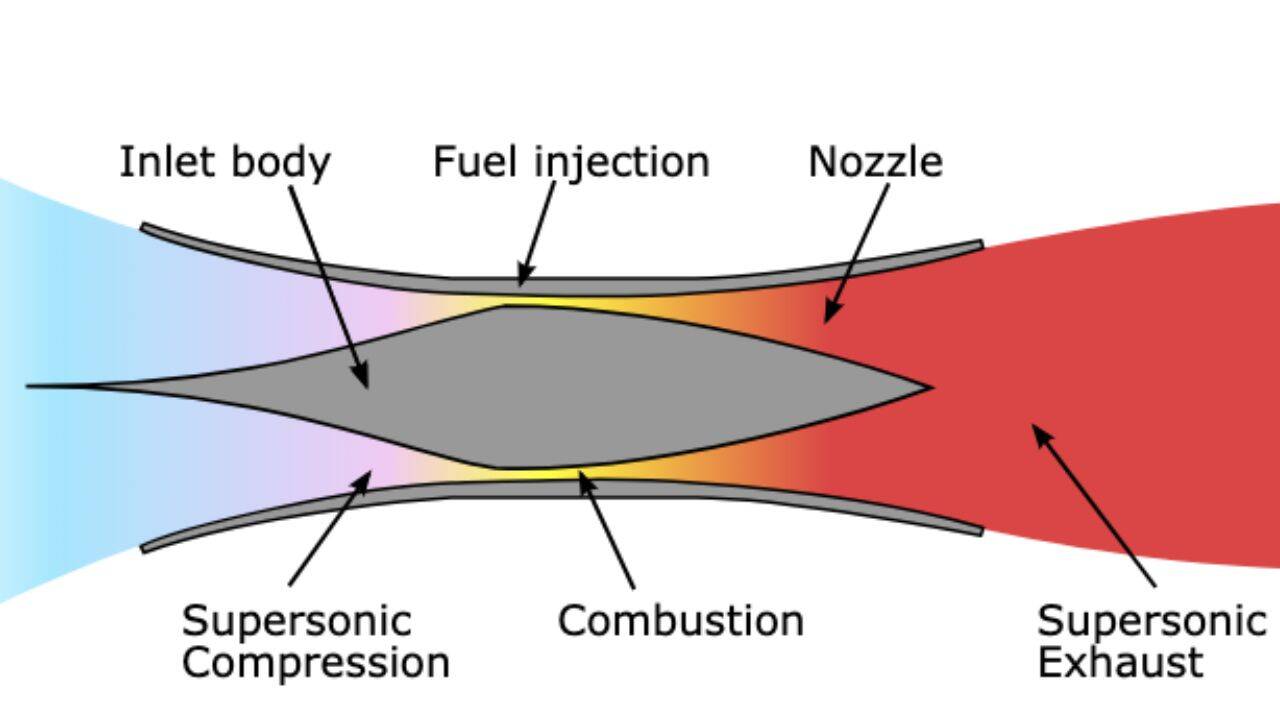
Scramjet (Image Credit: Wikimedia Commons)
Why does that matter? At hypersonic speeds, generally defined as Mach 5 and above, the air surrounding a vehicle behaves very differently from the air encountered during an ordinary flight. Shock waves, intense heating and complex airflow patterns make designing and testing aerospace vehicles a challenging task. Thus, the wind tunnels and arc jets allow researchers to investigate how engines and materials behave under conditions that would be difficult, dangerous or impractical to reproduce in ordinary flight tests.Zaichikov’s device combines a specially designed convergent-divergent nozzle with an arc jet to investigate these extreme conditions. His apparatus enabled him to test a scramjet engine model at temperatures exceeding 3,000°C.
The challenge wasn’t just the heat
For Zaichikov, one of the biggest headaches was the vacuum chamber. The design flaw was that it kept leaking, forcing him to search for 3D-printable material capable of maintaining an airtight seal.He also built his own Schlieren imaging system, a technique used to make changes in air density visible. Because air is normally transparent, observing the shock waves and density variations associated with high-speed airflow is not as simple as pointing a camera at the experiment. Schlieren imaging makes these otherwise invisible changes observable.Together, the apparatus and imaging system allowed him to investigate airflow around his engine model
A prize, and years of curiosity behind it
Zaichikov’s success did not materialise overnight. The Fondation Jeunes Scientifiques Luxembourg (FJSL), which supports young researchers, first encountered him when he was 11. Since then, he has participated in its programmes and represented Luxembourg at international science events.His list of experiences is quite extensive for a fifteen year old. Rodion visited the Eurospace Center in 2022 and attended the Mobisciences programme in Morocco in 2023. In 2024, he also received the best international project at the Mostra Nacional de Ciência which is a national science exhibition in Portugal. Then in 2025, he received an engineering award at the Taiwan International Science Fair. The recent EUCYS prize in 2026 marked just another milestone in his growing scientific journey that is only beginning.The European Union Contest for Young Scientists (EUCYS) brings together talented young researchers to present projects spanning different scientific and engineering disciplines. The 2026 edition took place in Kiel from September 22 to 27, with participants representing countries across Europe and beyond. The Ellison Scholars Prize recognises promising young scientific talent and is sponsored by the Ellison Institute of Technology, which works on technological solutions to major global challenges.For Zaichikov, however, the prize is not the end of the experiment. He has expressed an interest in continuing to develop his ideas, with a long-term ambition of creating a fully controllable vehicle capable of returning to Earth. That is a substantial goal, even for an experienced aerospace engineer. For a 15-year-old, it offers a glimpse of just how far his curiosity might take him.


