
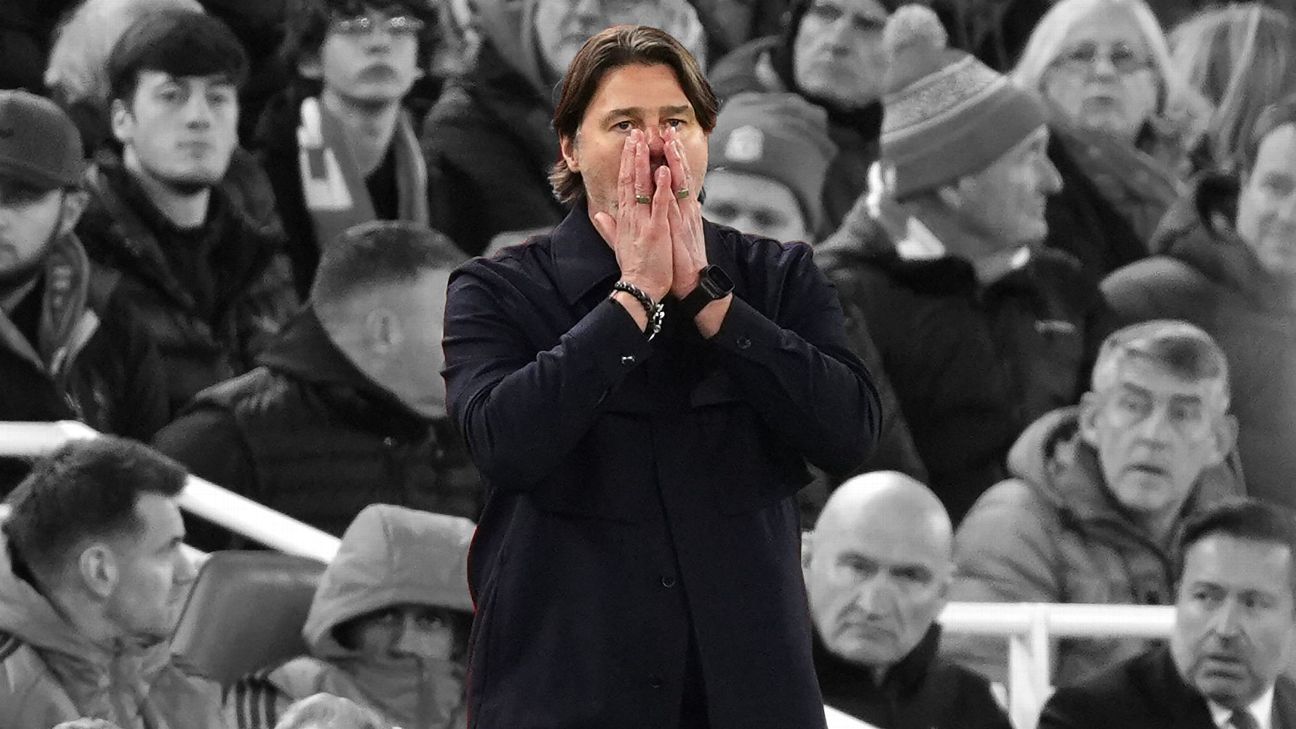
There was certainly a logic to Manchester United’s decision to hire former USMNT boss Mauricio Pochettino; the crisis got so deep that any option beyond a “safe pair of hands” gradually slipped out of the equation. Indeed, with the club second from bottom in the Premier League and facing the real threat of relegation, an experienced manager capable of restoring order and credibility was the only sensible appointment.
Of course, Sunday’s 4-0 defeat at Liverpool, following an early red card for young defender Leny Yoro, was a miserable start to Pochettino’s tenure, but we learned practically nothing about what lies ahead for United under his leadership from that game.
What we did learn from his appointment, however, was that the club have decided once again to place themselves in the hands of a strong figurehead. There are echoes of Louis van Gaal and José Mourinho — though not in tactical terms — and the hiring does suggest that United expect Pochettino’s authoritative personality to bring the club back on track, almost single-handedly.
For the decision-makers at Old Trafford it was the best option, as there is extraordinary pressure when a club of United’s size hits a crisis. It’s easy to suggest that United should simply copy the modus operandi of the southern “B-clubs” — Brighton & Hove Albion, Brentford and AFC Bournemouth — and, with their vastly greater resources, easily find their way back to the top of the Premier League. But that ignores what a buildup of pressure can do to decision making.
At United, every poor run becomes a judgement on the entire project; poor results breed impatience, which subsequently encourages short-term decisions that undermine any long-term strategy. But after more than a decade of attempts at restructuring — some more half-hearted than others — the storied club find themselves in a familiar place, despite spending €2.86 billion on new players since the Glazers’ takeover in 2005, and fans are getting tired of the cycle repeating itself.
So how did we get here? Who is really to blame for this situation? And will Pochettino buck the trend?
Trying, and failing, to replace Sir Alex Ferguson
United’s problems can, at least in part, be traced back to how they handled the retirement of the Premier League’s most successful manager in 2013. Ferguson’s authority stretched a lot wider than his job description as “manager” entailed; he had spent 26 years shaping the club as he wanted and working closely with chief executive David Gill, including through the Glazers’ takeover.
While his successor, David Moyes, inherited the same powers, the former Everton boss lacked the experience, influence and relationships that made Ferguson’s system work. Yet, In October 2013, Ed Woodward — who replaced Gill — told the United We Stand fanzine: “We don’t have a director of football because we back the manager.” He then added: “He [Moyes] has the same power that Alex did.”
In other words, Woodward oversaw soccer decisions without an independent sporting director to ensure continuity. That was despite competing Premier League clubs starting to implement the continental approach of splitting the manager’s responsibilities with a sporting director (or director of football/technical director).
The lack of a specialist sporting director also became evident in the varying styles of the post-Sir Alex appointments. Moyes favored a pragmatic, relatively direct approach for his 10-month spell; Van Gaal introduced a more methodical, possession-based game in 2014-16; while Mourinho then returned to a reactive, transition-oriented style in 2016-18.
As a result of repeated changes in those six years, the makeup of the United squad became out of tune with the changing demands of the successive managers. High-profile signings on lengthy contracts and salaries that few prospective suitors could match proved difficult to accommodate and harder to offload. Alexis Sánchez, recruited for free (but on huge wages) from Arsenal under Mourinho and subsequently loaned to Inter Milan under Ole Gunnar Solskjær before being released inside two years, is one example of a rather expensive mistake.
Solskjær — who took over from Mourinho — initially made the best out of his inherited squad and took United to third place in 2020, then second the following year, with a flexible, transition-oriented approach that made good use of width and pace. Though when attempting to develop a more dominant game model, he ran into the same problems as his predecessors as the personnel didn’t quite fit the expansive style. He was sacked in November 2021.
Open-heart surgery that never took place, and a pivot to ideological managers
When Ralf Rangnick took over from Solskjær on an interim basis in December 2021, he brought a different perspective on how clubs should be run. Having worked at German side Hoffenheim and within the Red Bull group, he believed the club, not its manager, should determine the overall footballing direction.
On departing his curious six-month cameo, his subsequent call for an “open-heart surgery” pointed toward the club lacking the recruitment/footballing blueprint capable of surviving changes in the dugout. John Murtough had already been appointed football director in March 2021, with Solskjær’s backing, but the irony was that Murtough reportedly recommended Rangnick’s appointment, only for the German coach to diagnose the shortcomings that should arguably have fallen within the director’s remit.
United appeared to change course with the appointment of Ajax coach Ten Hag in April 2022. His reputation was predominantly constructed on the sophisticated, possession-based soccer he had developed in the Netherlands. For the first time, United turned to a head coach who exclusively sold a clear tactical identity without any pretentions of being a “figurehead” — an instructor type, rather than a leader.
Ultimately, Ten Hag fell into much the same trap as some of his predecessors. Having initially tried to implement his preferred game model and being heavily backed in transfer windows, he concluded that the players at his disposal were not suited to the Ajax-style of attacking that had won him the job in the first place.
Ten Hag was sacked and replaced in November 2024 by another “project manager” in Sporting CP‘s Ruben Amorim. But the Portuguese’s insistence on his 3-4-2-1 formation proved another mismatch; the United squad lacked natural wingbacks, while the established wide attackers faced unfamiliar or nonexistent roles in his system. He lasted just under 14 months, with United finishing 15th in 2024-25.
It can be argued that Ten Hag and Amorim arrived with the right profile and ideas, but they failed to cope with the pressure that the old-school managers like Van Gaal and Mourinho took in their strides. Perhaps the outcome would have been different with support of a sporting director who had the authority and experience to set out a club-led blueprint?
New hierarchy, same old contradictions, and a missed opportunity
In February 2024, the arrival of Sir Jim Ratcliffe’s Ineos as minority owners (later placed in charge of soccer matters) offered an opportunity for Man United to break that pattern. The club recruited Omar Berrada as CEO, Jason Wilcox as technical director, and paid Newcastle United substantial compensation to bring in sporting director Dan Ashworth. The idea was to create a hierarchy and direction independent of whoever happened to be head coach.
Those appointments — instigated by Ineos — were met with initial enthusiasm by the media and supporters. Yet some decisions were met with skepticism. One of those was United’s decision to hand Ten Hag a new two-year contract after their FA Cup final victory over Manchester City in 2024 (before either Ashworth or Berrada had formally started) and, just a few months after putting pen to paper, he was replaced by Amorim.
Berrada took a leading role in that decision and Ashworth, in turn, departed in December (after just five months) amid speculation that he had vocalized reservations about the Amorim appointment. His reasons for leaving remain unclear to this day, but it raises questions over how much influence the sporting director had over his department.
United then chose not to appoint a direct replacement for Ashworth, but promoted Wilcox to director of football instead. Having paid Newcastle considerable compensation to secure Ashworth’s services, why had the club suddenly decided that his much sought-after expertise wasn’t that valuable after all?

When Amorim was sacked, Michael Carrick, who was appointed as interim in January 2026, looked to follow the Solskjær recipe by restoring a 4-2-3-1 formation and making better use of the team’s pace and attacking transitions. United shot up the table and somehow finished third with 12 wins from his 17 games in charge.
That form earned him the permanent job in May, but Carrick then fell into the same trap as Solskjær as his attempt to develop a more dominant possession game once again exposed doubts about the squad’s balance. By November, he was gone; replaced by Pochettino.
Replacing Carrick was the right decision given United’s league position and descent into a relegation battle — Berrada rightly described changing the coach as one of the few midseason measures capable of providing an immediate reaction. But, crucially, the crisis that grew worse by the week might have pushed a more fundamental choice aside.
Rather than appointing a coach to serve a defined long-term playing style and setting an independent sporting structure, United opted for someone who can make a difference in the short term. Understandable, certainly, but the structural debate around the club is bound to resurface yet again if results don’t improve. It’s just a matter of time.
2:15
Burley labels Pochettino has the biggest manager since Mourinho for Man United
Pochettino is a manager for the immediate crisis
On the positive side, Pochettino has something that Ten Hag and Amorim never managed to offer at Old Trafford: the assertiveness of an experienced communicator and the aura of a traditional “strong” manager (though his official title is that of “head coach.”)
Though this interpretation of the role is somewhat dated, it still matters — if only unconsciously — in the minds of the media and supporters. And having managed Tottenham Hotspur, Paris Saint-Germain, Chelsea and the United States, the Argentine does know how to handle the scrutiny and pressure that comes with a massive job, while he also has a proven track record of challenging players and executives alike. All those factors will be needed at Old Trafford right now.
Indeed, Berrada cited Pochettino’s maturity and experience as reasons for the appointment. Pochettino’s ability to deal with pressure could be invaluable, though it will also allow for the executive leadership to take cover behind a manager with the authority to speak for the entire operation.
Stylistically, the Pochettino of 2026 also fits the bill. From the Marcelo Bielsa-inspired soccer — intense, aggressive and vertical, with coordinated pressing and relentless running — that made his name at Southampton and Tottenham, he has since become more of a pragmatist. He changes formation, the use of a mid-block is more frequent than the constant high chasing, and he adapts more to the opposition.
This version of Pochettino is well suited to addressing United’s immediate concerns. Rather than implementing style and form throughout the club, points on the board are the priority — especially since the current squad arguably lacks the physical capacity to carry out his previous trademark, high-energy soccer. For that to work he needs a full preseason to develop the physical basis; and with matches coming at a relentless pace, neither is there much time for detailed, tactical work on the training ground.
More than anything, Pochettino’s first six months at the club will be about absorbing the pressure and learning by doing. But the club’s hierarchy have to learn some lessons from the past failures if the appointment is to work, and greater public involvement from its senior executives would help distribute accountability more fairly.
1:18
Onuoha: Man United’s two-year deal for Pochettino makes sense
Do United’s problems run deeper than the manager?
Pochettino has a history of enjoying a strong influence over the recruitment choices at his clubs. At Chelsea, differences over strategy and his limited say on signings reportedly contributed to his departure. And though he is officially United’s “head coach,” he has already mentioned his desire to be involved in all major decisions affecting the squad.
Though Pochettino and Wilcox may very well work successfully together — and a head coach should have a substantial say in the transfer priorities — the danger is that Pochettino’s stature becomes a replacement for the independent club-building authority United sought in Ashworth.
Another issue is whether United can prevent short-term transfer priorities from overriding the club’s long-term interests — though with relegation a distinct possibility this season, a short-term approach may be needed in January at least to get them back on track.
Pochettino’s contract runs until summer 2029. By then, he might well have lifted the club out of its current predicament and brought stability to the dressing room, or he could have left as so many of his predecessors did. But the more interesting question is where United stand as an organization by the end of his tenure.
The real measure of their success will be whether the club is strong enough in its own right and less “manager-dependent;” whether players are signed with a long-term philosophy at play, instead of spending a lot to plug gaps as they appear.
This requires a consistent approach to recruitment, with the club’s long-term interests and pre-defined playing style taking precedence over the immediate preferences of whoever happens to be in charge. After more than a decade of changes, United now need to demonstrate that the direction of the club no longer depends solely on which head coach is in the dugout.


