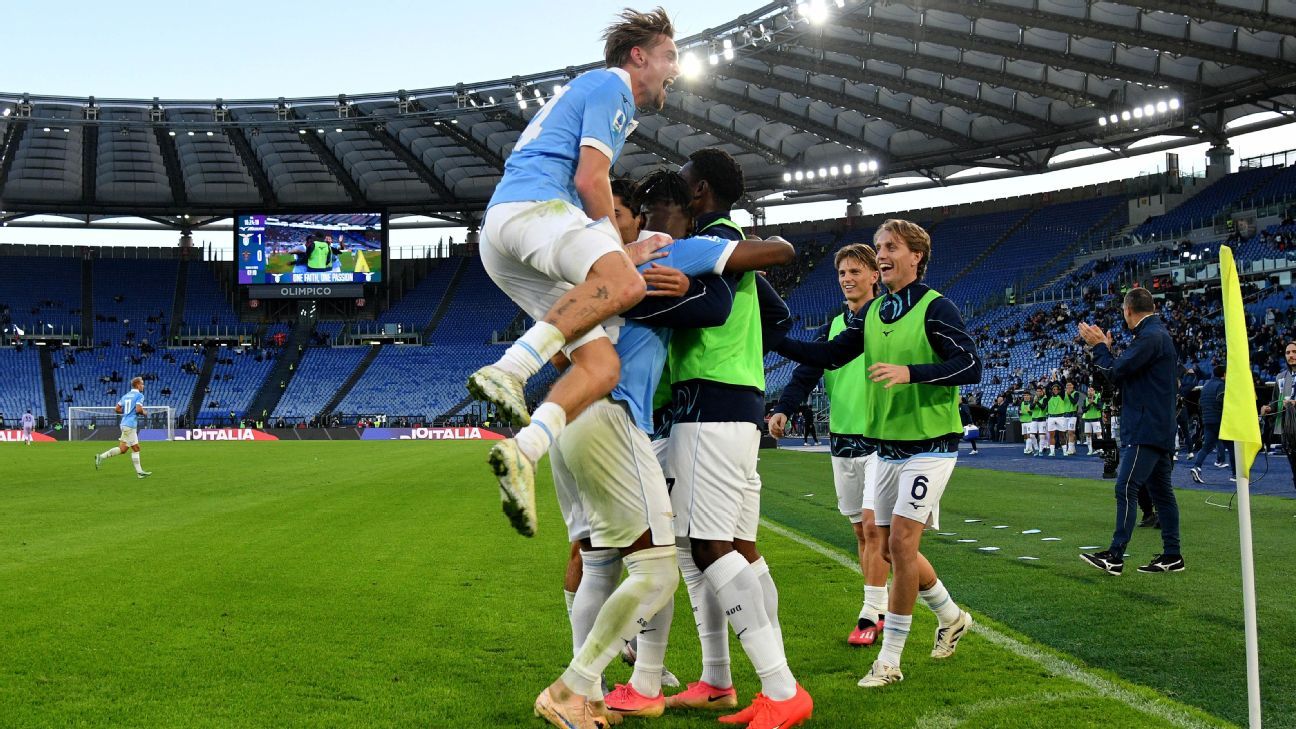
We’re approaching the end of November and Lazio are top of Serie A, with 32 points in 12 games. The last time it happened was more than 25 years ago and back then, soccer — and Lazio — were entirely different animals.
The Lazio team that would win the league in 1999-2000 was an expensively assembled super club — so expensive assembled, in fact, that they’d go bankrupt a few seasons later. They boasted Siniša Mihajlović and Alessandro Nesta at the back, Juan Sebastián Verón, Diego Simeone and future Ballon d’Or winner Pavel Nedvěd in midfield, Marcelo Salas, Alen Bokšić and Simone Inzaghi up front. Coaching them was the late Sven-Göran Eriksson, who a year later would leverage the gig into the England job, becoming the Three Lions’ first-ever foreign manager.
The Lazio team doing it in 2026-27 are built on a shoestring, a function of an unpopular owner perennially accused of underinvestment. Still, they’re a colorful — if unremarkable — bunch.
Their standout goalkeeper, Christos Mandas, is in his first full season at a starter, having played just 90 minutes of cup football last year. Right back Romano Floriani has a famous great-grandfather (Benito Mussolini), and an even more famous great-aunt (Sophia Loren). Their big summer signing, former Inter Milan super-sub Davide Frattesi (he made just 18 league starts in three seasons), has an influencer sister who dated Weston McKennie. Their playmaker, Reda Belahyane, started just six games in 18 months at the club before this year and was widely considered a bust until now. Their center back, Oliver Provstgaard, did win the Champions League in 2021 … albeit the eSports Champions League.
And then there’s the manager, Gennaro Gattuso, last seen in charge of Italy‘s national team in April where he lost a do-or-die playoff to Bosnia-Herzegovina and denied the Azzurri a shot at the World Cup, a tournament nobody — other than Brazil — has won more times. Lazio is Gattuso’s 11th job. None of his previous ones lasted more than two seasons and his average tenure has been 41 weeks.
All this — and Lazio’s recent history of unremarkably finishing seventh, seventh and ninth — would make their top spot an underdog story. But the remarkable part is that they’re doing it with almost no home support after a fan boycott that began last January.
Lazio’s fans feud with the owner
Lazio’s average attendance through their first five home games has been around 10,000 spectators per game, a bleak number in the 70,000-seat cavern that is Rome’s Stadio Olimpico. When you then consider that even that number is inflated by visiting supporters who often outnumber Lazio fans — as happened for the visit of AC Milan in September, when the crowd was 21,000-strong — you get a sense of how surreal the notion of “home support” is for these players.
For context, Lazio averaged around 44,000 a game in the two full seasons before the boycott, but season ticket sales cratered from 29,918 in 2025-26 to less than 3,000 this year.
The boycott began as the culmination of a long-running dispute between Claudio Lotito (who has owned the club since 2004) and the club’s hardcore supporters known as ultras, though fans of all stripes quickly joined in. Their main gripe is a perceived lack of respect toward the fan base, a lack of ambition and a general sense of drift at the club. They demand that Lotito put Lazio up for sale, something he is refusing to do.
Lazio supporters say it’s painful not being there to cheer on their side at home games, but describe it as “an act of love,” and they try to make up for it in other ways. Ahead of each match at the Stadio Olimpico, they gather outside to greet the team bus and the players with flares, songs and banners, pep-rally style, before going off to watch the game, often communally. Away matches are all sold out, and often they’ve managed to secure additional tickets from the opposing club.
Caught in the middle between the fans and the club are the players and Gattuso. In keeping with his straight-talking image, Gattuso isn’t mincing words, while also threading the needle (a balancing act he manages better than most).
“We miss the fans, playing in a stadium that’s 20% full sucks: it’s like COVID all over again,” he said. “For me, football without fans isn’t football, it’s another sport, you might as well go and take your dog for a walk.
“The fans are suffering too; it’s killing them inside not coming to see us. But I have to respect their decision, because they’re showing integrity. And I thank them for the tremendous support they are showing us in other ways.”
For his part, Lotito says he won’t be blackmailed into selling the club, nor will he give away tickets for free or at knockdown prices to artificially fill the stands. He merely says: “We’re top of the table. If you love Lazio, you should be in the stadium instead of leaving the players to fend for themselves.”
The boycott will be suspended for the derby against Roma next month — staying home for that one would be a step too far — but beyond that it’s going to be business as usual, and the fans seem undeterred. Not to mention that, whatever they’re doing seems to be working both in terms of results and reawakening the fanbase.
Will Lazio still be top come the end of the season? Probably not. The schedule has been relatively kind to them thus far, and their underlying metrics suggest regression to the mean. They’re greatly outperforming xG, both in goals scored (25 on 17.3 xG) and conceded (9 against an xGC of 13.6), and top-to-bottom, this doesn’t seem a particularly talented side. Some have compared them to the Leicester City side that won the Premier League in 2015-16, but while Fratessi, Mattia Zaccagni and Kenneth Taylor are fine players, Belahayne and Provstgaard have been revelations and Mandas is having a monster season, there’s no obvious Jamie Vardy, N’Golo Kanté or Riyad Mahrez here.

Will the boycott work and get Lotito to sell the club? This one’s more complex and perhaps of interest to fans of Manchester United, Valencia and any club with an unpopular owner.
The reality is that Lotito is a particularly unpleasant and stubborn nut to crack. He’s had credible death threats over the years, which is why he travels with armed bodyguards, yet seems entirely unfazed.
The boycott is undoubtedly hurting the club financially, but this is a guy who took over Lazio when they were bankrupt — “I resuscitated Lazio … now we’re in a coma and on life support, hopefully I’ll be able to reverse that” is one of his memorable quotes from 20 years ago — and appears unafraid of financial hardship. If revenues go down, he simply cuts costs. Nor does he care about negative publicity, and goodness knows, he and Lazio have had plenty of that over the years.
On the other hand, the length and size of the boycott has no doubt surprised even Lotito, and the fact that they’re having success on the pitch has only heightened the attention. Imagine the negative publicity of a Lazio side still under boycott in the Champions League next season.
Lotito may or may not cave, but there’s no question this expression of fan power — some might say “customer power” — combined with success on the pitch is rewiring what we thought we knew about supporter boycotts and what they can achieve.