
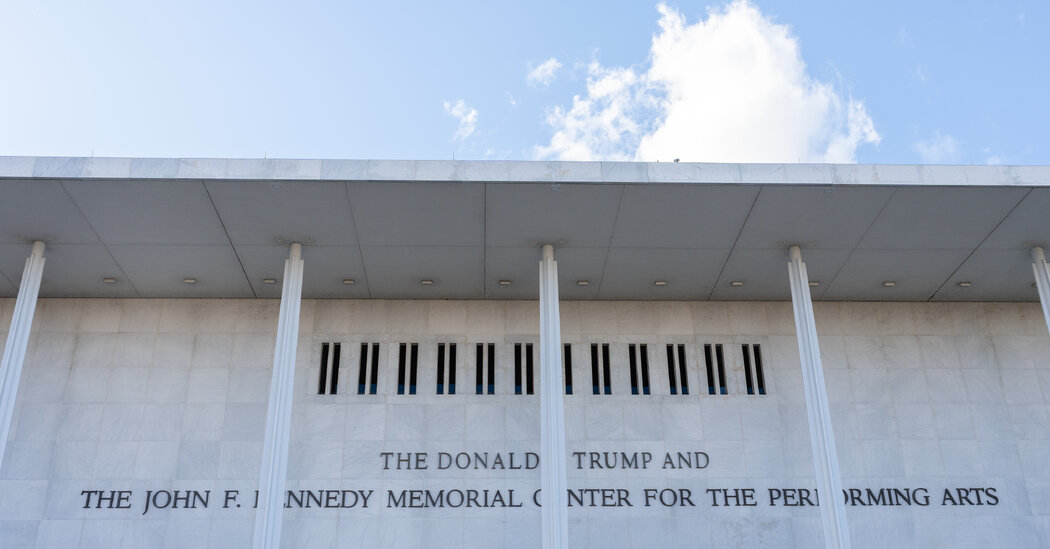
A federal judge in Washington ordered on Friday that the John F. Kennedy Center for the Performing Arts remove President Trump’s name from the building’s facade and all official branding, finding that the board’s decision to add it was unlawful.
Judge Christopher R. Cooper of the Federal District Court in Washington wrote in a 94-page opinion that a law passed by Congress in 1964 made “crystal clear” that the institution was to be named for President Kennedy.
“Congress gave the Kennedy Center its name, and only Congress can change it,” the judge wrote. He ordered that the 18 letters added to the center’s front portico be removed within two weeks.
The judge also temporarily blocked the institution from shuttering this summer for renovations, months after the president announced a two-year closure.
Mr. Trump, who has been chairman of the center’s board for more than a year, railed against the decision in a social media post. He suggested that the order may prompt him to rethink his role at the Kennedy Center, writing that he has “no interest in continuing what could only be a hopeless journey.”
“Unfortunately, Judge Cooper and the Radical Left would rather see it DIE than have President Trump transform it into something that everyone could be proud of, much as I have done, in many cases, throughout my life,” he wrote.
Roma Daravi, a spokeswoman for the center, said that it would appeal the ruling on the name change, signing her statement as the “Trump Kennedy Center Vice President of Public Relations.”
“We are confident that on appeal the court will uphold the board’s will to recognize President Trump’s historic contributions to our nation’s cultural center,” she said.
The center’s board of trustees, a vast majority of whom are allies to Mr. Trump, voted in December to add the president’s name to the performing arts center. Less than a day later, new lettering was added to the building’s marble facade, which now reads: “The Donald J. Trump and the John F. Kennedy Memorial Center for the Performing Arts.”
Judge Cooper found that the board had been “derelict” in considering the possible consequences to programming when shuttering the center, as well as its legal responsibility to maintain the center as a memorial to the slain president. His order did not make any specific directives for reinstating programming as the board reassesses its renovation plans.
The judge’s order came in response to a lawsuit by Representative Joyce Beatty, Democrat of Ohio, who is an ex officio member of the Kennedy Center’s board. She objected to both the renaming and the plans to close the institution, which her lawyers argued was in fact a decision “designed to hide their embarrassment about declining ticket sales.”
In a statement celebrating the ruling, Ms. Beatty said that “the Kennedy Center is an institution that belongs to the American people, not to Donald Trump.”
In a parallel ruling in a separate lawsuit on Friday, Judge Cooper, who was appointed by President Barack Obama, stopped short of blocking the center from beginning renovations after preservationist groups said they had been undertaken without the required permits.
While that coalition of groups had argued that the administration appeared intent on remaking the center in Mr. Trump’s image, and potentially demolishing the structure entirely, Judge Cooper found that possibility too remote for now. But he warned that he would re-evaluate if the facts on the ground changed, saying there were a “paucity of concrete details as to the project’s scope.”
“If the work is, say, more transformative than present testimony suggests or requires permits that the center has yet to acknowledge or secure, the court’s legal analysis might look substantially different,” the judge wrote.
After shunning the Kennedy Center in his first term, Mr. Trump has staged a wholesale takeover of the institution in his second. He stocked the center’s board with loyalists who installed him as chairman, ushering in a period of upheaval as many artists boycotted an increasingly politicized institution.
Mr. Trump announced in February that the center would be closing this summer, calling the building “dilapidated” and in desperate need of renovations. Kennedy Center officials have asserted that it would have been irresponsible to keep the building open while addressing its maintenance needs, which they say includes widespread water damage and corrosion, outdated stage equipment and necessary security updates.
The Kennedy Center’s executive director, Matt Floca, defended the decision to shutter the building during testimony in court in the case brought by the preservation groups. Mr. Floca, a facilities professional whom Mr. Trump promoted in March, testified that there were “very clear efficiencies” — including financial — to not have to complete major renovations while working around “thousands of patrons moving throughout the campus.”
But he acknowledged that there had been no studies comparing the cost of construction to a closed building with the cost to one that remained open.
“There is no need to,” Mr. Floca testified.
The board approved the plan in March, but the judge found that it had not done its due diligence in assessing the practical and legal questions surrounding such a major decision. He noted that although Mr. Trump had said in a social media post that there had been a one-year review of the issue involving contractors and “musical experts,” there was no evidence that such a review had taken place.
“None of the board members had sufficient information in advance of the March 16 meeting to make a well-considered decision to close the center,” the judge wrote.
Judge Cooper noted that his decision did not prevent the center’s board from deciding to close the institution for renovations in the future, but he urged it to prepare itself with “sufficient information to make a considered, independent decision, taking account of its obligation to both maintain and operate a premiere arts venue and its solemn duty to memorialize a fallen president.”
The judge ordered the sides to file an update by June 5, proposing next steps for how to proceed.
In anticipation of the Kennedy Center’s closure, its performance calendar has largely been stripped bare. Several Broadway productions that were set for runs at the center were forced to cancel. The National Symphony Orchestra, which is attached to the center, has had to search for other local venues for their performances. Officials also began laying off staff members, saying that only a bare-bones work force would be retained during the closure.
In her statement, Ms. Daravi indicated that the center would push forward with what she described as an “urgent and significant restoration.”
“With $257 million secured by President Trump and approved by Congress,” she said, “the resources are in place and we remain committed to pursuing every lawful avenue to ensure the Trump Kennedy Center is restored as a national cultural landmark for all Americans to enjoy.”

