
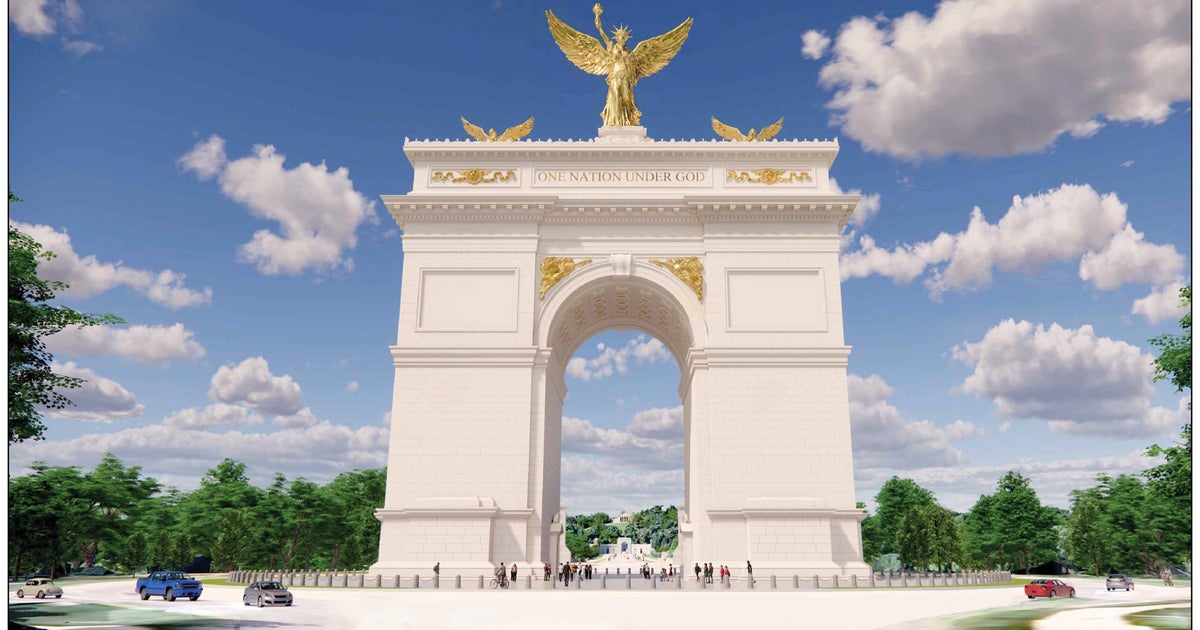
Washington — The Justice Department and a group of Vietnam War veterans are set to face off in a Washington, D.C., courtroom on Friday over the fate of President Trump’s proposed 250-foot arch that he wants to build between Arlington National Cemetery and the Lincoln Memorial.
U.S. District Judge Tanya Chutkan will hear arguments over a preliminary injunction that would stop the arch’s construction. Attorneys representing three Vietnam veterans and a historian who sued earlier this year to stop construction argue that the project has been rushed and lacks proper congressional approval.
According to court filings by the Justice Department from earlier this month, construction on the arch could begin as soon as Nov. 5 if the National Capital Planning Commission issues final approval of the plan the same day.
The plaintiffs pointed to that looming timeline in court papers ahead of Friday’s hearing, saying “public interest leans heavily against allowing Defendants to blaze ahead.” They asked Chutkan to block the project quickly before the Trump administration takes steps to begin construction “in the hope that they can render the arch a fait accompli before this Court has made a final determination.”
The group challenging the project also argued that recent renderings show it would disrupt the symbolic connection between the Lincoln Memorial and the Robert E. Lee Memorial, a carefully considered sightline meant to convey unity after the Civil War.
Shaun Byrnes, one of the plaintiffs in the case, told CBS News in an interview earlier this year that his opposition to the arch was “more about the duty I feel towards my colleagues and friends who did not come home to stand up against this project, regardless of who’s in charge.”
“I think it’s just disrespectful to those that I served with who didn’t come back, and then, of course, to all those who are lying in Arlington National Cemetery,” Byrnes said.
Mr. Trump said in a post on Truth Social in September that he converted plans for the arch to make it, in part, a “top grade Military Complex,” equipped with snipers and drones.
In court filings, the Justice Department called the plaintiffs’ motions “breathless” and urged Chutkan to follow recent Supreme Court precedent in the White House ballroom case. Government attorneys said that the arch challenge should also be dismissed because the plaintiffs do not have proper legal standing to bring the suit.
The Justice Department said that the first six months of construction would include below-ground and foundation work, and not interfere with the plaintiffs claims of irreparable harm by not being able to see the Lincoln and Lee memorials in the same line of sight.
“Plaintiffs lack standing because their aesthetic and emotional displeasure at the perceived symbolism of the proposed arch does not establish a concrete and particularized injury under the Supreme Court’s controlling decision [in the White House ballroom case],” the Justice Department argued.
The Trump administration also submitted two sworn declarations from top Cabinet officials, Secretary of Homeland Security Markwayne Mullin and Secretary of Defense Pete Hegseth, stating that the arch would allow for the military and Secret Service to use the structure to defend the nation’s capital against unmanned drone attacks and other potential threats.
In his declaration, Hegseth said that the proposed arch “is a generational national defense opportunity” to stop future threats.
Critics of the project have raised concerns that it could interfere with flights in and out of Ronald Reagan International Airport. Arlington County, adjacent to where the arch would be located on a currently empty traffic circle, sued in federal court in Virginia to block the project.
The Federal Aviation Administration determined that the arch would not pose a hazard to flights coming into and departing from the nearby airport despite those concerns, but the county argued that the arch would necessitate changes to the flight paths of planes traveling in and out of Reagan International Airport, and asked for a federal judge there to order an environmental review of the arch.


