
John Cage’s “Apartment House 1776,” like the country whose founding it commemorates, is a work of transcendence and frustration.
When commissioned by six orchestras for the United States’ bicentennial in 1976, Cage submitted this “musicircus” that overlaps, according to the score, “Protestant, Sephardic and American Indian songs, and Negro calls and hollars [sic],” with fragments of American music from the 18th century.
Singers and instrumentalists were encouraged to “make his or their own program,” ensuring that no two performances of “Apartment House” were remotely alike. In the case of its premiere run at the Boston Symphony Orchestra in 1976, it was simultaneously performed with Cage’s “Renga” for 78 instruments or voices, adding to the uproar.
“The overlapping textures were fascinating to hear, but the continuing coherences of the whole were as elusive as they were probably meant to be,” the critic Richard Dyer wrote in The Boston Globe of the premiere.
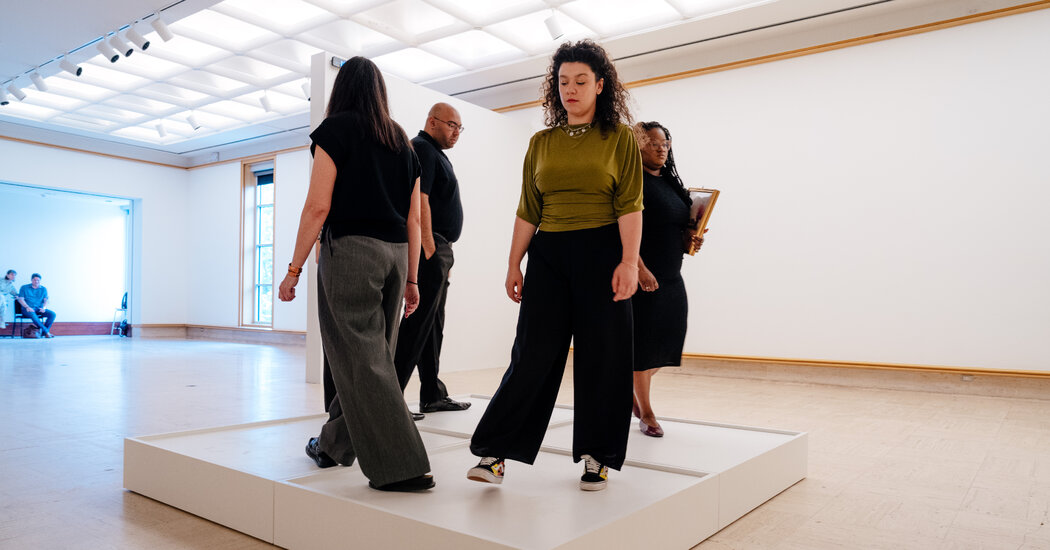
Now, for the 250th birthday of the United States, “Apartment House” is back for a new production at Detroit Opera, where it opens on Thursday. Here, audience members will be able to tease out the threads of Cage’s boisterous tapestry — if they choose. Staged in a wing of the idyllic Cranbrook Art Museum, 20 miles northwest of downtown Detroit, the show will split attendees into four groups for entry into the galleries, each corresponding to one of the work’s four singers. From there, the audiences can either stick with their assigned singer or freely roam the installation-like production.
Then, they can do it all over again. Entries are scheduled in batches of three. Those with tickets to one can automatically enter the next, meaning you could experience “Apartment House” up to three times in a single visit.
Alexander Sulen Gedeon, the director, said that this production is “about frames” rather than commands. He added, “How do we create an experience where, like Cage wants, we’re not telling you where to look?”
So much of Cage’s music is, at its essence, a dance between freedom and limitation. In “Apartment House,” the dance comes to reflect the United States. Its multitude is ecstatic — yet, amid the din, people struggle to apprehend one another’s fullness. Even in Detroit Opera’s generous re-entry concept, if you were to shadow a specific singer each time, you’d still miss one of them.
Cage’s score, Gedeon said, has pitfalls. What was progressive in 1976 — namely, Cage’s highlighting of religious and ethnic groups living in the American colonies — can, in 2026, seem naïve in its neatness. But Gedeon resolved to make Cage’s flaw a feature.
With the scenic designer Lena Sands and the dramaturg Kee-Yoon Nahm, Gedeon began by interviewing the four singers. What did 1776 mean to them today? How did they place themselves in an ethnic or religious tradition? How did Cage’s directions sit with them?
“Starting out with what strikes me as problematic,” Gedeon said, “could be a really productive place to start.”
The cast and creative team follow Cage’s stipulations while busting open their boxed-in labels. Pushing against his “Negro calls and hollers,” the soprano Brianna J. Robinson will perform music representing four centuries of Black classical composers. The tenor Travis Leon Williams, whose father is Black and mother is white, is responding to Cage’s “Protestant songs” with spirituals and protest anthems of the civil rights movement. While the French soprano Mia Mandineau, the descendant of a cantor in Prague, sings a Sephardic melody, it comes to her by way of her Greek heritage.
“I don’t think that they’re trying to resolve the conflicts and contradictions of the nation in 1776,” said Selena Kearney, a Coast Salish artist who will perform songs in Chehalis and Ichishkíin Sinwit, Native American languages spoken in the Pacific Northwest. “And I also don’t think that they’re asking me — and I assume the other vocalists — to resolve it. We’re sort of sitting in that tension.”
The production comes at a troubled time for Detroit Opera. For a while, it was the darling of the opera world, with Yuval Sharon joining as artistic director in 2020. He helmed some of the company’s boldest programming, like “Twilight: Gods” — which adapted the finale of Wagner’s “Ring” to a drive-through show in a parking garage during the pandemic lockdown — and an earlier foray into Cage with “Europeras 3 & 4” in 2024. (Gedeon assisted Sharon on both those productions.)
But Detroit Opera, whose annual budget hovers around $16.4 million, has shown signs of financial strain. Last fall, it canceled its production of Puccini’s “La Fanciulla del West” and in December, Sharon abruptly parted ways with the company, announcing he was departing two years before the end of his contract.
Sharon’s tenure technically continues through the end of this season, but he backed out of “Apartment House,” which he had been set to direct. He has since become a fixture at the Metropolitan Opera, where his new, $3.5 million production of “Tristan und Isolde” sold out an extended eight-show run and where he will next direct the “Ring.” (Sharon declined a request for an interview.)
In early stages of planning “Apartment House,” the company considered a built set with rooms for its performers, as other productions have adopted. Sharon told a Detroit-area radio program that he planned an immersive experience that presented “the sights of what an American home really looks like,” and the National Endowment for the Arts conferred $50,000 to support a production that, at the time, would include “constructed apartment-like spaces.”
“What it was going to be for him was a much larger spectacle,” Gedeon said of Sharon. “And spectacle is really his language: The form of the thing speaks for itself, in a way.”
The final form of this “Apartment House” is comparatively minimal. It does away with the room staging, which Gedeon feared would turn the cast into “objects on display.” Instead, the costumed performers flow through the galleries, their walls emblazoned with phrases from the cast’s preproduction interviews.
Although the staging is conceptual, the production has been shaped by real-world intrusions. Mandineau, the French soprano, has dreamed of moving to the United States since she was 11. She got a taste of American life as a student, then as a fellow at Detroit Opera. But her visa expires after the run of “Apartment House,” and it will be her last job in the country for the foreseeable future.
“I’m three things, and I’m always one too many: I’m a foreigner, I don’t come from a rich family, and I’m an artist,” Mandineau said. “If I was an artist and a foreigner, but if I had money of my own, I could stay. If I had no money and I was a foreigner, but I was working in finance or technology or engineering, I could stay. And if I had no money and was an artist, but I was American, I could stay.”
In her “Apartment House” arc, Mandineau packs a set of bags and loads it onto a dolly, which she wheels through the galleries. At one point, breaking the fourth wall, she stares at a timer, tracking the performance’s length, watching the seconds flash by with wide eyes. Then she sings “Adieu, notre petite table,” from Massenet’s “Manon”: “Farewell, our little table, which brought us together so often.”
Mandineau closes her eyes, palms facing outward, stealing a moment of silent prayer. Her bags are packed. The clock ticks.

