Want to bookmark your favourite articles and stories to read or reference later? Start your Independent Membership today.
Already a member?
Log in
The Bank of England (BoE) raised interest rates for the first time in more than three years on Thursday – but stopped short of confirming that future hikes were an inevitability.
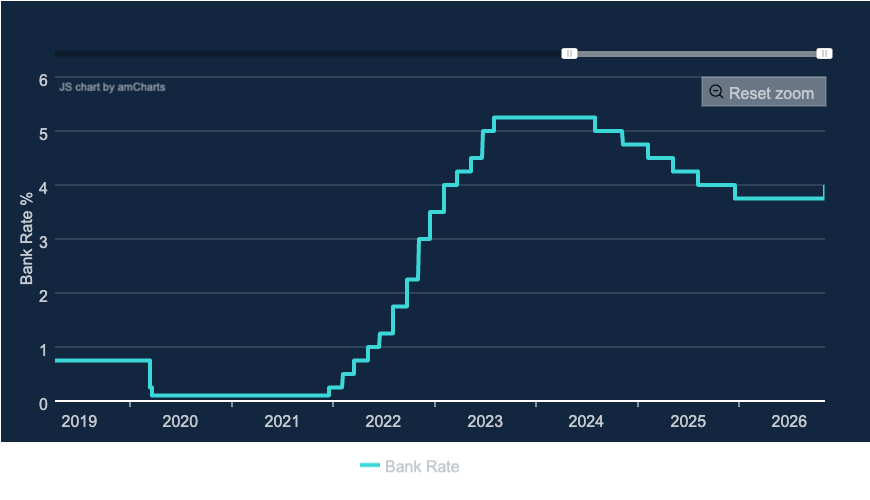
Interest rates had been locked at 3.75 per cent for almost a year, with the last cut coming just before Christmas 2025. But the return of inflation concerns due to the Iran war and spiralling oil costs have meant the need to hike back up to 4 per cent finally outweighed the earlier trajectory of further cuts to stimulate the UK economy.
A vote of 8-1 in favour of raising the Bank Rate was largely expected this time around, but money markets have been pricing in up to three further hikes across the next year or so.
However, the BoE’s Monetary Policy Committee (MPC) members signalled that may not be the case, with governor Andrew Bailey reiterating they were “not on a pre-set path” – though the one dissenting vote this time was for an immediate double bump to 4.25 per cent, not for a hold.
The prospect of a rate hike had led to the pound rallying strongly, hitting its highest level in over a decade in terms of relative strength against global currencies. That could be tested now though, following the MPC’s suggestion that further rate rises were not a guarantee.
Prior to this year, rates had been coming down from a high of 5.25 per cent. That surge in the base rate was as a result of the invasion of Ukraine by Russia, which sent energy costs spiralling and saw inflation race to more than 11 per cent in 2022.
Higher interest rates help to control rising inflation by lowering consumer and business demand, given that the cost of borrowing increases. But that can be problematic in an economy which is not already growing.
Mr Bailey noted that there remained the option on the table to hike rates further, if the situation in the Middle East failed to improve.

Invest at least £100 in Stocks or ETFs of your choice. Get fractional shares worth £50!
Terms and conditions apply.
ADVERTISEMENT
Invest at least £100 in Stocks or ETFs of your choice. Get fractional shares worth £50!
Terms and conditions apply.
ADVERTISEMENT
“The case is clear for a 25-basis point rise now,” he said. “Without news which softens the risks to inflationary pressures, I can see the argument for a further increase in rates and thereafter taking a more conditional approach, dependent on the evidence on energy prices and inflation dynamics.”
But he also pointed out that inflationary “indirect and second-round effects have not emerged yet” across the economy, while the MPC minutes also said “there remains limited evidence of knock-on effects on other prices and wages”.
Bailey’s words about the BoE having no predetermined rate course have plenty of analysts expecting that future changes may therefore be minimal.
Thomas Pugh, chief economist at RSM UK, acknowledged that a “second rate hike in February looks a good bet”, but added the expectation would be that rates “then stay on hold through the rest of next year” if energy prices didn’t surge even higher. David Rees, chief economist at Schroders, said this was “not the start of an aggressive tightening campaign”.
“Ultimately domestic inflation remains relatively well behaved, and there is still slack in the economy,” he said. “While growth and labour-market data have improved recently, we think UK interest rates will peak at 4.25 per cent – well below the path currently priced by markets.
“The risks, however, are mounting. Energy prices have continued to grind higher, meaning inflation is likely to peak later and higher than previously expected, at around 4.5 per cent next summer. The key question is whether this imported inflation shock remains contained, or will it start to feed into domestic wages and services prices. If the recent improvement in labour-market data continues, the Bank may be forced to act.”
Tom Stevenson, investment director at Fidelity International, added that the results of upcoming economic data would play a big part in the BoE’s thinking – and there’s more outside their control than inside it right now.
“The inflation, growth and unemployment forecasts suggest real concerns about stagflation, the toxic mixture of stagnant growth and persistently rising prices,” he said. “The committee concluded that growth was likely to fall back in the coming quarters.
“The bond market has already priced in several further rate hikes next year. But following America’s momentous mid-term elections, there is considerable uncertainty about the future path of inflation.”
Isabel Albarran, investment officer at TrinityBridge, said the hikes could be a “one and done” situation, but only “if energy prices fall back before February”, with Chris Jaccarini, senior economist at the Energy & Climate Intelligence Unit (ECIU), adding that the “strong positive correlation between oil price and mortgage costs changes” highlighted the need to accelerate the energy transition.
“This is why achieving net zero is so fundamental to taking back control of the cost of living, reducing our exposure to volatile global markets while tackling the climate change that threatens to push up costs even further,” he said.
Not everyone agrees, of course.
“Most forecasters see December as a pause. I think they’re underestimating how uncomfortable the Bank is with where inflation is heading,” said Nigel Green, chief executive of wealth managers deVere. “Today’s move looks to me like the start of something, and I believe a second rise in December is more likely than many expect.”
Think tank the New Economics Foundation (NEF), meanwhile, suggested the BoE’s decision “risks damaging the economy while doing little to fight the inflation we face” and called the vote an “act of economic self-harm”.
For mortgage holders, Thursday’s interest rate increase was already largely baked into the price of deals on the market, with five-year fixes averaging at around 6 per cent for the last month. However, the tone of the MPC members suggesting the future trajectory of the base rate might not be continually upwards could see more lenders bring down mortgage rates a little.
Barclays and Halifax were among the lenders to do so, albeit in small amounts, across the past week.
On the other hand, savings rates only continue to increase and consumers can easily earn above 4.5 per cent on their money now in both Cash ISAs and ordinary easy access savings accounts. With inflation still projected to rise across the rest of this year and into 2027, it remains vital to ensure cash savings are earning enough interest to out-pace inflation, to avoid losing buying power.
The next MPC vote is on Thursday 17 December.