
Andrew here. There’s hand-wringing in Silicon Valley about how Chinese open-weight A.I. models may upend the economics of frontier labs like Anthropic and OpenAI. But a counterview is attracting less attention: Beijing could clamp down on these models, which make their internal settings public, if regulators decide they’re too hard to control.
Remember that China was remarkably permissive around cryptocurrency — right until it pulled the plug on the sector. So while new open-weight models from Moonshot AI, Alibaba and others are enjoying tremendous momentum, Beijing could suddenly change its mind about them.
That could drastically reset the A.I. narrative in Washington and Silicon Valley all over again.
A big bet on top sports teams
It’s a good time to sell equity in a major sports franchise.
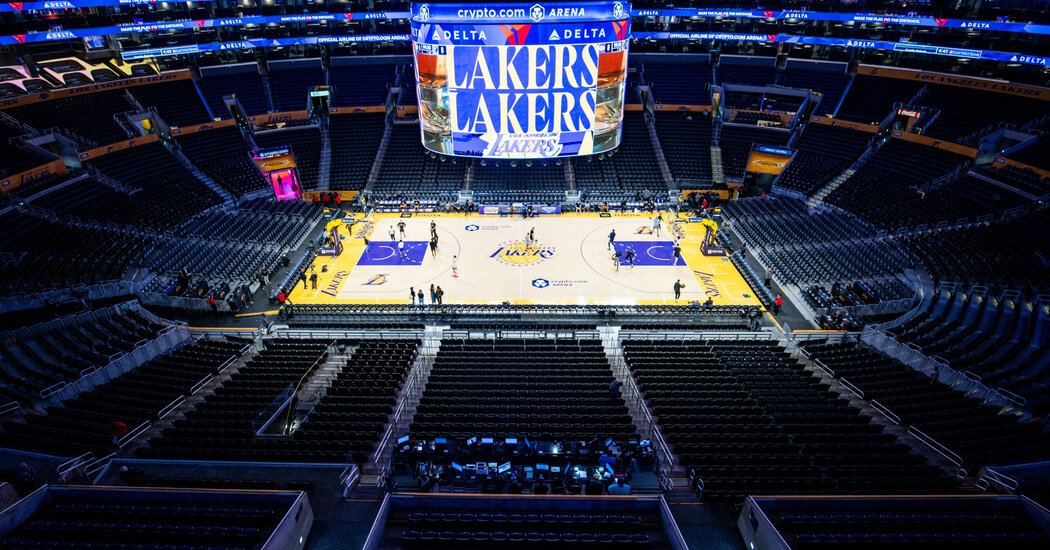
The latest proof came on Wednesday, when Josh Kushner, the venture capitalist, and Bob Iger, the former C.E.O. of Disney, said that they planned to buy the Los Angeles Lakers for $12.5 billion.
That’s a record price for a U.S. sports franchise. The deal underscores that some deep-pocketed buyers think the benefits of owning a world-renowned team outweigh the steep expense, Michael de la Merced reports.
How the deal came together: Kushner and Iger had been working on buying an N.B.A. expansion team in Las Vegas for months. But the rising price for that franchise had the two considering an alternative, according to a person with knowledge of the discussions: buying an existing team.
On Friday, Kushner called the financier Mark Walter, who bought control of the Lakers last year at a $10 billion valuation. Over the weekend, the two sides — who didn’t use investment bankers — hashed out an agreement, reaching one by Sunday.
But word of the deal leaked on Wednesday, forcing the sides to acknowledge the transaction.
-
Under the terms of the deal, Kushner is putting up personal money, and Iger may as well. Thrive Eternal, an offshoot of Kushner’s Thrive Capital investment firm that Iger is involved in, is also expected to be involved, though N.B.A. rules would cap its stake at 20 percent.
Investors are betting big on the power of big-name franchises. Consider the recent activity in sports M.&A.:
-
An affiliate of Apollo Global Management agreed this week to invest $2.6 billion in the New York Yankees.
-
The majority owner of Liverpool F.C., the English soccer team, is in talks to sell a stake to an investor group that reportedly includes Jeff Bezos.
-
Thrive Eternal’s first deal, announced in May, was an investment in the San Francisco Giants.
Thrive Eternal’s website hints at the appeal of what it calls “iconic franchises.” They can withstand technological disruption — in other words, the teams’ games are can’t-miss live events for their global fan bases. Their franchises can command top dollar for media and merchandise rights and more.
Iger is also a lifelong basketball fan, and as Disney’s C.E.O. he understood the power of franchises.
Walter may also have been under financial pressure to sell, despite owning the Lakers for just a year. Federal prosecutors have been examining loans made by his insurance business to a Chicago firm over potential disclosure issues, Bloomberg reported last week, citing unnamed sources.
Walter’s firm, TWG Global, has approached investors about selling assets to pay down these loans, Bloomberg reported on Wednesday, again citing unnamed sources.
The Lakers deal, if it closes, would accelerate that effort, Bloomberg adds, considering the team’s valuation is poised to jump 25 percent in just over a year.
HERE’S WHAT’S HAPPENING
Luigi Mangione is said to be in plea-deal talks. Mangione, who is accused of fatally shooting the UnitedHealth Group C.E.O. Brian Thompson, is discussing a guilty plea to avoid a federal trial, Bloomberg reports, citing unnamed sources. (He has pleaded not guilty.) Mangione still faces charges in state court in Manhattan; prosecutors there will probably oppose any effort by him to dismiss their charges on double-jeopardy grounds.
Anthropic investors reportedly anticipate a $2 trillion I.P.O. Unnamed backers of the artificial intelligence giant told The Financial Times that they expect the company to double its valuation from the current level when it goes public, as soon as the fall. In the meantime, Anthropic is in talks to buy Decart, an A.I. start-up, for about $6 billion, according to Bloomberg, which cited unnamed sources.
A plan to sell early access to President Trump’s social media posts is challenged. Plaintiffs including The Intercept sued Trump and several White House officials, arguing that a move to give customers access to the president’s posts on Truth Social violated the First Amendment. Truth Social has so far signed up around 10 customers, who would pay up to $100,000 a month.
Does the Fed have inflation under control?
Stocks notched higher on Wednesday after a tame inflation report was seen to relieve some pressure on the Fed to raise interest rates. Prices rose 0.1 percent in July from a month earlier, and 3.4 percent from the previous year on a seasonally adjusted basis.
Lydia DePillis, who covers the American economy for The Times, talked with DealBook about the key takeaways.
What is the headline takeaway from the report?
Inflation is easing from its height following the U.S. and Israel’s attack on Iran in the spring, but it remains far too hot for comfort and is running well above where it stood at the beginning of President Trump’s second term.
Does the slight easing of prices actually relieve pressure on the Fed?
Maybe, but not much. Inflation has been well over the Fed’s target for more than five years. And although economists expect it to come down slowly for the rest of this year, several members of the rate-setting committee have expressed the view that rates are currently too low.
(A lot rides on the next Consumer Price Index reading, which will come right before their September meeting.)
How much are the Iran war and tariffs showing up in inflation data?
Last year, inflation might have fallen back to the Fed’s target if it weren’t for tariffs. Their impact has been waning as prices have reset at higher levels to accommodate the extra import taxes.
But then the Iran war essentially replaced the fading tariff impact on inflation — not just through the price of gasoline, but also through items that heavily depend on oil, such as airline fares.
What will you be watching for in the next report?
Grocery prices, which fell slightly in July. That’s a good sign, but the resurgence in energy prices may be felt more in August, and companies are also looking to recoup margins they lost when fuel prices jumped earlier in the year.
Also, the artificial intelligence build-out has been popping up in some strange places, like laptops and software, and pushing the index up overall.
The quest to be No. 1 at rating A.I. models
The artificial intelligence race is a high-stakes competition for capital and computing power that hinges in part on a central question: Which company’s A.I. model is the best?
Vals AI is one of a group of start-ups seeking to answer that query, by measuring models’ performance against a set of benchmarks. Did the newest version of Anthropic’s Claude edge ahead of the last iteration of OpenAI’s ChatGPT? Or vice versa?
On Thursday, Vals is announcing a $40 million funding round at a $400 million valuation, Sri Muppidi is first to report.
Andreessen Horowitz led the round, with the existing investors 8VC, Bloomberg Beta and Pear VC participating. HRT Ventures and NextLadder Ventures also joined.
Vals built an automated system to grade A.I. models against a set of tasks and rubrics. These tests can judge models’ performance on a range of tasks, including those focused on coding, law and finance. Vals says that this system makes it difficult for A.I. labs to game the tests.
The start-up offers its test results of major models free to companies in the market for A.I. But it generates revenue by charging A.I. labs, including OpenAI, Anthropic and Google, to test their models.
Vals also sells its service to enterprise customers, such as the legal A.I. start-up Harvey, and government organizations including the Center for AI Standards and Innovation, which pay for proprietary evaluations of their products.
The start-up said its revenue had increased eightfold this year, although it declined to share dollar amounts.
There’s a need for trusted third-party groups, said Rayan Krishnan, the Vals C.E.O., who compared his company’s service to the product-testing nonprofit Consumer Reports and the credit ratings agency Moody’s. Without an independent appraisal, businesses may be reliant on self-reporting from A.I. companies themselves, Krishnan said.
“You can’t have the carmakers making the crash tests,” Jennifer Li, a general partner at Andreessen Horowitz, said.
The competition is fierce. There are at least half dozen other start-ups vying with Vals to become the dominant name in A.I. model evaluation. That group includes Arena, which already has $100 million in revenue and has raised $250 million from investors including Andreessen Horowitz.
Inside the shake-up at Forbes
When Randall Lane abruptly resigned last month after 15 years as the top editor of Forbes, he said that it was “time to live the spirit of the brand and try something new.”
He didn’t say what had prompted that decision. And neither did Forbes.
Now we know. Lane was fired after the company learned that he had accepted a payment of about $6 million from the founder of a company that does business with the magazine, Ben Mullins reports for The Times:
Lane, the magazine’s chief content officer, was paid by RJ Shook, whose company, Shook Research, has teamed up with Forbes since 2016 to publish rankings of wealth advisers. The payment was made after Mr. Shook sold a majority stake in Shook Research to PPC Enterprises, a private equity firm, last August, two of the people familiar with the transaction said.
It isn’t clear why Mr. Shook paid Mr. Lane. According to a person familiar with Mr. Lane’s thinking, he considered the payment a gift in recognition of the advice he had provided Mr. Shook over the years.
Lane violated company policy by not disclosing the gift, a decision he told The Times that he regretted.
“I should have disclosed the gift, and failing to was a serious error in judgment. I deeply regret that, and I lost the job and team I love because of it. None of this changes how I feel about Forbes and the amazing people there.”
THE SPEED READ
Deals
-
A group led by Trian, Nelson Peltz’s investment company, is said to be preparing a takeover bid for Wendy’s, the fast-food chain. (FT)
-
Shein, the fast-fashion giant, reportedly plans to stage its I.P.O. in Hong Kong on Aug. 28 but may drop its valuation target below $30 billion. (Bloomberg)
Technology and artificial intelligence
Best of the rest
We’d like your feedback! Please email thoughts and suggestions to dealbook@nytimes.com.

