- Islamabad says India is backing militant groups, including TTP, BLA.
- Says India supporting attacks through proxies based in Afghanistan.
- Envoy says India providing material, logistical support to Taliban govt.
UNITED NATIONS: Pakistan has said that India is providing material and logistical support to the Taliban government in Afghanistan to facilitate terrorist attacks against Pakistan, saying Islamabad is fully aware of the cost of India-sponsored terrorism.
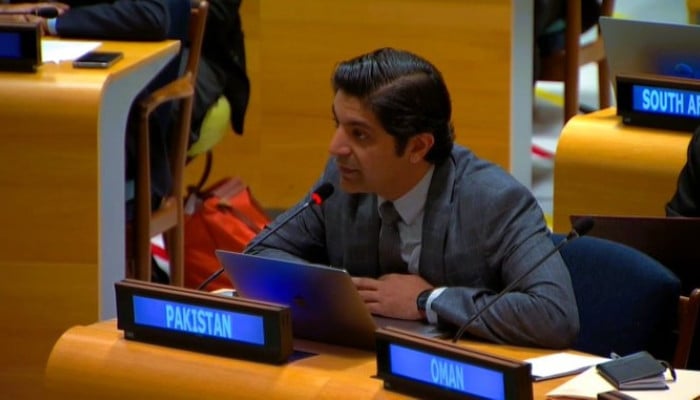
Muhammad Jawad Ajmal, counsellor at Pakistan’s Permanent Mission to the United Nations, said this while exercising Pakistan’s right of reply to remarks by the Indian representative at the UN on October 7.
Ajmal said India’s “newfound love” for the Taliban regime was not accidental, saying that New Delhi was supporting the Afghan authorities under the cover of humanitarian assistance.
“Under the garb of humanitarian aid, they have been actively supporting the Taliban regime with material and logistical support for carrying out terrorist attacks against Pakistan,” he noted.
He further stressed that India was using proxies in Afghanistan to support militant groups, including Tehreek-e-Taliban Pakistan (TTP) and the Balochistan Liberation Army (BLA), which Pakistan refers to as Fitna al Khawarij and Fitna al Hindustan respectively.
“Their newfound love for the Taliban regime is no accident,” Ajmal said, saying that India was providing material and logistical support for attacks against Pakistan.
India seeking to destabilise region
Ajmal said Pakistan had repeatedly warned the international community about Indian attempts to “sow discord and create mischief” in the region.
He also said that India was involved in human rights violations, saying New Delhi had mainstreamed Islamophobia and extremist ideologies and was seeking to engineer demographic changes in Indian Illegally Occupied Jammu and Kashmir (IIOJK) “in gross violation of international law and UN Security Council resolutions”.
Pakistan disputes India’s position on Jammu and Kashmir and maintains that the territory is subject to international law and relevant UN Security Council resolutions.
The diplomat also referred to the case of Indian national Kulbhushan Jadhav, whom Pakistan says was a serving Indian naval officer involved in espionage, sabotage and terrorist activities on Pakistani territory.
Ajmal described Jadhav’s capture as evidence of “Indian state terrorism”.
“The capture of serving Indian naval commander Kulbhushan Jadhav on Pakistani territory and his confession for acts of sabotage, espionage and multiple terrorist incidents in Pakistan that have resulted in the deaths of scores of civilians, including women and children, is a glaring example of Indian state terrorism,” he said.
Pakistan raises alleged killings abroad
The Pakistani envoy also mentioned that India was involved in extraterritorial killings and assassination plots overseas.
He referred to the case of Nikhil Gupta, who pleaded guilty in the United States to a plot to assassinate a Sikh separatist leader, and the killing of Hardeep Singh Nijjar in Canada.
Ajmal said such cases had become a “global feature” of India’s illegal actions.
Pakistan vows to defend sovereignty
The Pakistani envoy said Islamabad would take all necessary measures to protect its sovereignty, territorial integrity, people and security.
At the same time, he reaffirmed Pakistan’s commitment to resolving disputes peacefully and complying with international law and the UN Charter.
“Pakistan will defend its sovereignty, territorial integrity, its people and its security,” he noted.
“And Pakistan will do all that is needed towards this end, while maintaining its steadfast commitment to peaceful settlement of disputes and compliance with international law and the UN Charter,” he stressed.
Ajmal also referred to Operation Sindoor, the Indian military operation in May 2025, and Pakistan’s subsequent military response.
He said the international community had witnessed the events and Pakistan’s response, adding that he did not need to repeat the details.