
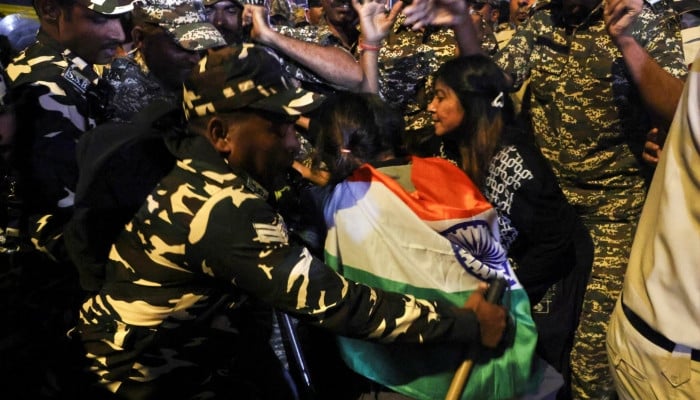
India is facing mounting political challenges as protests led by the Cockroach Janta Party (CJP), joined by the Congress Party and other opposition groups, question the integrity of electoral institutions and the direction of the country’s democracy. Simultaneously, concerns about the Modi government’s treatment of religious minorities, particularly Muslims, are deepening social divisions.
Against this unsettled domestic backdrop, reports of India adopting a more muscular posture towards Pakistan raise the prospect of another dangerous military confrontation in South Asia.
The convergence of domestic polarisation, institutional distrust and regional tensions presents a serious challenge. Another war with Pakistan would not resolve India’s internal problems; it could instead compound them while inflicting devastating costs on both countries. Many factors are contributing to India’s deteriorating situation.
First, the controversy surrounding electoral integrity has become a test of Indian democracy. The current agitation centres on the Special Intensive Revision (SIR) of electoral rolls and demands that Chief Election Commissioner Gyanesh Kumar resign. Opposition parties and protesters allege that the exercise has excluded millions of eligible voters and undermined confidence in the Election Commission.
An October 2026 TIME report cited claims that more than 130 million voters had been removed from electoral lists. The Election Commission maintains that revisions are intended to eliminate duplicate, deceased and otherwise ineligible entries. However, the government has yet to clarify the allegations of politically motivated disenfranchisement of minorities or the opponents of the BJP.
The consequences warrant serious scrutiny: the accuracy of electoral rolls and the protection of citizens’ constitutional rights are at the core of the issue. Excessive documentation requirements can disproportionately disadvantage poor people, migrants, women and marginalised communities. Transparent procedures, independent oversight and accessible appeals are essential to ensure electoral administration does not become a source of political exclusion.
The Congress Party’s participation has broadened the agitation beyond a youth-led protest. Other parties may also join the agitation. The Modi government faces a major challenge in determining whether the controversy remains a manageable institutional dispute or develops into a wider crisis of political legitimacy.
Second, the BJP’s majoritarian politics has already deepened India’s social divisions since Narendra Modi came to power in 2014. Critics believe that the growing influence of Hindu nationalism on the country’s political discourse and institutions has pushed the minorities to the wall. Muslims, who constitute a substantial minority, have been particularly vulnerable, and their loyalty and place in Indian society have always been questioned.
The issue is not whether a majority has the right to elect its preferred government. It does. The issue is whether electoral victories confer the authority to weaken the rights of minorities or redefine national identity around one religious community.
If substantial sections of the population come to believe that their votes carry less weight, their rights receive less protection, and their identities invite suspicion, the resulting alienation could become a long-term source of instability.
Third, economic and political grievances could pose a broader challenge for the Modi government. The CJP initially drew attention through protests over education and unemployment before the movement expanded to questions of electoral integrity and constitutional accountability, posing a formidable challenge to the Modi government.
Young people struggling to find employment or secure educational opportunities may become more receptive to movements that challenge the credibility of established institutions. If their grievances converge with those of the urban poor, disadvantaged castes and religious minorities, the opposition could acquire a broader social base.
An independent review of disputed voter deletions, protection of peaceful assembly and a transparent response to allegations of institutional bias would help restore public confidence. Heavy-handed repression, by contrast, risks turning a political dispute into a more serious confrontation between the state and its citizens.
Fourth, to divert the attention of the people from the ongoing agitation, renewed military confrontation with Pakistan cannot be ruled out, which may introduce an even more dangerous dimension. The May 2025 conflict showed how rapidly a crisis between the two nuclear-armed neighbours can escalate. Following the April 2025 attack in Indian Occupied Kashmir, India launched Operation Sindoor on 7 May, striking targets it claimed were linked to militant activity. Pakistan responded militarily, and the confrontation escalated before a ceasefire was reached through President Trump’s mediation.
The episode should have reinforced the limits of military coercion. Neither country can assume that a future confrontation would remain short, geographically contained or politically manageable.
The consequences of a new conflict would extend well beyond military casualties. Civilian deaths, displacement, disrupted trade, infrastructure damage and declining investor confidence would impose high costs on both populations. Resources desperately needed for education, healthcare, employment and poverty reduction would instead be diverted towards conflict.
Fifth, ideally, domestic political pressures must not justify external adventurism for temporary nationalist mobilisation during international crises. Yet the assumption that an external confrontation will unite the population behind the leadership is risky.
If a military campaign fails to achieve its objectives or produces unexpected casualties and economic costs, public discontent may intensify. In India’s present circumstances, a conflict could also aggravate communal tensions and expose minorities to collective suspicion. Muslim citizens must not be held responsible for the actions of individuals or groups based on their religion.
Finally, Pakistan must combine preparedness with diplomacy. Islamabad should maintain credible defence capabilities while avoiding the assumption that war is inevitable. Military-to-military communication, reliable crisis-management channels and international diplomatic engagement are essential to preventing miscalculation.
Both countries should preserve emergency communication mechanisms and make clear that neither seeks uncontrolled escalation. Even sober Indian commentators admit that the Kashmir dispute remains a central source of tension and requires sustained diplomatic attention alongside practical confidence-building measures.
India’s present political challenges are ultimately for its citizens and institutions to address. However, their regional implications cannot be ignored when domestic polarisation coincides with military tensions.
The Modi government faces a choice: strengthen democratic institutions and reassure minorities, or allow political polarisation to deepen while risking another confrontation with Pakistan. The latter course would be dangerous for India and the region.
The real measure of leadership is not the ability to wage war, but the wisdom to prevent one. Another conflict could inflict greater destruction than the four-day confrontation of May 2025, while leaving India’s underlying political and social divisions unresolved. Restraint, constitutional accountability and diplomacy offer a more durable path to national strength and regional peace.
The writer is a former ambassador of Pakistan to Iran and the UAE. He is also a former special representative of Pakistan for Afghanistan and currently serves as a senior research fellow at the Islamabad Policy Research Institute (IPRI).
Disclaimer: The viewpoints expressed in this piece are the writer’s own and don’t necessarily reflect Geo.tv’s editorial policy.
Originally published in The News


