
We don’t know what state the New England island community of Widow’s Bay is in, except for the state of terror. It is plagued by unnatural fog and storms, serial killings, a history of cannibalism and violence, the occasional revenant and a generations-old curse visited upon it by a demonic pact.
And it is the most delightful place I have visited this year.
“Widow’s Bay,” approaching the end of its first season on Apple TV, works for many of the reasons good TV works. It is impeccably cast with character actors. If you told me that Jeff Hiller, Toby Huss and Stephen Root were all in the same series yet none gave its greatest supporting performance, I would not have believed you — but it’s true, and the honor goes to Kate O’Flynn as the neurotic and formidable mayoral aide Patricia Moyer.
Its tone is perfectly executed. The series is that tricky chimera, a horror-comedy, and it is equally — and more impressive, simultaneously — effective at both. A laugh and a scare are different outcomes of the same achievement, a good surprise, and “Widow’s Bay” has more of those than there are fish in the sea.
Give me all that, and I’m ready to call this the most fun new show of the year to date. What elevates it to the best new show is how it reinvents a well-worn TV trope — the cozy backwater full of adorable kooks — and how it turns the town’s history into its biggest monster.
You’ve visited this kind of idiosyncratic hamlet before, be it Schitt’s Creek (in the series of the same name) or Stars Hollow (in “Gilmore Girls”) or Pawnee (in “Parks and Recreation,” on which the “Widow’s Bay” creator, Katie Dippold, served as writer). In some series, like “Best Medicine,” this kind of setting promises a light diversion; in others, like “Twin Peaks,” it promises dark secrets.
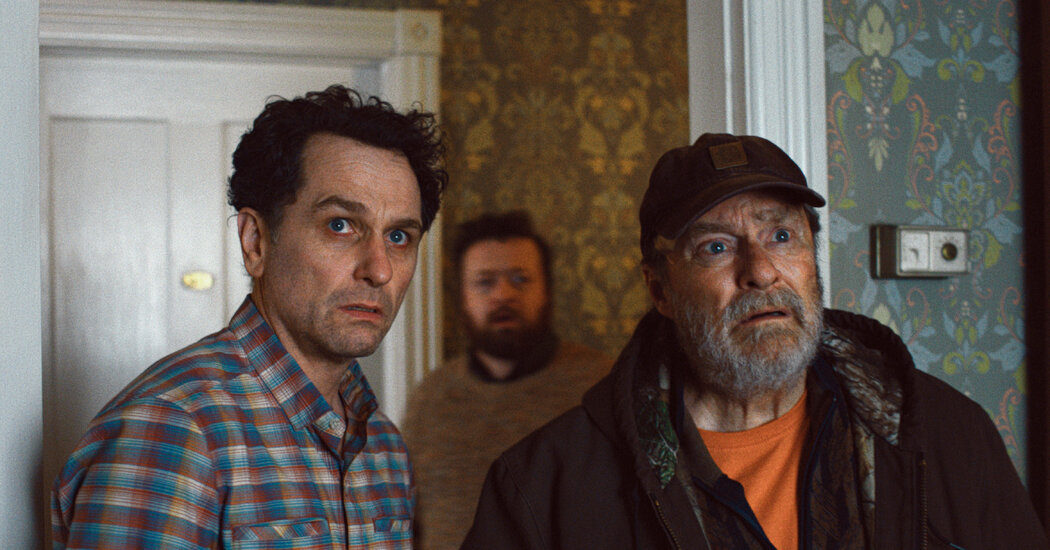
“Widow’s Bay” delivers both. It begins as Mayor Tom Loftis (Matthew Rhys, in his best role since “The Americans”) is orchestrating a publicity campaign to turn the languishing town into the next Martha’s Vineyard. The locals are dubious of bringing in tourists. The loudest objector is Wyck Crawford (Root), a briny and crotchety mariner who warns that the island’s deadly spirits are showing signs of reawakening.
The mayor pushes ahead. Change may be scary, he argues, but without it, Widow’s Bay is doomed to decline. (The population is sustained mainly by the belief that it is deadly for anyone born on the island to leave it.) He laughs off the horror stories as so many fish tales — until a stay in the local haunted inn and a run-in with a sharp-clawed sea hag convince him otherwise.
In its heightened way, “Widow’s Bay” is a familiar small-town story of change versus stagnation. Tom, born off-island but anchored there by his job and his troublesome teenage son (Kingston Rumi Southwick), makes the perfect, overwhelmed focal character. He is both insider and outsider; he has responsibility but lacks respect.
There are blessedly no overt politics in the series. (Tom won his thankless office unopposed.) But the conflicts are echoed in communities everywhere. Do newcomers owe deference to long-timers, or do the preservationists need to step aside and let the future roll in? How do we deal with the buried secrets of our ancestors?
It is certainly a wryly timed gift for America’s 250th birthday, as the country wrestles with how to celebrate its own history and which parts to ignore.
At the root of “Widow’s Bay” is the residents’ relation to their quaint, oppressive home. For some — like Patricia, still bullied in middle age by the mean girls she went to high school with — the town can be suffocating even before the masked murderers start to re-enter the picture.
For others, it’s simply home sweet hell. In the first episode, the local historian (Nancy Lenehan) chipperly tells a visiting travel writer about a colonial-era witch hunt: “Great source of pride. We caught ’em. We burned ’em!” (This also recalls “Parks,” in which municipal history murals depicted various colorful atrocities.)
Showrunners often like to say that the setting is a character. It’s not — the characters are characters — but a well-imagined setting creates character. In “Widow’s Bay,” the island’s isolation has made it a human Galápagos, evolving odd creatures with peculiar ways.
It’s as if “Widow’s Bay” were a period piece that happened to take place now. The setting is roughly the present, but people place calls on corded landlines, thanks to the lack of Wi-Fi and cell reception. They hang out at the old restaurant, and guests stay at the old hotel, and everything looks like you would expect it did in 1980. (This includes the title typeface, which appears lifted from a mildewy paperback you’d find in your Airbnb.) The pumps at a gas station look as if they filled up Edsels; the installation of an espresso machine in a local shop is like the arrival of a spacecraft.
We’re trained to believe this sort of preserved antiquity is charming. It is! But in this horror-comedy, it’s also wrong — the byproduct of a deal with the devil struck by the island’s imperious colonial-era “Lord Protector,” Richard Warren (Hamish Linklater), to save the settlement from starvation.
The troubles of history, on “Widow’s Bay,” often boil down to the legacy of patriarchs. Tom deals with a personal version of this, having spent summers on the island with his alcoholic father, who “never should have had a kid.” (He confesses this in a surreal interlude at the haunted hotel, where he comes across a hilariously Freudian board game called “Daddy’s Home.”) Now, he’s trying to break the cycle with his own son, with mixed and awkward results.
Eventually, we meet the island’s prodigal dad, Warren, who has been entombed undying in his casket since the 1700s, a side effect of his eldritch bargain. Decrepit and weary, he agrees to let Tom and Wyck take him by boat outside the island’s enchanted radius, in the belief that he will die and take the curse with him.
Naturally, he changes his mind en route, and Tom has to subdue him — literally battling the father figure — to complete the mission. As it happens, Warren’s return to dust is not enough to lift the enchantment. By the next episode, Patricia is confronting a seemingly resurrected murderer from her teen years, who requires gunshots and gasoline to dispatch.
This is life in Widow’s Bay, where your history keeps coming at you even after you’ve killed it with magic, fire and buckshot. Maybe at some point the spirits will be dispelled and the island will finally be made safe for the mainlanders, with our cellphones and money and Instagram poses. What new curses will we bring in our luggage?

