
Reno, Nev., was born in the silver and gold rushes of the mid-19th century. It is now a growing tech-hub — and the fastest-warming city in the United States.
About 20 miles east, along Interstate 80 and the Truckee River, lies the Tahoe Reno Industrial Center, known as T.R.I. Its website boasts that it is the “largest industrial park in the world.” Though established in the late 1990s, most of its development has taken place in the past decade, since Tesla built its Gigafactory Nevada, which makes lithium-ion batteries and other parts for electric cars, followed by data centers for companies including Google and Switch. Wild horses graze on hillsides while construction vehicles rumble toward guarded, windowless facilities.
The architect Rem Koolhaas has called the area “Silicon Valley’s back of house.” Across the region, such development continues Nevada’s legacy of environmental extraction, with lithium taking over from silver and gold, and data centers drawing on groundwater reserves and the fast-flowing Truckee River for cooling equipment. The awe-inspiring Pyramid Lake lies downstream from the Tahoe Reno Industrial Center, on a reservation governed by the Paiute Tribe, for whom it remains both sacred and ecologically vital. Pollution and falling water levels once pushed the Lahontan cutthroat trout to near extinction, though tribal hatchery efforts have helped revive it.
The Nevada Museum of Art, in Reno, is uniquely placed as a witness to the Great Basin’s environmental magnificence and degradation. Co-founded in 1931 by a group of regional landscape painters and the environmental scientist James E. Church, the museum focuses on Land Art, Indigenous art and photography of the altered environment.
“Into the Time Horizon,” a yearlong multipart exhibition of environmental art organized by the museum’s chief curator Apsara DiQuinzio, hones the museum’s focus, inviting participants to consider how to confront climate change, especially in the Great Basin Desert. In April, the “Art + Environment Summit” convened artists, performers, writers and advocates.
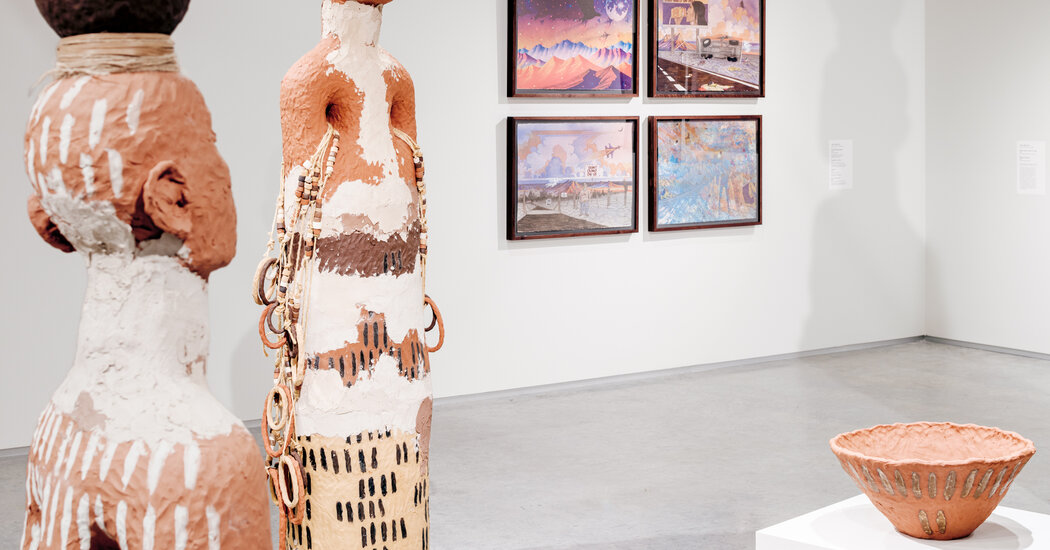
The show is thematically anchored by Indigenous art by American, Pacific Islander and Australian Aboriginal peoples. It is not, on the whole, an exhibition of activist art. Much of it, from mesmeric paintings by the Aboriginal artist Lily Kelly Napangardi to the landscape photographers Len Jenshel, Richard Misrach or Victoria Sambunaris, is beguilingly attractive.
But several participants from “Into the Time Horizon” — not all even consider themselves artists — stood out for their inventive entanglement with real-world problems, showing hopeful ways in which art and aesthetics can make a difference in the Great Basin and beyond.
Jonathon Keats
Jonathon Keats, an artist, writer and philosopher, has created a clock which, he says, answers the question, “How do we hand time back to nature?”
The 11-foot-tall, dual-pendulum timepiece was made in collaboration with the clockmakers Phil Abernethy and Brittany Cox as a permanent feature in a new extension by Will Bruder. A decade in conception, the piece, “Centuries of the Bristlecone,” was commissioned by the museum and unveiled in 2025. It is designed to tick for five millenniums more.
The Museums Special Section
One side of its ornate apparatus tells time as we know it, steadily advancing and set to the average of hundreds of atomic clocks. The other side tells what Keats calls “Bristlecone time,” based on the incrementally slow growth of Great Basin bristlecone pine.
This species is thought to be the longest-lived complex organism on Earth, with some trees estimated to be about 5,000 years old. A grove grows atop a mountain preserve in eastern Nevada stewarded by the Long Now Foundation, co-founded by the musician Brian Eno and Stewart Brand, editor of the Whole Earth Catalog.
By monitoring the growth of these trees — which is slowed or sped up by climate changes — Keats calibrates his clock to tell time as the pines experience it.
“What I’m trying to do with this project,” he said, “is the opposite of what clockmakers have done for hundreds of years, which is to insulate the clock. If the clock is sensitive to all that is happening in the world — much of which is on account of us — it then gives us a means by which to observe the impact of our actions, and to calibrate our future actions accordingly.”
Oscar Tuazon
Bahsahwahbee is the Shoshone name for Spring Valley, an area of eastern Nevada where subterranean aquifers support unusually large specimens of Rocky Mountain juniper trees (known locally as swamp cedars), which the Shoshone believe embody the souls of ancestors killed by the Federal Army in the 19th century.
Around 2018, the Los Angeles-based sculptor Oscar Tuazon heard of a conflict between the Shoshone and the Southern Nevada Water Authority, which proposed connecting the aquifers of Spring Valley to Las Vegas, 200 miles south.
Tuazon was developing a project, titled Water Schools, intended to create spaces to educate about threatened water sources. Much of his work is architectural; in Los Angeles, he built a prototype polyhedral structure known as a “zome home,” insulated by stacked barrels of water, in which he hosted water-related events. He wondered if eastern Nevada might be a suitable location for another Water School.
With the assistance of the tribe, he bought a spring north of Bahsahwahbee, fed by the same system of aquifers, with the aim of securing water rights on behalf of the Shoshone. His intention is eventually to return Cedar Spring, as his land is called, to the tribe. After the battle against the pipeline was won, chiefly because of the efforts of Shoshone advocates, Tuazon began conceiving his project in less overtly activist terms. Cedar Spring is becoming a contemporary Land Art site as he considers how to make it more accessible to visitors.
In “Into the Time Horizon,” three maps by Tuazon, painted with ink and watercolor, chart the area’s interconnected water sources. Nearby, a stark sculpture — made of a gnarled, carbonized juniper fence post salvaged from the land standing next to a 4-by-4-inch timber that Tuazon shaped himself — is a minimalist metaphor, perhaps, for Cedar Spring’s past and its future, or for the landscape and his presence within it.
Haley Mellin
As founder of the nonprofit organization Art Into Acres, Haley Mellin has been instrumental in conserving millions of acres of threatened land from Australia to South America to the United States. The organization’s funding model is principally based on the sale of artworks; Carol Bove, Anicka Yi, Jonas Wood and Dana Schutz have all contributed works.
The organization focuses on intact forest landscapes, “areas so wild that they’re exceptionally healthy for reproduction and the continuation of evolution of species,” Mellin explained.
Mellin is a painter, and her small but intense canvas “Cloud Forest II,” 2024, shows, in vivid, hyperrealist detail, teeming green growth in an area of the Northern Highlands of Guatemala, one of Art Into Acres’ continuing projects.
Slowness is a virtue of both her painting process and of her work with Art Into Acres. She estimates that one hour of observational painting corresponds to about 100 hours of work required to protect the land it depicts.
Mellin works in gouache; her modest painting equipment fits in a backpack. Usually, she paints as her conservation efforts are nearing completion. “They’re not paintings of woe, actually, they’re paintings of celebration,” she said.
Kai Anderson
The term “pictographs,” especially in the Great Basin region, usually refers to ancient drawings found on the walls of caves, often mysterious in significance. The colorful, decorated maps made by Kai Anderson, which he also refers to as pictographs, are necessarily more legible.
A Washington, D.C.-based policy advocate who once worked as deputy chief of staff for Senator Harry Reid of Nevada, Anderson does not consider himself an artist. Much of his work has been lobbying to designate new national monuments and to protect other wilderness areas, specializing in bringing diverse stakeholders together to solve environmental problems.
“My maps are basically to help me learn the material that I’m working on,” he said at the symposium, the first time he had shown his maps publicly.
A drawing Anderson did in colored pencil delineates the complex negotiations around the expansion of the Berryessa Snow Mountain National Monument in California. Alongside the tessellated outline of Molok Luyuk — the Patwin people’s name for Condor Ridge, a 13,696-acre area that was added to the existing national monument — Anderson has added notations listing relevant politicians, Native tribes, interested organizations like the Sierra Club and the California Native Plant Society, and — tucked into a corner — an acknowledgment of Art Into Acres, which was involved in the campaign.
Whether or not we (or Anderson) consider such a drawing to be art, it proves the effectiveness that aesthetics can have in understanding — and sometimes solving — seemingly intractable environmental problems.
Jack Malotte
Jack Malotte, a member of the South Fork Band of the Te-Moak Tribe of Western Shoshone, has combined art and activism since he was at art school in Oakland, Calif., in the early 1970s. His drawings and paintings of the beleaguered Nevada landscape combine a delicate use of line and color that is rare in graphic art, and a zingy imagistic directness that is rare in the landscape genre.
Malotte has designed posters, T-shirts and murals. Last year, for educational signage at Bahsahwahbee, he painted spectral Indigenous figures haunting the valley floor, with dramatic lilac mountains and a fiery sky.
The dusky, airbrushed palette of the pictures in this exhibition reflects, perhaps, the world-weariness of an artist looking at places and people that are still, after decades of protest and advocacy, fighting for respect.
In his drawing “Mother Earth Is Not for Sale,” from 1983, Malotte allegorized the relationship of his activist art to the raw landscape. From inside a house, we look through a window at a magnificent mountain range, a hawk soaring above. Hanging on the wall is a large painting of a similar view, pierced by a road and a billboard warning: “Mother Earth Is Not For Sale” and “This Property Zoned: Western Shoshone.” Malotte confronts us with two versions of the same scene: one marred by human intervention and protest, and one pristine. It would be better if the billboard did not have to exist, he seems to say.

