
Federico Songprasert was excitedly preparing to go see “Toy Story 5” one recent Tuesday when he learned of a horrid setback: The movie theater the 11-year-old was heading to didn’t allow snacks.
He was a patient at Chelsea and Westminster Hospital in London, where he was being treated for a hernia, and the cinema was just a short trip from his ward. It’s one of nine movie theaters run by the nonprofit MediCinema inside hospitals around Britain to give patients a chance to escape the stress or boredom of ward life for a few hours while watching the latest blockbusters.
MediCinema bans snacks to protect patients with allergies or other food-related issues. Still, Federico looked saddened by the news until his mother, Giovanna D’Urso, reassured him that all would be fine. “We had dinner,” she said cheerfully. “We’re all good.”
At a time when doctors and academics are increasingly recommending that people visit museums, theaters and concert halls to improve their health, MediCinema is one of several organizations making sure hospital patients don’t miss out on the benefits of culture either.
There is a growing realization that “patient experience influences patient outcomes,” said Daisy Fancourt, a professor at University College London who has written extensively on the links between culture and health. Too often, she said, the benefits of the arts in clinical settings have been undervalued.
Nurses at the recent “Toy Story 5” screening did not need convincing. “Sometimes when you’re in hospital, patients lose their sense of identity,” Nikki Mulhall, one of the nurses on duty, said. “But when they come here they can be themselves.”
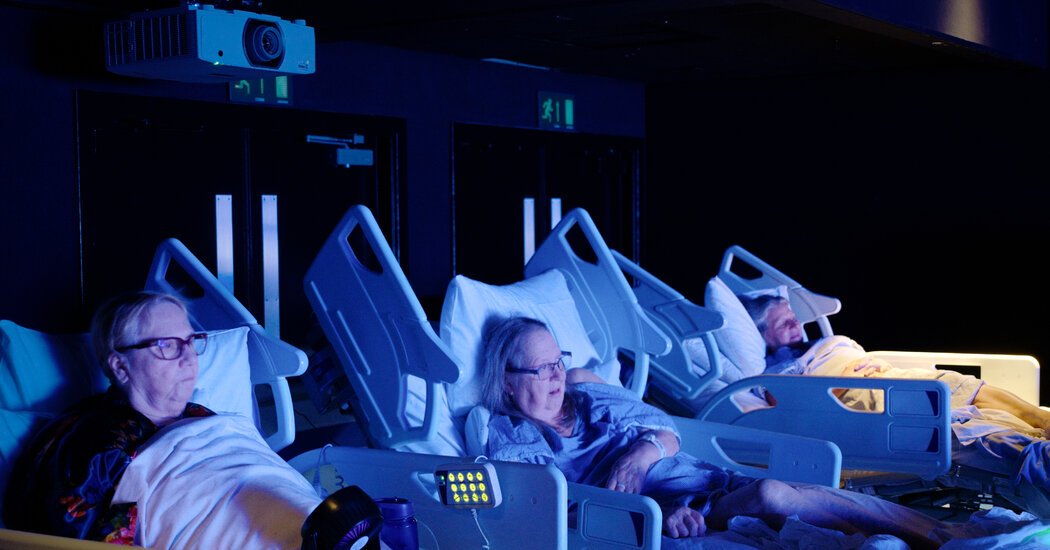
The dozen patients in the audience included a woman waiting to give birth, a 4-year-old with an autoimmune condition and a 71-year-old with a bone condition whose youngest son had come to watch the movie with her. It was one of four regular screenings that week in the 40-seat movie theater, which also has space for four bedridden patients and three patients who need recliners.
The morning before showtime, Simon Hickson, the cinema manager, toured the wards to find patients who wanted to attend, and checked with the nurses that it was safe for them to do so. Then, just before the screening began, nurses and volunteers collected the attendees, leading them past movie posters to the brightly colored seats.
For first-time visitors, the experience often raises questions. As the lights dimmed for “Toy Story 5,” Gary Cook, 72, who said he had “busted” his legs in a recent accident, asked: “What happens if we need to pee? Or someone has a heart attack?” (A nearby nurse said staff members would help anyone if needed.)
The idea for MediCinema came, appropriately, from a movie enthusiast. About 30 years ago, Christine Hill was working at St. Thomas’ Hospital in central London on a hot summer’s day when she saw nurses wheel some of the young patients outside to a garden so they could watch boats pass along the River Thames.
“It looked like they were in a cinema,” Hill, 77, recalled, and the scene made her think of the joy she got from going to the movies. Soon, she decided to try to bring that same feeling to patients.
Some hospital doctors didn’t support the idea. Hill recalled one telling her, “If someone’s well enough to go to a cinema, they’re well enough to go home.” But Hill persisted and found a medical lecture theater inside St. Thomas’ that could fit a full-size cinema screen, a projector and tiered seating.
Then, she raised the money to convert it to a movie theater, and learned how to accommodate patients’ medical needs and deal with issues like sound leakage. “We couldn’t have ‘Star Wars’ blaring out during the middle of operations,” Hill said.
Her first cinema opened in December 1999, with a showing of the family comedy “Inspector Gadget.”
In those early days, distributors, fearing that showing the films in such spaces could enable piracy, only let MediCinema have movies a month after they were released. Now, those same companies often give the nonprofit preview copies, allowing patients to see the films before they appear in multiplexes. Forthcoming showings include Christopher Nolan’s “The Odyssey” and “Taxi Driver” for its 50th anniversary.
MediCinema has become so respected by Britain’s film industry that last year it won a BAFTA, Britain’s equivalent to an Oscar, for its outstanding contribution to cinema. Last month, the nonprofit opened its latest site, in Manchester.
Patients of varying movie tastes can find something to watch while undergoing treatment. Hickson, the cinema manager, who in a previous career was a star of children’s television in Britain, said that the only genre the charity tended to avoid was horror, and that it didn’t shy away from showing movies depicting medical conditions.
A few years ago, Hickson recalled, he showed “Here Today,” a comedy starring Billy Crystal as a writer with dementia. He flagged its contents to one patient, who simply smiled and said, “Oh, I’ve got that!” and then sat down to watch.
As well as the regular programing, MediCinema also hosts personal screenings for patients who couldn’t otherwise attend. Hickson said his team had once learned of a couple who had suffered severe burns after an explosive fire and hadn’t been able to see each other, because one of them had a high risk of infection.
Hickson arranged for them to watch a screening from beds just a few yards apart, as if on a date. “To my astonishment, they picked the ‘Hitman’s Wife’s Bodyguard,’” Hickson recalled — “one of these crazy, over-the-top, explosion-heavy films.” He warned the couple that it might remind them of their recent experiences, but they assured him that they could tell the difference between fantasy and real life.
“They weren’t going to let what happened get them down,” Hickson said. “I was in awe of them.”
Another time, a regular attendee undergoing treatment for terminal lung cancer told Hickson that she was about to enter a hospice for end-of-life care and was sad to be missing the premiere of the Queen biopic “Bohemian Rhapsody.” After learning about the situation, the distributor rushed the movie to Hickson. The next night, he said, the patient and her family watched and sang along to “We Are the Champions.” He attended her funeral not long after.
At the “Toy Story 5” screening, the benefits of patients leaving the ward to see a movie were clear. As the it ended, Danyal Kazemi, a 4-year-old with an autoimmune condition, turned to his mother, Saba, and boasted, “I stayed awake, mum, for the whole cartoon!” she recalled.
Federico, the boy with a hernia, also left beaming. He told his mother he had been in pain at points, but had wanted to stay. “It’s probably my new favorite movie!” he said.
It wasn’t just the children who enjoyed the occasion. Diana Cetara, 71, a regular cinema-goer who had spent over six months at the hospital because of a bone condition, said she would discuss the movie’s story, which pits old-fashioned toys against tech products, with other patients on her ward — and then with her grandchildren during their next visit.
She may be in the hospital, she said, but she had gotten to see “Toy Story 5” long before they had.

