
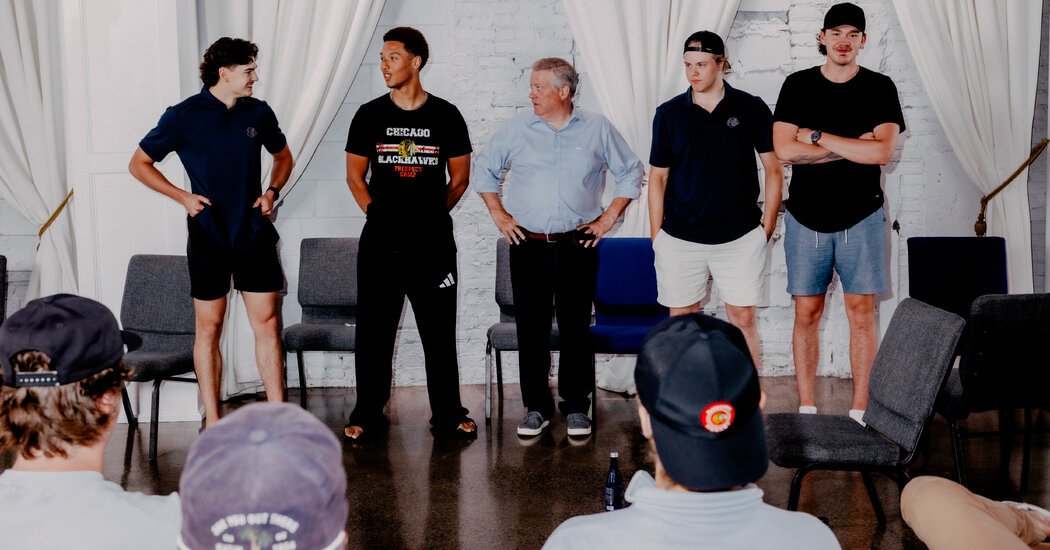
Sandy Jobin-Bevans looked out over a sea of faces in a crowded hotel conference room and zeroed in on a bored-looking hockey player half-awake in the back corner. “You there,” he called out. “For massive bonus points: What duck-billed, egg-laying mammal was first discovered in 1799?”
The kid bolted upright. He hadn’t been paying attention, but now he was desperately trying to recall the word “platypus.”
A lot was at stake. It was the National Hockey League’s weekend symposium with Second City Works — an annual training and on-boarding session for the league’s newest batch of rookies — and more than 200 draftees had been separated into groups based on their teams and divisions for an intense game of rapid-fire trivia. The top prize was a $50 Apple gift card, and these players, many of them already worth millions, wanted it badly.
“They will do absolutely everything they can to win,” said Jobin-Bevans, a comedian with the Second City comedy troupe and the host of the seminar. “Obviously, as hockey players, they all have that competitive spirit.”
Second City Works, the business-to-business arm of the Chicago-based comedy institution where Bill Murray, Tina Fey, Stephen Colbert and Amy Poehler cut their teeth, was founded in the mid-1980s. It originally handled work for marketing agencies and advertisers, including creating humorous ad copy. But Second City leaders noticed that many of the people enrolling in its traditional improv classes were there to learn self-confidence, quick thinking and public-speaking skills for use in the business world — rather than as a steppingstone to a career in comedy. So the Works program shifted from marketing to “learning and development” that catered to corporate clients who “wanted to apply these skills to their jobs,” said Tyler Dean Kempf, the creative director of Second City Works.
But over the past decade and a half, the program has expanded its client pool from corporate executives and sales teams to include a very different group: professional athletes. Using icebreakers, scene-building challenges and spins on the traditional “Yes, and …” improv exercises, Second City is teaching sports stars how to get loose, trust one another, and feel more comfortable in and out of games. That includes the breakneck trivia sessions, which Jobin-Bevins said help players speak up and interact.
Teams and entire leagues have taken note. Second City has run improv workshops for the Chicago Blackhawks, the Chicago Cubs and Major League Baseball itself. The league’s rookie career development program uses Second City to prepare incoming ballplayers for the demands of the sport.
“They’re not taking these classes because they want to be the next stars of ‘S.N.L.,’” Kempf said. “It’s because they want to apply these skills to their personal and their professional life.”
The N.H.L. began integrating Second City improv into its rookie development plans in 2013, as part of a provision in the new collective bargaining agreement between players and the league that rookies would receive an orientation program after being drafted to a team.
“We’re a young league, and we have a lot of 18-, 19- and 20-year-old players coming in who often haven’t been to college or had any type of experience in the real world,” said Bill Daly, the deputy commissioner of the N.H.L. “We wanted to get in front of them and show them the resources that we have and that we’re in this for their best interests.” The improv program, Daly said, was “a passion project” for him and the organization.
Athletes may not have much experience with live theater, and Kempf said that the players coming into their programs seem, at minimum, highly skeptical. “You walk into these rooms sometimes, and everyone has their arms crossed — the body language is not thrilled about what we’re trying to do,” he said. “And mostly that’s because they’re afraid. The word ‘improv’ instills fear in people. Fear of the unknown. Fear of looking a certain way.”
This is human nature, but it’s especially true of pro athletes. “This is a group of guys who, maybe stereotypically, were all sitting in the back of their classrooms in high school, not participating,” Jobin-Bevans said.
The trick, Kempf said, is “making them realize that the stakes truly could not be lower.”
The players aren’t asked to do full-blown performances, but the exercises are broadly similar to Second City’s typical comedy training, including interactive exercises and improvisational word games. In one, players are paired off and asked to use the last word of their partner’s previous sentence as the first word of their response — an exercise that teaches them to listen.
“What they learn is that when a reporter is asking them a question, they can’t assume they know where it’s going and that they’ve heard it a million times, because it shows the journalist that you don’t care,” Jobin-Bevans said. Another exercise asks them to recite the alphabet and count to 26 at the same time — A1, B2, C3, and so on — which teaches them “that if you’re at your locker trying to change and you’re being asked a question, it’s hard to focus.”
In addition to preparing players how to deal with the news media, the program also aims to teach them about how to present themselves on social media platforms — skills honed with storytelling exercises like a game in which players are asked to tell a story in 60 seconds, then 30 seconds, then 10 seconds, paring down the information more and more to its essence each time.
“These athletes are about to become famous,” Kempf said. “They’re about to use their social media to promote their brand. It helps them to think about truly connecting with an audience and telling a story the right way.”
They also use scene work to show the players what can happen if media questions are answered the wrong way. Jobin-Bevins performs a scene in which he acts out “the worst-case scenario” for an interview with tough questions, then asks the players to imagine a better approach. “It’s more interactive, fun and funny for them to see it done this way,” Daly said.
The sports-focused improv classes don’t deal so much with the actual sport, of course, but working together over the weekend can have a knock-on effect for the game. “It helps build camaraderie, doing improv together,” said Jamey Horan, the N.H.L.’s vice president for communications. “These guys have never met before. After this, there’s a level of respect when they meet on the ice.”
Professional athletes might come away from the improv classes learning some soft skills, too. “What we discovered when we first started working with the N.H.L. is that these guys had to be introduced to the concept of applauding,” Jobin-Bevan said. “These are future superstars, so it’s not something they ever had to really do before.”

