

Want to bookmark your favourite articles and stories to read or reference later? Start your Independent Membership today.
Already a member?
Log in
It’s just before midnight and around 11 miles into my first ever backyard ultra that I start questioning several of my life choices – the top one being my decision to try the latest mad craze in endurance running without doing much in the way of actual training.
That’s swiftly followed by the decision to pop my backyard cherry with an event that starts at 9pm and involves running through the night. And then, hot on its heels, the choice of this particular course: an unnecessarily hardcore option that includes 102m of elevation, translating into one of the steepest, bleakest hill climbs I’ve ever encountered.
Up until a few months ago, I’d never even heard the term “backyard ultra”. My partner mentioned it to me – and then, bam! In a perfect demonstration of the Baader-Meinhof phenomenon in action, the floodgates opened and I seemed to hear it everywhere.
The concept is simple but brutal. A loop of 4.167 miles – otherwise known as a “yard” – is mapped out, and participants must complete it within an hour. At the start of the next hour, they go again. They continue completing one yard per hour for as long as they can until they can go no more and decline to start the next lap, or finish the circuit after the 60-minute time limit has elapsed. The very precise distance of the route is no accident; those who manage to keep going for 24 hours, completing 24 yards, will have covered 100 miles exactly.
There is no minimum or maximum distance for a backyard ultra; there is no official “finish line”. The winner is the last man – or woman – standing, and the race automatically ends when the penultimate contender (known as “the assist”) drops out, leaving one person remaining. That person is also the only runner to officially “finish” the race; everyone else is recorded as DNF (Did Not Finish).
The invention of Gary “Lazarus Lake” Cantrell – one of the founders of the famously gruelling Barkley Marathons, an ultramarathon trail race so difficult that it has only been successfully completed 26 times in more than 30 years – the original Big’s Backyard Ultra was first held in 2011 on Cantrell’s property in Tennessee. Since then, the unique formula has exploded in popularity, capturing the imagination of an ever-increasing number of runners keen to test their limits and inspiring countless other backyard events around the world.
When Matt Blackburn, one of the UK’s top backyard ultra athletes, did his first event in 2020, there were “probably about six races in the UK”, he says. “Now, I think you could probably do one every weekend.”
He puts this accelerated expansion down to the fact that it’s arguably as much a test of mental toughness as it is physical. “I think that’s why it suddenly got really popular, don’t you think?”
There is no minimum or maximum distance for a backyard ultra; there is no official finish line
The nature of the thing also leads to a natural camaraderie among competitors that’s distinct from other long distance races, and there’s something equalising about the set-up. It doesn’t matter how quickly or slowly you completed your last yard: each time, there’s a reset; each time, you start with a clean slate.
Those at the top of their game will go for days without sleep or rest, other than the precious few minutes they can grab between the end of one yard and the start of the next. Safe to say, I won’t be attempting anything like this kind of madness. A previous marathon runner, I’ve never seen the appeal of a traditional ultramarathon – a socially acceptable form of masochism if ever there was one – but I’m intrigued by the backyard set-up. I like the idea that you don’t have to go a certain distance. The power is in your hands; you can tap out whenever you like.
That’s part of the joy of it, according to the UK’s own Sarah Perry, the current women’s world record holder, who completed a staggering 95 yards in 2025.
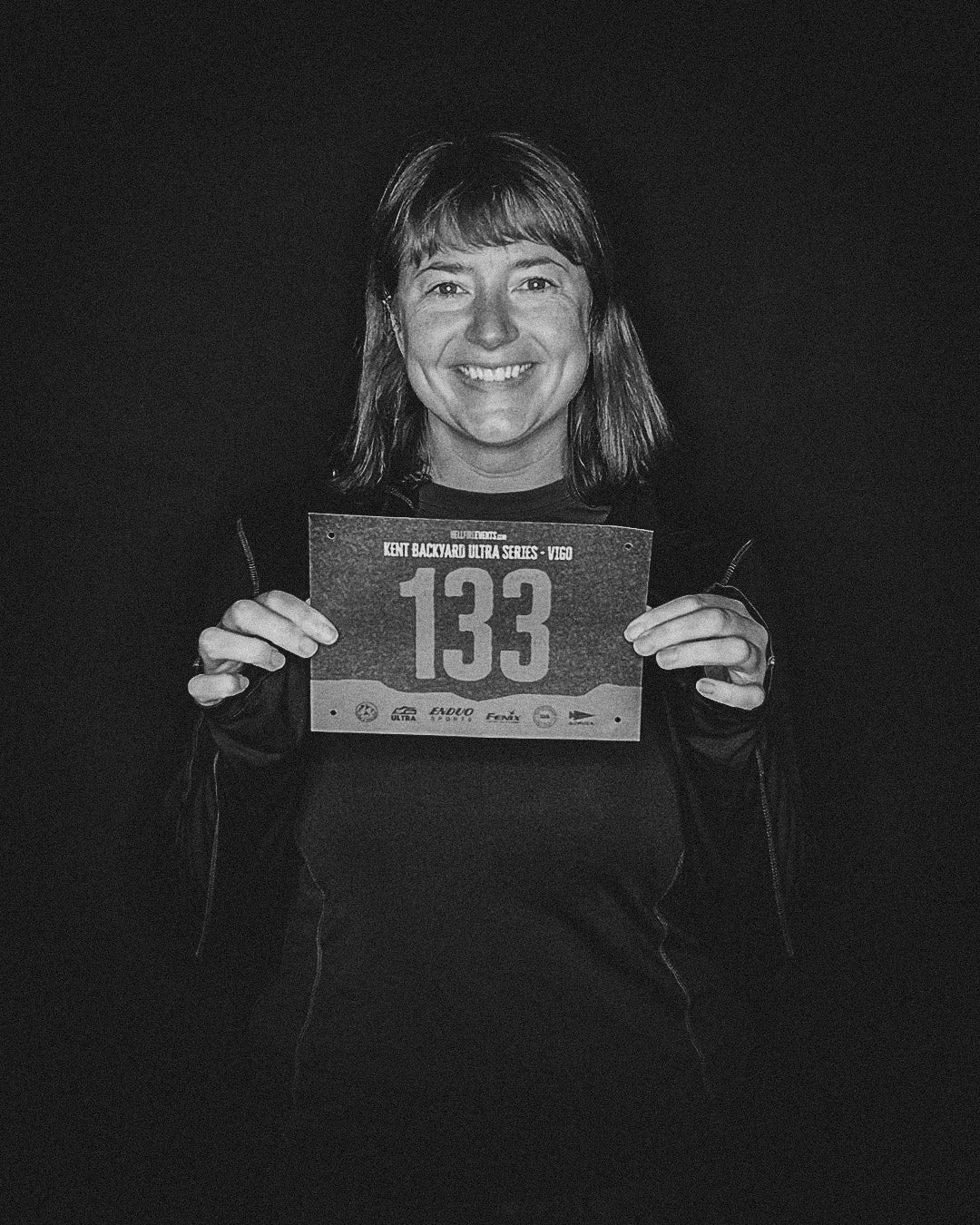
“It’s such a friendly environment that it’s a great place to run your first ultra, a distance PB, your first 50 miles, your first 100 miles…” she says. “There’s a huge spectrum of what people are turning up to do, and I think that’s what makes it fun. You can all have different challenges, but be running together.”
In typical impulsive style, I signed myself and my partner up for the next available event an hour’s drive away, barely registering the precise details. It’s only later that I discover this specific backyard, named the Vigo, is very much considered the most challenging in a series of four hosted by the Kent-based Hellfire Events, thanks to its nighttime start and the aforementioned humongous hill. It is, as other people are quick to inform me after I’ve already sealed our fate, quite the baptism of fire for a debut.
Training for a backyard is unique from training for a traditional road or trail running race. I garner tips from both Blackburn and Perry, who advise things I hadn’t even considered: we need to get used to running at night with a head torch; we need to practice varied terrain and speed-walking up hills; we should experiment with taking breaks mid-run to find the sweet spot to recharge without seizing up; we need to try eating while running, and plan a mix of sport nutrition like gels and carb drinks with snacks and real food.
There’s a huge spectrum of what people are turning up to do, and I think that’s what makes it fun
Sarah Perry, world record holder
While we do our best to follow this sage guidance, what I don’t manage to do is get in the adequate mileage. Life is busy, and the fact that it isn’t a marathon – that I can, in fact, stop whenever I like – engenders complacency. By the time we reach race day, the longest run I’ve managed to fit in is nine miles, which would only equate to a paltry two (and a bit) yards. As we pull into basecamp, the Vigo rugby club bar, I feel nauseous with nerves.
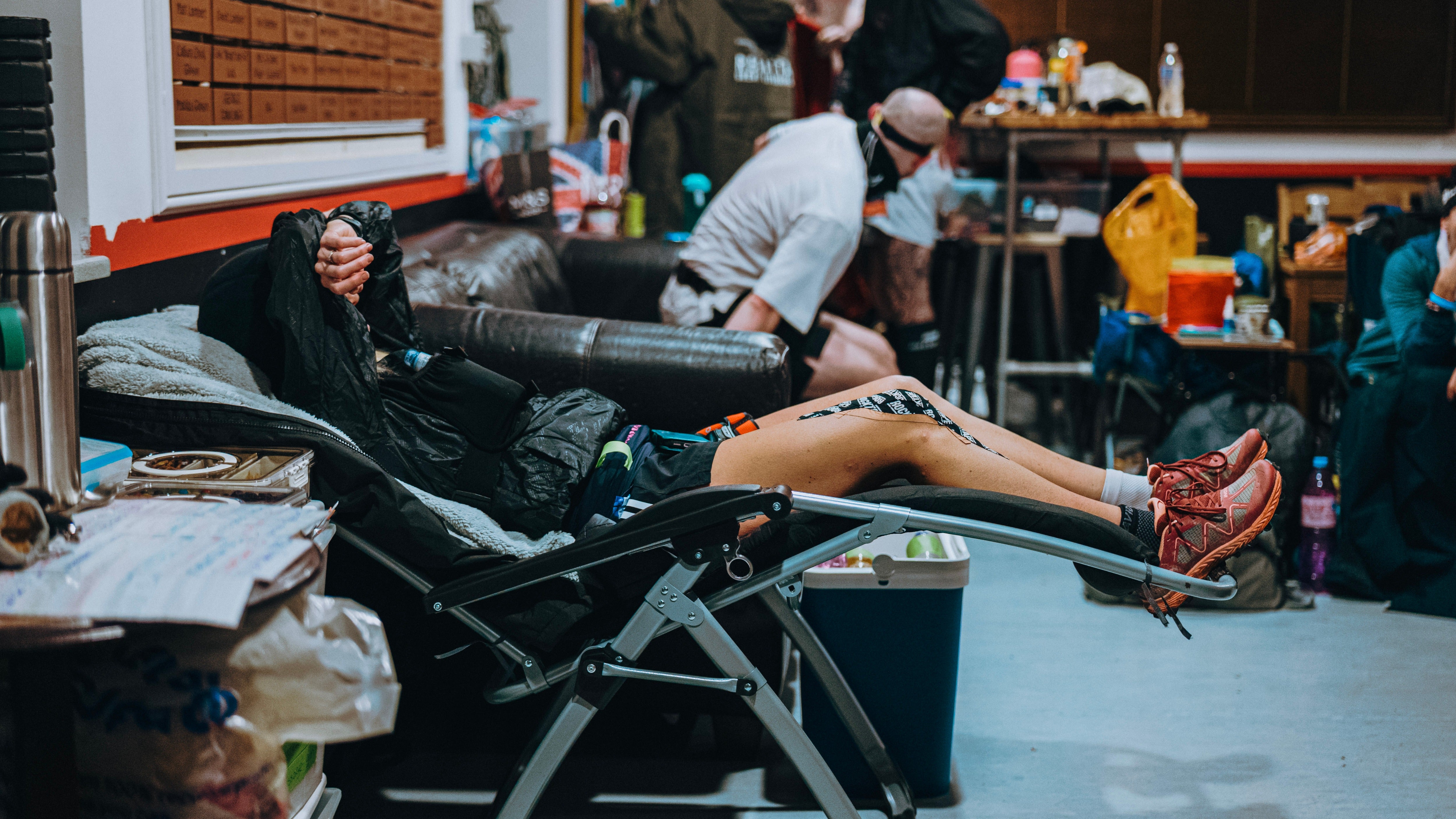
Once inside, the feeling grows. It’s ninety minutes before kick-off and plenty of runners are already ensconced, with advanced set-ups that serve to highlight just how woefully ill-prepared we are in comparison: fully reclinable chairs; impeccably organised container systems separating snacks, gels and drinks into compartments for each specific yard. We, meanwhile, have brought two cheap camping chairs and a ramshackle box of random foodstuffs we panic-bought from Sainsburys.
With a few minutes to go, I can feel the adrenaline surging. The atmosphere is like nothing I’ve ever experienced at a running event – people are laughing, joking and dancing at the start line, an infectious energy seeming to shimmer collectively through the group.
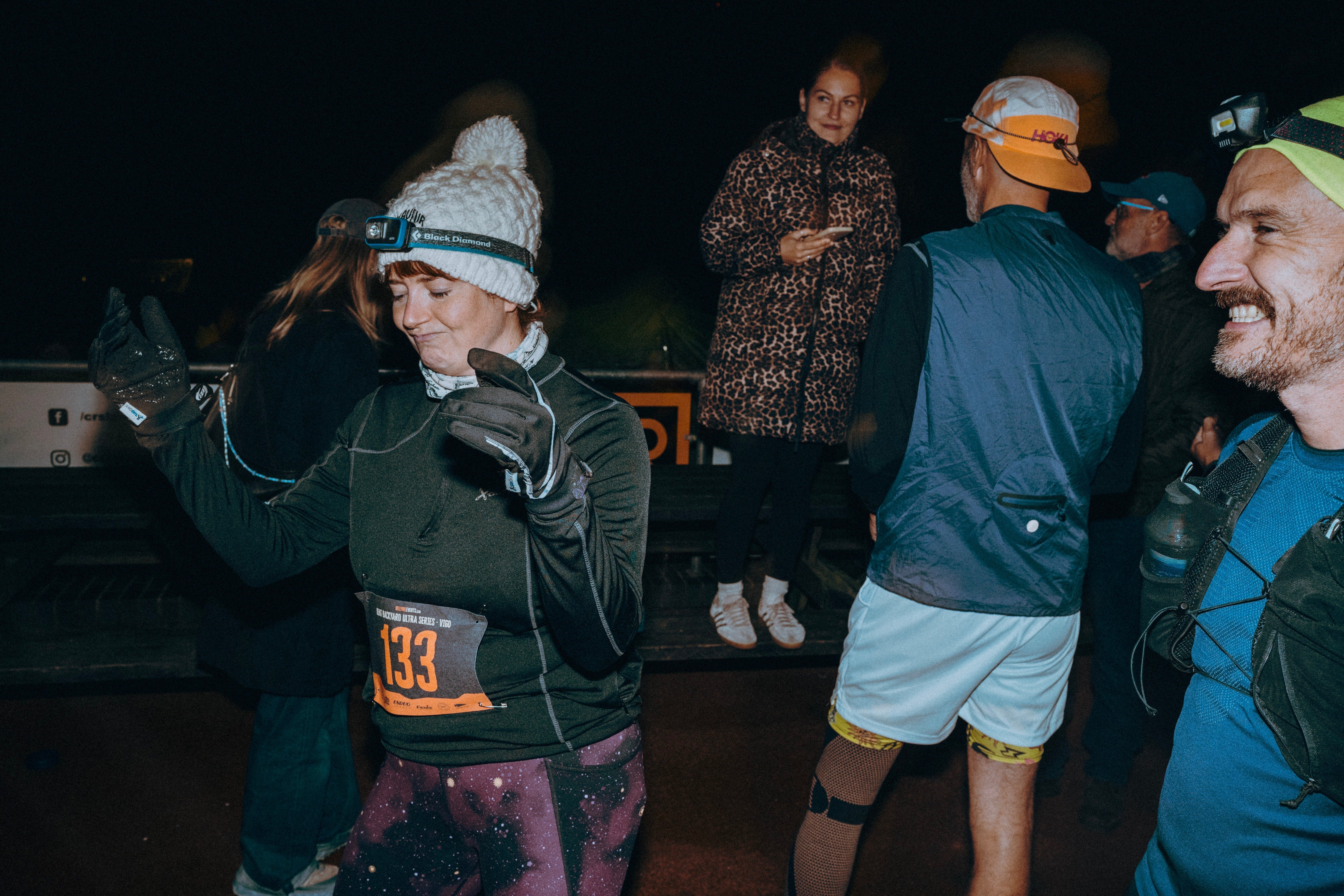
Three, two, one, and we’re off! That strangely festive air only intensifies; whoops and hollers carry us off on a wave of excited endorphins into the night. These people feel more like an 82-strong gang of mates than competitors.
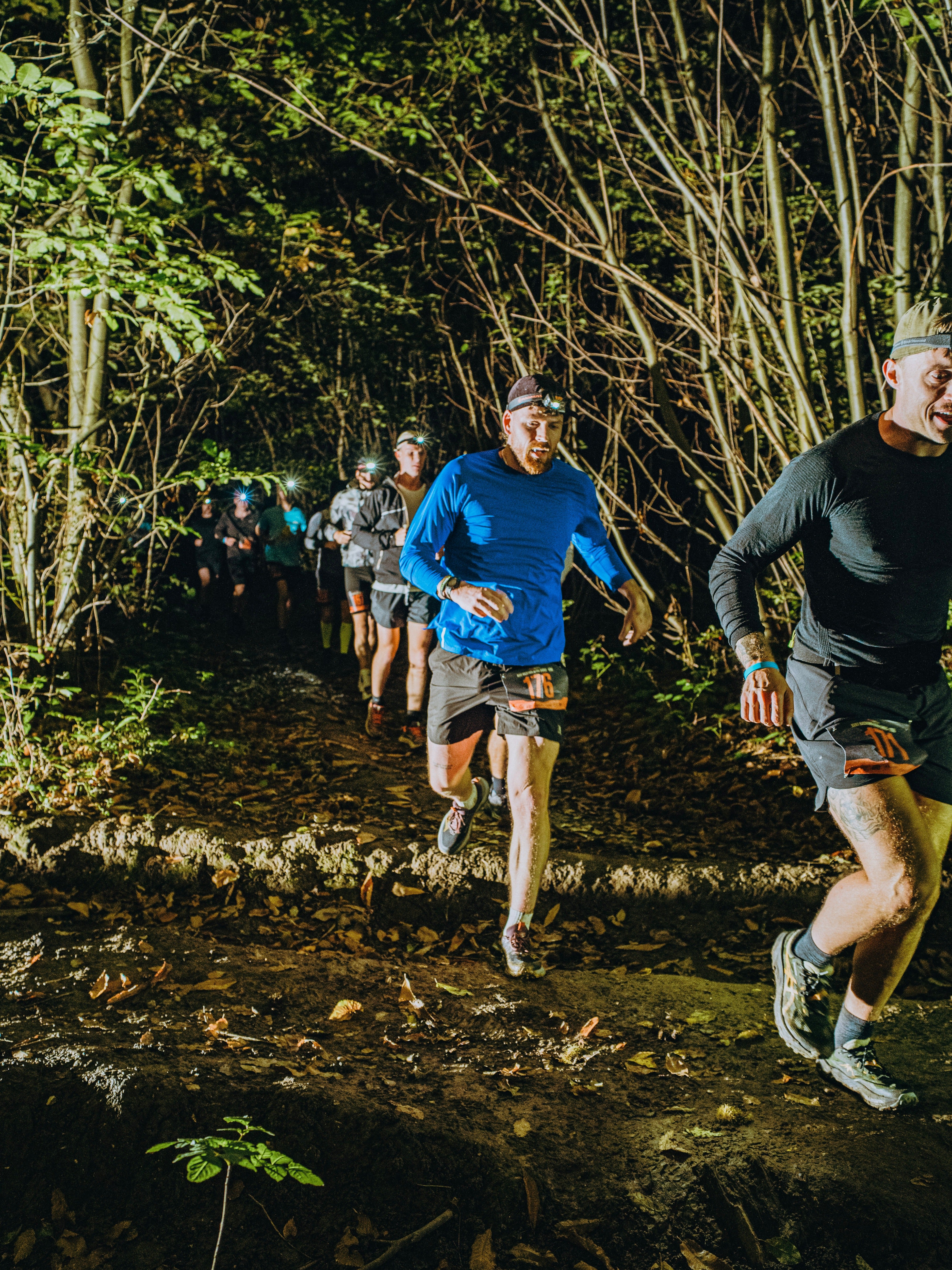
The first yard passes deceptively quickly. Everything is a novelty: the route itself, of course, but also the disorientating sensation of running in the pitch black, springing through woodland and over fallen logs like a limber gazelle. Small groups form, chatting as they go. The pace is slow: absolutely essential if you want to go far, not fast.
Before the infamous hill comes an arguably worse stretch of treacherous downhill, all slippery stones and shingles under foot. Then, the climb, which everyone walks rather than runs up to conserve energy, before the path flattens out for the final kilometre.
The welcoming lights of the rugby club appear and a team is ready to greet us with cheers and cowbells. We have just over eight minutes before the next yard starts: time to strip off a layer, chomp down some fizzy sweets and chug an energy drink. Then, we go again.
Yard two feels good, the legs still fresh, the atmosphere still buoyant. We’re familiar with the course and the anxious jitters over the possibility of getting lost have dissipated. I spend the time eavesdropping on my fellow runners – a fascinating, eclectic bunch from all walks of life.
Whoops and hollers carry us off on a wave of excited endorphins into the night
We get in with another eight minutes to spare. Time for more drinks; mini cinnamon rolls; an emergency wee. We go again.
I can’t quite say why, but yard three is different. Time becomes strangely elastic. Every “section” – I now mentally filter the route into segments like “fun bit through trees” and “never-ending, boring path” – feels like it takes triple the amount of time. The shared grumbling is the one thing that helps: we commiserate with the group behind as we once more trudge up that cursed hill.
Back at base, in the brief window between yards three and four, I make what turns out to be a fatal error: I change my socks for a pair that, while drier, are also thinner. As soon as I start running again, I can feel my big toe banging around inside my trainer in a way that is… concerning. It’s weirdly easier than the previous yard, though; we make friends with a couple of new people, one of whom has come all the way from Gloucestershire.
By now, the time between yards seems to elapse in the blink of an eye. By the time I’ve shoved a PB and jam sandwich down my gullet, I’ve barely had five seconds to sit in the uncomfortable camping chair before they’re blowing a whistle and summoning us back to the start line. We go again.
Quite soon into yard five, I suspect it may be my last. The big toe is feeling very bad indeed; everything hurts. Strangely, I don’t feel the slightest bit sleepy, just wired and alert – the same evolutionary survival mechanism, presumably, that would allow me to outrun a predator chasing me past my usual bedtime.
I perk myself up by listening to music, but my feet are shuffling as if encased in lead slippers. The only way I can make it up the hill, hamstrings caterwauling all the way, is by telling myself that this will absolutely and definitely be my final time doing it. I stagger over the finish line five minutes before yard six commences; it is 2am and I’ve completed 20.84 miles. Enough, I think, is enough.
My superstar partner, displaying a stubborn resilience I can only marvel at, is determined to do more than a marathon and charges round a further two yards, totalling 29.17 miles and finally calling it a day – or should that be night? – at 4am.
Depleted but elated, we crawl into bed at 6.30am and spend most of the next day there, occasionally checking the Hellfire website to see how many runners are still going. The event finally ends at 11pm, 26 hours after it began.
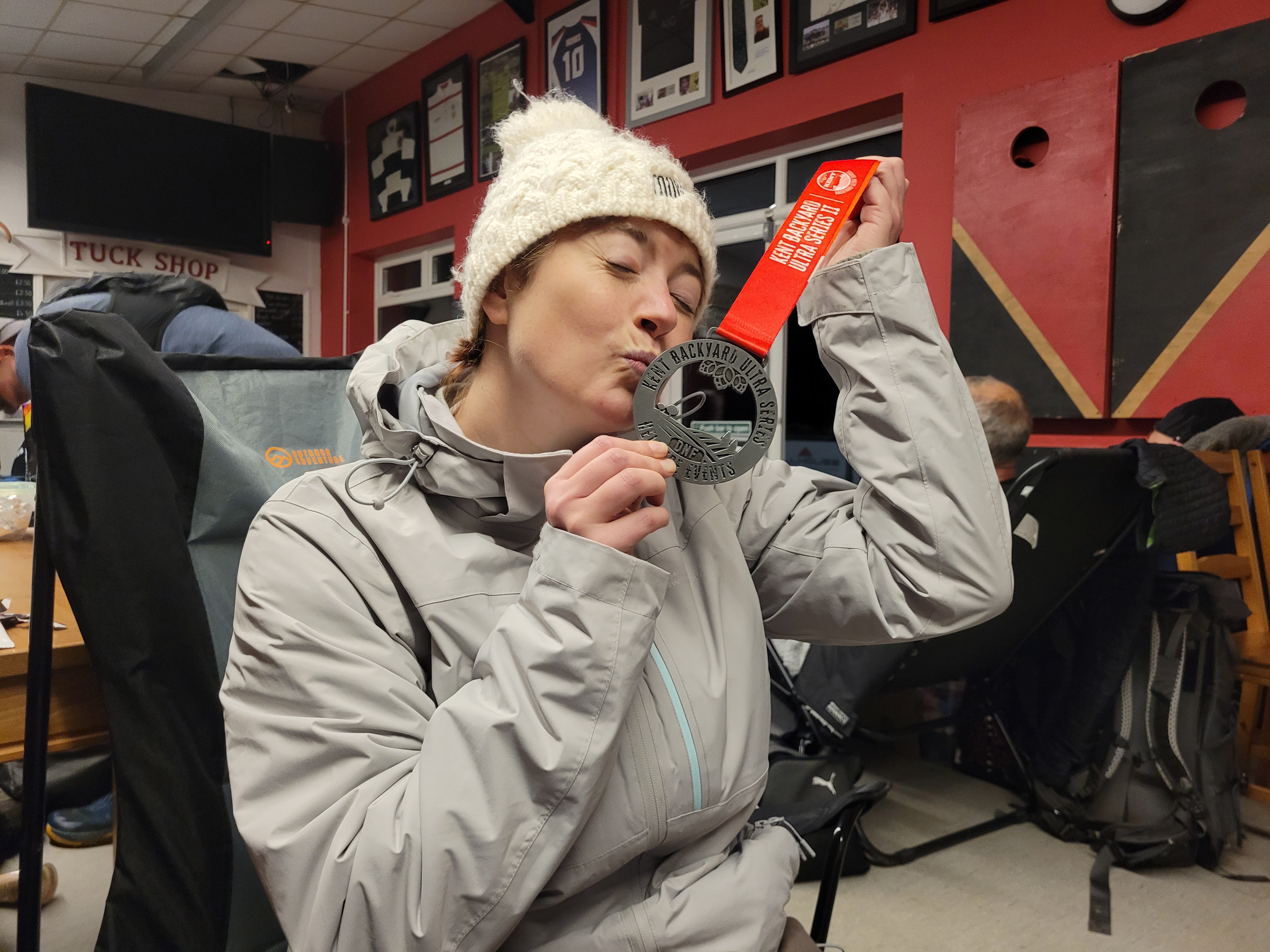
Our tentative steps into the world of backyard ultras just so happened to coincide with the World Championships, which saw 67 nations go head to head with teams of 10 runners apiece, and the winning squad the one that accumulated the most laps between them. While the US team wins overall, the final Belgian duo pull off an astounding feat, breaking the previous world record by making it through 124 yards. (The UK comes a very respectable fifth place; I’m proud to see that Matt is the second British team member standing, completing a far-more-than-respectable 89 yards.)
Over the next 24 hours, the strangest thing happens. Despite being sleep-deprived, sore-limbed and convinced my big toe will never be the same again, I keep thinking I’d actually quite like to have another go. I’m not convinced I pushed myself hard enough. Plus, with a tad more training, a flat, daytime course and – crucially – the right socks, surely I could do seven yards? Or eight? Or more…?
It turns out my partner feels the same. It turns out there’s another backyard ultra happening in Dover in January. We tentatively put it in the diary.
WE GO AGAIN.


