
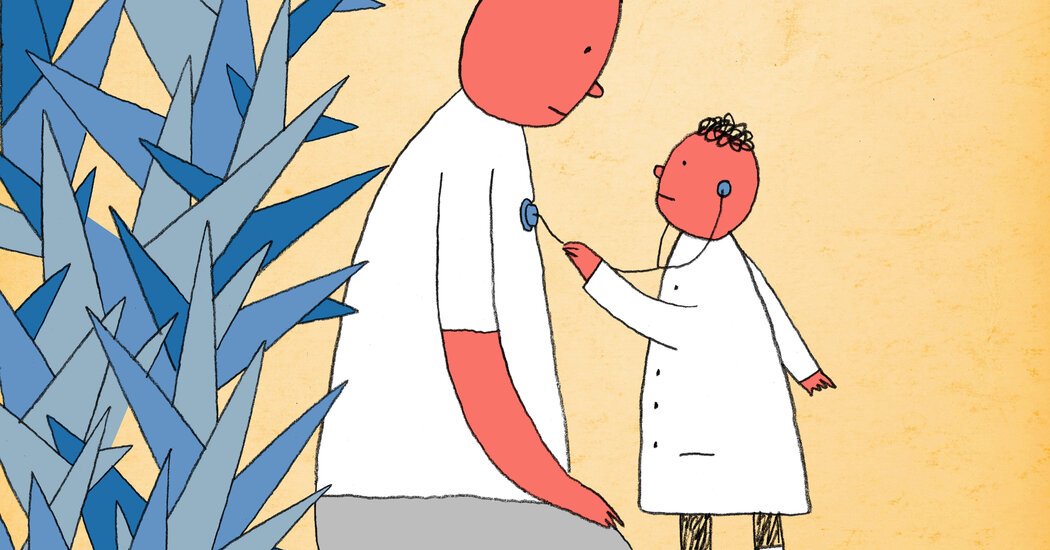
I’m in love with my doctor, who happens to be 3 years old. Though I should explain that this love is the love of a father, as my doctor is also my son.
After dinner, he dons his white jacket and stethoscope, toy syringe in his small hand. He rehearses the motions learned each time he’s had a fever, asking me to tilt my head back and open wide, ensuring I drink the medicine. I pretend to spit it out, at which point he looks at me seriously and says, “No, no, Daddy — time for your medicine.”
He listens to my heart, looks into my ears with his toy otoscope, and, to my surprise, my nostrils. Then he brings out his plastic reflex hammer, the very tool that led to my diagnosis nine months before he was born. He swings it against each of my kneecaps.
“Your legs working good, Daddy?” he asks.
“Yes, why thank you Doctor Miles,” I lie.
Then I say, “You’re a very good doctor.”
He finishes his work and says, “All better, Daddy.” Half question, half statement. I nod. I bring him close and kiss his cheek.
I learned I was sick the day after I learned I was going to be a father, Miles’s father. It took nearly two years for my wife to become pregnant; we had almost stopped trying. In vitro fertilization was on the calendar, just three weeks away.
Then my wife took a test we assumed would be negative, as it had been countless times before. And we wept as we watched a blue line darken, indicating a positive result. Our first glimpse of a future that had felt increasingly impossible. We canceled the I.V.F. appointment and kept our savings. We would need the money for diapers.
The next day, another test result, also positive, but delivering a considerably less happy glimpse into the future. A week earlier, they’d taken my cerebrospinal fluid during my first overnight at the hospital, repeatedly puncturing my spine with a needle I didn’t care to see. I curled into myself, hugging my knees to expose vertebrae as my wife sat beside me.
Each errant attempt sent spasms down my legs. The resident apologized, I began to shake, and my wife began to cry.
“This is the worst back massage I’ve ever had,” I said, trying to stanch her tears.
It almost worked. The resident and the wide-eyed medical student both laughed. My wife rolled her weary eyes and said, “Don’t listen to him.” Eventually, the attending physician arrived. To our relief, she got it right on the first try.
A week before, I was in the same hospital. It’s where I worked. I was in the final year of my Ph.D. in clinical psychology and was an intern at the hospital on my last rotation before graduating.
I knew these halls. I traveled them daily as part of the consult-liaison team, wearing glorified work pajamas — black scrubs and a fleece vest, my badge above the waist, signifying my role. But that day, my scrubs were folded away as I donned a different version of pajamas, the outfit I had seen a thousand times but never worn: a sea-foam green hospital gown with a drawstring at the back. The uniform of the suffering.
I tried to convince myself and the medical team that I don’t belong in it. That I was not, in fact, sick. I sat on the couch instead of the bed, my badge clipped to the collar of my gown. I played the good patient. I smiled and made jokes. I told them about my wife’s pregnancy after years of trying. As if there were an accounting to illness and healing. As if my résumé — father-to-be, good-spirited, colleague — would somehow merit me a cure.
Instead, at 30, I was given a diagnosis without one: multiple sclerosis. I felt as though I’ve been cast in a role I did not audition for, a role I am too young, too healthy, to play. “No, no,” I wanted to explain to the director. “This must be some kind of misunderstanding. You’ve got the wrong guy. I’m going to be a father.”
M.S. is a disease of mistaken identity. My immune system, believing there is an intruder, mounts a defense. But there is no intruder, no one to defend against. I try to tell it this, but it doesn’t listen. It goes on protecting against a phantom threat, and the efforts lead to holes in the wall of my spine, broken panes in the window of my brain. Its attempts to keep my body safe become the instrument of its undoing.
I am used to suffering, just not my own. Emotional calluses are necessary, I was taught in graduate school, because otherwise the pain would break you open. For me, there is a safety in hiding behind the label of intern, psychologist, provider that we think will inoculate us from the pain we treat. Of course, there is no such divide. I was a provider, then a patient. Now I am both. We begin as visitors to these rooms. Eventually we all become the visited.
But my son doesn’t know I’m sick. One of the benefits of being 3 is he doesn’t understand much yet. He knows everything about “Sesame Street,” nothing about loss. He knows that on Saturdays I take him to music class with Ms. Aimee, and on Mondays, Wednesdays and Fridays he goes to school with Ms. Karen.
He also knows that each evening, when I get home from work, we’ll go through the sliding doors to the backyard where I will lift him skyward, the falling light resting on his hair and eyes.
I want to prolong this innocence as long as I can. Let the world remain as simple as he sees it now. Lifted in my arms, safe and untroubled, believing this is how the world is. How the world will always be.
But this world will change. Eventually, he will learn that I am sick. How old will he be when my wife and I tell him? I think of my parents, who told me about sex early on because they wanted me to hear it from them first. Will sharing my diagnosis with him be like that, a conversation of our choosing? Or will he notice on his own, like when I saw my own father hiding eggs in the backyard and realized the truth about the Easter Bunny?
Through the back window, I watched my father crouch near the playscape, tucking eggs under the slide and along the fence, and felt both disappointment and pride. The innocence of childhood belief shifting into adult understanding.
Will he pretend not to know, protecting me from the realization that he’s crossed the threshold, just as I pretended to be surprised by those eggs the next morning? Will he tell his younger sister, or will she have to figure it out for herself?
Or, worst of all, will someone else point it out to him? I think daily of this calculus: How long can I wait to tell him before it’s too late? Before I risk the cruel kid on the playground asking him why I walk funny, pointing out something he did not notice about his own father? For now, he is unburdened by the concept of illness, of loss. Something I want to preserve forever. Something I can only preserve for now.
Even if this story was not one of illness, it would still be a story of loss. No parent gets to keep their children forever, I know, nor the other way around. Instead, we exist in tandem for a time, drifting down the same river, before the current spins us away and down our own winding tributaries.
He is only 3, this boy who made me a father. How can I expect him to remember me as I am now? And how many memories will I get of him? I find myself frantically collecting them, storing them each day — my fragile currency against loss. Like the memory of my doctor’s visit this evening.
As the appointment ends, my boy packs up his medical kit, and we trade our roles as patient and clinician for those of father and son. I watch him take off his white jacket, and I have just one thought: How I wish he could heal me.
Then he sheds the rest of his outfit in a frenzy, gets naked, and begins scampering around the house. He is cackling, zigzagging across the linoleum of our living room before we’ve even turned on his bath. I watch him run, delirious, full of light. And I realize how, in so many ways, he already has.

