
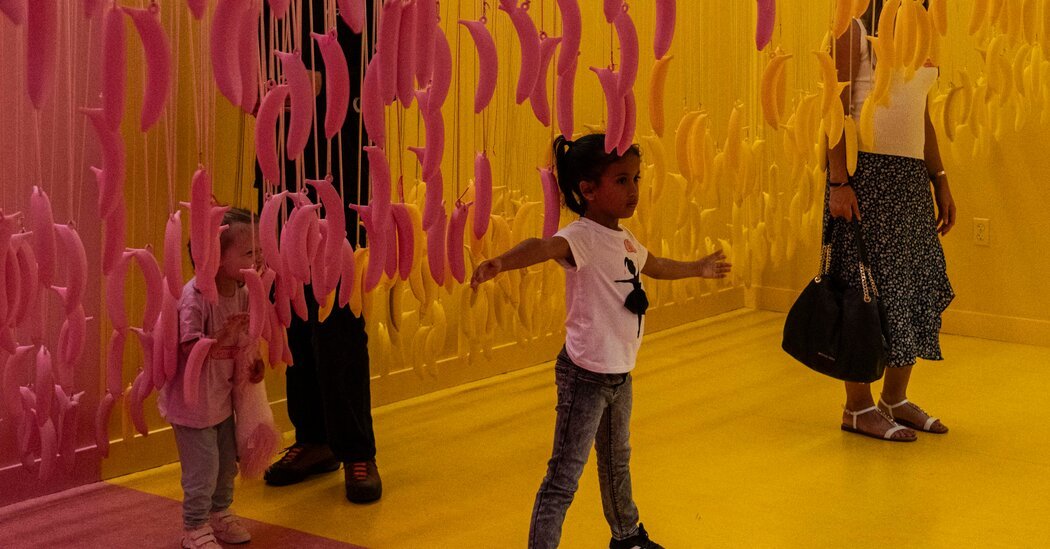
Critics mocked its sprinkle pool and banana room. They laughed at its meager presentation of sugary memorabilia, like a recreation of Fudgie the Whale. But while many traditional museums are suffering from low tourism and high overhead costs, the Museum of Ice Cream is expanding its audience and charging as much as $89 for a V.I.P. (Very Important Popsicle) ticket.
Despite its name, the Museum of Ice Cream, a for-profit amusement center, has more in common with Chuck E. Cheese than an educational institution; however, its adoption of museum branding and its emphasis on immersive experiences have blurred the lines in the cultural landscape, wooing tourists and families that might otherwise visit a traditional museum. The company said it received about a million visitors annually across its six locations, including in New York, Chicago and other big cities — higher attendance numbers than the Whitney Museum of American Art and the Cleveland Museum of Art.
At a time when audience levels have plateaued at many traditional museums, the ability of entertainment companies styled as arts institutions to siphon away visitors poses a new challenge to the industry, according to experts. The Museum of Ice Cream was one of the first in a wave of immersive amusements that include the Museum of Illusions, teamLab, Meow Wolf and the Museum of Balloons (the last two plan to open locations in Manhattan within the next two years). And there are always newcomers. Dataland, a for-profit company that bills itself as “the world’s first museum of A.I. arts,” opened in Los Angeles last month.
“What has made people feel like it’s worth their time and money?” asked Stephen Reily, a former museum executive whose think tank, Remuseum, looks at innovation in the industry. “The culture has diverged, and museums could have done more to seem relevant to people.”
“My simplistic way of thinking,” he added, “is that if you are creating positive memories, then people will want to return.”
When the Museum of Ice Cream started a decade ago, it was just a pop-up store across the street from the Whitney. Manish Vora, the company’s chief executive and co-founder, said he had sought advice from the Whitney’s director at the time, Adam Weinberg, who took Vora’s staff through docent training and discussed the advantages of timed ticketing.
The Museums Special Section
Vora initially based his business model on attracting young adults. “All our institutions are struggling to get younger people off their phones and into real life,” he said, explaining how an early version of the museum was pitched as an alternative date spot. But after the coronavirus pandemic the strategy shifted its focus to families with young children, which now account for more than half of the center’s visitors.
The Museum of Illusions, which offers Instagrammable optical tricks like oversize kaleidoscopes and infinity mirrored rooms, has followed a similar growth model. The original location opened in Zagreb, Croatia, more than a decade ago, and the museum has grown to encompass more than 70 locations, with 12 new sites planned to open by year’s end. General admission for adults at its compact venue in New York is $35, slightly higher than the $30 they need to enter the Whitney, just a few blocks away.
“We live in a very experiential economy,” said Kim Schaefer, the illusion museum’s chief executive, who was previously an executive in the water park industry. “People want to touch. They want to feel.”
Unlike traditional museums, where admission might account for just 7 percent of overall revenue, according to a 2018 report by the Association of Art Museum Directors, companies like the Museum of Illusions expect about 80 percent of their revenue to come from annual ticket sales. Schaefer said families account for half of the Museum of Illusions’ customers, with much of the remaining attendance coming from young adults.
But the question of how to attract new audiences and increase admission revenue has become urgent for traditional museums, many of which are facing higher overhead costs and declining philanthropy. A recent study by SMU DataArts, a research center at Southern Methodist University in Texas, found that revenue at museums declined by 36 percent between 2019 and 2024. Just under half of the 6,500 institutions surveyed said they operated at a loss in 2024, compared with 36 percent in 2019.
There have also been waves of layoffs. Over the last year, at least seven American museums have cut their staff. In January, the Museum of Fine Arts Boston laid off 33 employees to alleviate what executives described in a staff letter as “an unsustainable deficit.” The Speed Art Museum in Louisville, Ky., laid off all nine employees of its education department in September; a reduced number of school tours resumed this year at an increased cost of $10 per student.
Experts said the success of companies selling ice cream and illusions compared with traditional museums presenting paintings and sculptures should be sobering but not surprising.
“If you look at all the research about people’s reasons for going to the museum, a top answer has long been ‘I want to have fun with my friends and loved ones.’ The ethos of the classic museum has not been that ethos,” said András Szántó, an author and strategic adviser to museums, private foundations and commercial brands.
And while executives like Vora have emphasized that their companies are not in direct competition with art museums, others have tried to blur that line.
“It’s an art museum, it’s a story experience, it’s a playground.” said Vince Kadlubek, the chief vision officer of Meow Wolf, an immersive art company that grew out of a collective he and other artists founded in 2008. “And so with that, I’d say we don’t design our experiences specifically for kids. We do design experiences for the kid in all of us.”
Meow Wolf’s five locations each attract hundreds of thousands of visitors annually, a spokesperson said. Adult tickets cost at least $45, but V.I.P. packages for the brand’s Las Vegas experience — a supermarket where visitors step through a freezer into a surreal world — can run as much as $119.
Like many executives, Kadlubek stressed the importance of traditional museums. But he also believes that their approach to the public is partly to blame for their challenges in audience growth.
“Honestly, there has been decades’ worth of ignoring the general population when it comes to art institutions, and that’s just the truth,” Kadlubek said. “Kids have been ignored, and families have been ignored, and people without the same level of education or socioeconomic privilege have been ignored in the art world generally.”
But traditional museums are working to woo more tourists and families. In 2023, the Metropolitan Museum of Art opened a $5 million interactive education center on the institution’s ground floor. And when the Studio Museum in Harlem opened its new $300 million building uptown, it emphasized new classroom spaces for local schoolchildren to learn about art.
Cyra Levenson, the deputy director of learning and engagement for the Solomon R. Guggenheim Museum, said the institution had “deepened its efforts in engaging with children, families and teens.” She pointed to the museum’s free membership program for teenagers, which has enrolled nearly 1,400 members, and she added that the museum’s attendance in learning and engagement programs had increased by 16 percent between 2024 and 2025.
The nonprofit model offers tax breaks to museums, but it also restricts their ability to fund-raise. For-profit museums are unencumbered by those regulations. For example, Meow Wolf raised “north of $200 million” in private capital between 2016 and 2019, according to Kadlubek.
While Kadlubek sees traditional museums as falling behind the times in drawing families, he is one of many executives in the for-profit field who agree that our culture needs nonprofits that work to preserve important artworks.
“The traditional museum space is incredibly relevant and won’t ever — and probably should never — be fully pop cultural,” he added. “We need spaces and resources and support for artwork that is created for reasons other than to sell a ticket.”
Proponents of traditional museums, like Reily of Remuseum, are concerned that slow-moving bureaucracies in art institutions are not fulfilling their mission. He is thinking ahead to what happens decades from now if younger generations don’t have meaningful relationships to art.
“If you want to think about your long-term relevance and survival,” Reily said, “being able to be attractive to children and parents is the way you ensure that you have visitors 10 to 40 years from now.”

