
In 2019, Maurizio Cattelan incited a media storm when he duct-taped a banana to the wall of a gallery booth during Art Basel Miami Beach. (It later sold for $6.2 million at auction.) But “Night,” an upcoming exhibition of the Italian-born artist’s work at Berlin’s Neue Nationalgalerie, will serve as a reminder that his oeuvre is broader and deeper than any one work. Included will be earlier provocations — his 2001 sculpture of a miniature Adolf Hitler praying, for instance — and new works, such as an almost 20-foot-tall wooden model of Berlin’s 18th-century Brandenburg Gate, which has come to represent periods of both strife and renewal in the city. An animatronic rendering of Oskar Matzerath, the young antihero of the German author Günter Grass’s 1959 novel, “The Tin Drum,” will sit on the edge of the building’s roof, directly above the entrance to the Mies van der Rohe-designed 1960s museum, surrounded by a flock of taxidermied pigeons. Several hundred more pigeons will fill the museum’s 28-foot-high glass-walled atrium.
Last month, Cattelan, 65, who splits his time between Milan and New York, visited Berlin to meet with Klaus Biesenbach, 60, the museum’s director, and the curator Lisa Botti, 40. During the visit, the three hosted a dinner to celebrate Cattelan’s having won the 2026 Preis der Nationalgalerie, the prestigious art award that led to the exhibition. Because much of Cattelan’s work relates to good and evil, and because the layout of the show will resemble that of a church, he dubbed the event the Last Supper, the implication being that society is on the brink of an epic moral reckoning. Still, the artist finds hope in free will — “It’s always up to us what we want to be, a pigeon or a dove,” he said — and in creativity. The show’s title, he said, isn’t about darkness: “It’s about the moment when certainty falls asleep and imagination wakes up.”
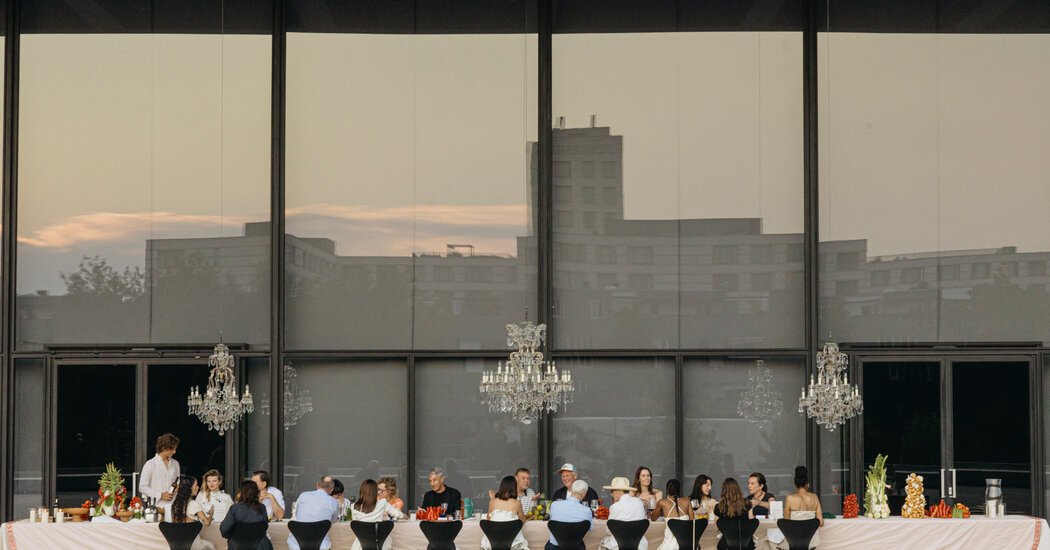
The guests — a mix of Cattelan’s friends, collaborators and fellow artists — mingled on the atrium’s terrace, then took their seats at a 45-foot-long table placed beneath a trio of chandeliers that had been installed especially for the dinner. Unlike in Leonardo da Vinci’s 1495-98 painting, people sat on both sides of the table, and while Cattelan and Biesenbach were in the center, neither of them dressed like Jesus. One thing that did feel in keeping with the original Last Supper was the sense of community. As Botti said during a welcome speech, “[It’s] about coming together … Let’s break bread!” Cattelan’s take, closer to the end of the evening, was, “This should happen more often. The exchange of ideas makes us stronger.”
The attendees: Apart from Cattelan, everyone was a full- or part-time Berliner. Artists in the crowd included Katharina Grosse, who’s German and known for vibrant installations created with industrial spray guns; the Turkish artist, researcher and writer Göksu Kunak; the Italian artist and filmmaker Rosa Barba; the Chinese artist Tianzhuo Chen, who also goes by Asian Dope Boys; the Scandinavian duo Elmgreen & Dragset; and Kiani del Valle, a Puerto Rican artist, dancer and stuntwoman who’ll perform at the Neue Nationalgalerie during Berlin Art Week, which will coincide with the September 10 opening of Cattelan’s show.
The table: Leonie Ondarza and Titina Eltz of LeTi, a creative production company based in Berlin and New York, designed the tablescape, dyeing the yellow-to-pink ombré cotton-silk cloth themselves. The menu text was written by the Berlin-based calligrapher Charlotte von Wrede, and the local floral artist Kim Görner made a series of edible centerpieces — towers of different types of produce. These drew the eye upward, toward the lights, which nodded to a work of Cattelan’s shown at a Manhattan gallery in 1994 that called for a live donkey to stand under a baroque chandelier.
The food: The cooks Max Frey and Sofia Tachias, who go by Max und Sofia and are also romantic partners, catered the event. There was sourdough from the Berlin bakery Sironi and a range of dishes showcasing local and seasonal vegetables such as garden peas with ricotta and dates, cucumbers tossed with watercress and red currants and grilled eggplant sprinkled with almonds and coriander. For dessert, the pair served Pavlovas topped with strawberries and whipped cream.
The drinks: When they arrived, guests were met by servers offering Negroni Sbagliatos — made with Campari, sweet vermouth and Prosecco — and Veuve Pelletier brut Champagne. During dinner, they had their pick of Vermentino, a dry white from Italy’s Lazio region, and a 2019 vintage of Brunello di Montalcino, a classic red.
The music: Friends of Cattelan, Arnaud Frisch and Marion Szabo of the Paris nightclub Silencio, made a genre-bending playlist. Among the tracks were “Nothing Can Come Between Us” by Sade, “Your Way Is My Way” by the South African disco group Jivaro and “Adome Nyueto” by the Togolese artist Yta Jourias.
The conversation: Several diners expressed gratitude for the intellectual freedom and community that Berlin offers, despite the rising cost of living and recent cuts to cultural funding. Biesenbach shared that quite a few people who’d viewed the maquette for “Night” were surprised by its strong political message and asked if he was really going to move forward with it. “I answered, ‘Yes, we are. Let us stand for free artistic expression in Berlin.’ ”
An entertaining tip: Make a creative gesture. Cattelan had handwritten a personal card for each guest with their name on it that included fragments of a new text-based artwork, “The Rest Is Yours” (2026), which will be on view in the exhibition. One read, “Belief never wears gloves.” Another, “The next mistake should be new.”

