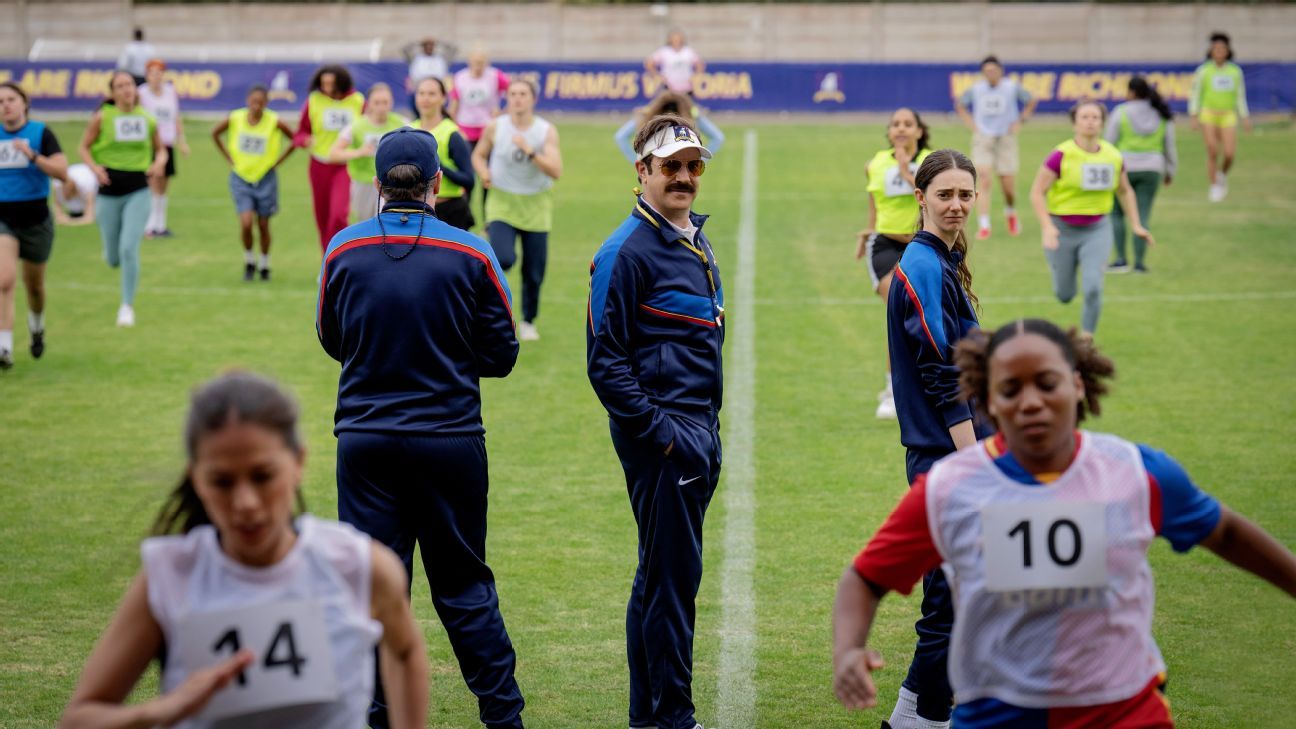
JUNO TEMPLE HARDLY let the question breathe before answering it.
It was posed to her, Emmy winner Hannah Waddingham and Jeremy Swift, who star in the hit Apple TV show “Ted Lasso” — Temple as model-turned-businesswoman Keeley Jones, Waddingham as fictional AFC Richmond owner Rebecca Welton and Swift as director of communications and football operations Leslie Higgins.
Why does women’s football work in “Ted Lasso” at this moment?
“Why wouldn’t it?” Temple said.
She beat Waddingham to it.
“Yeah, why wouldn’t it?” Waddingham jumped in. “Why wouldn’t it?”
Women’s soccer in the United States and around the world has never been so popular.
The sport has been on an upward trajectory for more than a decade and doesn’t look to be slowing down anytime soon. According to a report by Nielsen in 2025, women’s soccer is set to become one of the world’s top five sports by 2030 with a global fan base of 800 million with about 60% of those fans projected to be women.
In the NWSL, the growth has been constant since it was established in 2013 with eight teams. It had 16 teams during the 2026 season with two more to be added by 2028. In the past five years, the entry fee for a franchise has skyrocketed from $2 million in 2021 to $205 million in 2026. But, wait, there’s more. The entry fee grew $40 million between the 17th team and the 18th team. Salaries have also grown from $6,000 a year in 2013 to a league-record $2 million, which went to Trinity Rodman of the Washington Spirit in January. Viewership, attendance and retail sales were all up at the midway point of the 2026 season, with leaguewide retail sales jumping 72% from last year.
“Everything is just progressing in the upward direction and it’s growing and we’re expanding the league,” Angel City midfielder Nealy Martin told ESPN. “And, yeah, I think it’s a great time to invest in women’s sports, even in the entertainment space.”
According to veteran Gotham FC midfielder Meredith Speck, the league is unrecognizable from where it was when she joined the league in 2016.
When Speck heard that the hit Apple show was going to return for a fourth season with the beloved fictional football-turned-soccer coach managing a second-division women’s team, she was torn.
On one hand, she knew how wholesome, heartwarming and funny the show was in its first three seasons, when Jason Sudeikis’ titular character managed a men’s team. And she knew having a storyline that was written specifically about her sport would give it even more exposure than it already receives.
“I was excited because I do love ‘Ted Lasso,'” Speck told ESPN. “I had faith.”
Can a comedy accurately capture the realities of women’s soccer?
On the other hand, she was worried how this season would portray women’s soccer.
“I was a little nervous about how it was going to be received because I didn’t want it to feel like such a parody,” Speck said. “Now, looking at the league, it is serious and professional and women can. … It’s their livelihood.
“So, I was a little nervous.”
None of her concerns dissipated as she started watching this season. After the first two episodes, she noticed that the show was just as wholesome, heartwarming and funny as it was during the first three seasons, but it was also accurate in its depiction of women’s soccer.
A little too accurate, in fact.
“I’m like, ‘These jokes feel very close to home,'” said Speck.
There was the scene in the second episode of this season when Lasso sees the women’s locker room for the first time and notices there’s just one showerhead. Or the scenes from early in the series that highlighted the differences between the men’s and women’s locker rooms. Or when Waddingham’s character drunkenly asks, “Where are you?” to absent supporters of the Lady Greyhounds — which brought Speck back to Megan Rapinoe’s speech after her final NWSL home game, which set an attendance record at the time, when Rapinoe said: “I hope to see all of you at all the home games next year.”
Each scene brought back a memory for Speck of the early days of her NWSL career and it got her wondering if the league’s rookies would understand some of the references and jokes in the show.
“They’re like, ‘I don’t get it. What is the scene about our locker room having no showers?'” Speck said. “And I’m like, ‘Well, of course you don’t get that joke. That’s not your reality.'”
Early in the season, Speck continued to worry that viewers would think some of those situations were just written for a comedic impact.
“I hope that people don’t just laugh this off because it’s not so far from the reality,” said Speck, who attended the red carpet for the show’s premiere in New York.
Seven episodes and most of a story arc later and heading into Wednesday’s season finale of “Ted Lasso,” Speck’s concern and nerves about the show are finally gone.
“I think, now, having been caught up, I love it and I love that they’ve chosen to highlight women’s soccer,” Speck said. “And I think that they’ve done it in a really thoughtful, careful way, and I’ve been thrilled watching.”
Why did the creators decide to pivot to the women’s game for the latest season?
MONTHS AFTER THE Season 3 finale aired in May 2023 — open-ended and full of breadcrumbs, leaving fans yearning for more and speculating about where the story of the beloved coach would go next (if it went anywhere) — Sudeikis, the writer and star, and his costars started throwing out potential ideas for the next chapter of the Emmy-winning show.
One was spin-offs. Another was Lasso coaching a Major League Soccer team. And part of that idea was Welton buying MLS side Sporting KC.
“These are all things [we thought about],” Brendan Hunt, who plays Lasso’s righthand man, assistant coach Willis Beard, told ESPN. “So, yeah, this was potentially parallel universe and not definitively what we would come back and do if we were going to come back.”
And that’s where the future of “Ted Lasso” began to formulate.
Yet, through all the ideas, all the possibilities, Sudeikis felt that in order to bring back the immensely popular show, he’d have to have a good reason.
“I felt we had done, we all felt, I think, behind the scenes, that we had told that first story as I was hoping we would tell it,” Sudeikis told ESPN. “And, so, it was like, OK, well to come back, it has to be for some other reason.
“So what could that be?”
Sudeikis kept coming back to one storyline in particular — one that was teed up by Temple’s character, who, in the final minutes of the Season 3 finale, as Cat Stevens’ “Father and Son” plays in the background, hands Waddingham’s character a binder, inside of which is a plan for the AFC Richmond women’s team.
Abbie Hern, who plays prolific goal scorer Gemma Jay, doesn’t like to watch series finales. That way the shows never end, she said. So, it wasn’t until she got the role in “Ted Lasso” that she watched the last episode of Season 3 and when Temple handed Waddingham the binder, Hern knew where she and the other new actors fit in.
“We just loved these characters so much and we got to know them so well,” Sudeikis said. “But, it was like, ‘Oh, if, if.’ But I just love the idea. We love the idea of Keeley bringing this to Rebecca.”
Sudeikis knew one thing, though, if Ted Lasso were to continue in any way, shape or form: He wanted it to be in the world of women’s soccer.
So, when the decision was made to not just write a fourth season but to pivot the entire storyline to women’s soccer, Sudeikis said his costars were quickly and entirely on board.
“It was yes by a thousand cuts is the way I’ve been trying to describe it,” Sudeikis said.
“F— yeah, quite frankly,” Waddingham said was her reaction. “Yeah, about time, too.”
How is ‘Ted Lasso’ helping women’s soccer achieve true parity?
Then, in August, came this season of “Ted Lasso.”
Along with the show came a record number of eyes on women’s soccer. The show’s Season 4 premiere drew 296.6 million minutes watched Aug. 4-5, according to Variety, making it the biggest debut in Apple TV’s history. Nielsen reported that the first episode of Season 4 on Aug. 5 was watched for more than 200 million minutes, making it the most streamed program in the U.S. that day.
And that meant that during those 200 million minutes from the first episode, viewers saw footage from CPKC Stadium, the only venue in the country dedicated to women’s soccer, and home to the NWSL’s Kansas City Current. When Temple and other castmates were at the stadium for a press conference in July, she was so overwhelmed by being in a women’s-soccer-specific stadium that she was brought to tears.
“I feel like football in general, especially in America, has become more of a thing,” Temple said. “We grew up in England. It’s a religion there. But, I think in this day and age, I think being able to embrace women’s football in the way that people embrace men’s football, it may take a little longer, but it’s important that we’re open to it.
“I mean, it’s ridiculous that it wouldn’t be considered to be a great storyline.”
Washington Spirit center back Tara Rudd said coming off the men’s FIFA World Cup this summer was the perfect time for “Ted Lasso” to be released to help segue the soccer conversation back to the women’s game. Having her sport and, to a degree, her league, be showcased to a global audience has been “huge,” Rudd said.
Sofia Huerta, a right back for Seattle Reign FC, has been a “Ted Lasso” fan since the beginning and believes the show brings new fans to the NWSL.
“I think for the NWSL, it will be good because there’s going to be people who are fans of the show and then maybe they’ll recognize the NWSL and then they’ll fall in love with the way that we play in the athletes and atmosphere,” Huerta said.
“So, I think it’ll just help grow the game immensely, which is exciting.”
Faye Marsay, who plays Lizzie Davis, a single mother of two who’s a captain of AFC Richmond, grew up playing soccer in England until a knee injury she suffered when she was 16 ended her playing days on the pitch and launched her career on stage. When she played on a girls’ team in the late 1990s, she didn’t have a pathway to a full-time professional career because one didn’t exist. The Women’s Super League, the highest level of women’s soccer in England, didn’t enter its full-time, professional era until the 2018-19 season.
Being part of “Ted Lasso” now, has, in a way, filled in the void that soccer left in her as a teenager — while also saving her knees.
“It’s amazing, but it’s also about time,” Marsay told ESPN. “So, in a way, it’s kind of a bittersweet thing for me because I wish it had been when I was still younger.”
She added: “I think using ‘Ted Lasso’ as the platform to shine a light on and I don’t think it’s a moment that women’s football’s having. I think they’ve always been there. It’s just now we’re starting to appreciate it. And I think this will only create way more conversations around what we should be doing better.”
Seattle Reign manager Laura Harvey, who grew up in England and coached throughout the WSL from 2002 to 2012, when she last managed Arsenal, came of age when movies like “Bend It Like Beckham” exposed soccer to a global audience. She said “Ted Lasso” can have just as positive of an impact on the women’s game.
“I think I’ve always had the mindset that when people see it, that they’ll want to come back and watch it,” Harvey told ESPN. “I think that is true, still reigns true now.”
What does real-world support from figures like Sudeikis and the cast of ‘Ted Lasso’ mean for the NWSL?
THE WEEKEND AFTER the New York City premiere, Sudeikis, Hunt and a few of the actors who play on AFC Richmond attended Gotham FC’s match against San Diego Wave FC and spent some time with the players on the field after the game.
“They were so awesome and so excited to be there, which was just a funny moment because I feel like we were both very appreciative of meeting each other, which was nice,” Speck said.
It got to a point that night, that Sudeikis’ people had to pull him away from the field because of other obligations. The whole evening left Speck feeling like Sudeikis was as genuine as he came off.
And it’s hard to argue that his support for women’s sports isn’t.
Sudeikis has not been shy about his support of the WNBA, the NWSL and other women’s sports and athletes. And having an actor of his caliber from a show with the stature of “Ted Lasso” as an ally of women’s sports has been a boost for the league and its players.
“I think it’s important because, in reality, women’s sports has been neglected for a long time,” Huerta said. “And, so, now we’re seeing investment from whether that’s just the attention from people at that level or companies or businesses who are investing. We’re finally getting that attention and the water that we need.
“So, having someone like Jason, it’s big time because he’s obviously a celebrity and so hopefully there can just be more attention around that. He has a big following. Obviously, that’s part of his brand. He’s very passionate about women’s sports. And so just puts more eyes on the sports, which is really good for us. And I also think it just helps people connect with us because people connect with him, maybe they feel like since he connects with women’s sports, that they can connect with us as well and the players and the teams, and then they become more invested. So, it really, really helps us.”
Sudeikis said his inspiration to pivot the storyline came from experiences like his and his family’s love of the WNBA, and the experience of being in London in 2022 while filming Season 3 when the Lionesses won the UEFA Women’s Euro 2022 and then meeting some of the players.
“It just seemed like a natural progression,” he said.
Harvey said that for years, the perception was that anyone who publicly supported women’s sports did so “as a charity move.” That’s not the case anymore, she added.
“I think people like Jason and all the other people that are investing their time and effort and money into women’s sport are changing the narrative that it’s not just a cool and nice thing to do, but it’s actually a really smart business move, too,” Harvey said.
Sudeikis has a unique ability the others don’t: He can bring women’s soccer and their stories onto screens in people’s homes and hands all over the world.
And he understands the responsibility that comes with that.
Sudeikis said one goal of his with “Ted Lasso” was to make something that was “cool” for the people he looked up to like “Saturday Night Live” head Lorne Michaels; his peers like Kristen Wiig, Bill Hader, Andy Samberg; his mentors Amy Poehler and Tina Fey, and his sisters. He wanted them to think what he creates is funny, cool and uniquely him.
This season of “Ted Lasso” is all about accomplishing that. But there’s more. Something bigger than all of them.
“To then have this going into this world that I think is such an incredible space and is getting the attention, it’s long overdue, just women’s sports in general, you want to do right by them,” Sudeikis said. “I want to do right by all those people I just mentioned, too. It’s not like you’re thinking about that at every keystroke, but when you’re making these things, you just want them to watch it.
“They know the difference between it being real and a television show. Everybody all know[s] it’s not a documentary, but the little things that I think that we do pull from the real issues and even real plays and things being based on real players, we take a great care and a great responsibility to that and try to go about it as unparasitically as possible and truly try to honor and share our own enthusiasm for it and have that come across on the show. So, I hope that they enjoy it with that enthusiasm that we make it with.”
Temple hopes the show’s pivot to women’s soccer will inspire all women, regardless of age, pronouns, interests, backgrounds or stories to chase their dreams of soccer if that’s what they truly want to do.
For Waddingham, the show’s global impact, while, yes, it’s focused on women’s soccer, should expose the sport to everyone — not just women.
“The huge beam that this show has cast on football in the first place in America is vast,” she told ESPN. “So, if you think about that impact that this could have on the women’s game, let’s fill the stadiums. …There’s a section where Rebecca speaks to the fact that, yes, young girls and women need to go and support women, but moreover, the little boys need to be taken by their dads to the women’s game so that there is no divide.
“We’re not asking for more. We’re asking for parity.”