
Collaging Black Identity
When Wilson spoke about his influences, he would refer to the four “B’s”: Romare Bearden, Amiri Baraka, Jorge Luis Borges and the blues.
He discovered Bearden in 1977, when “The Prevalence of Ritual,” a 1964 series of Bearden’s collages collected in a volume, captured his attention. Bearden used his collages to piece together bustling portraits of Black life: Black people communing at home or in the streets, playing music or performing rites of passage.
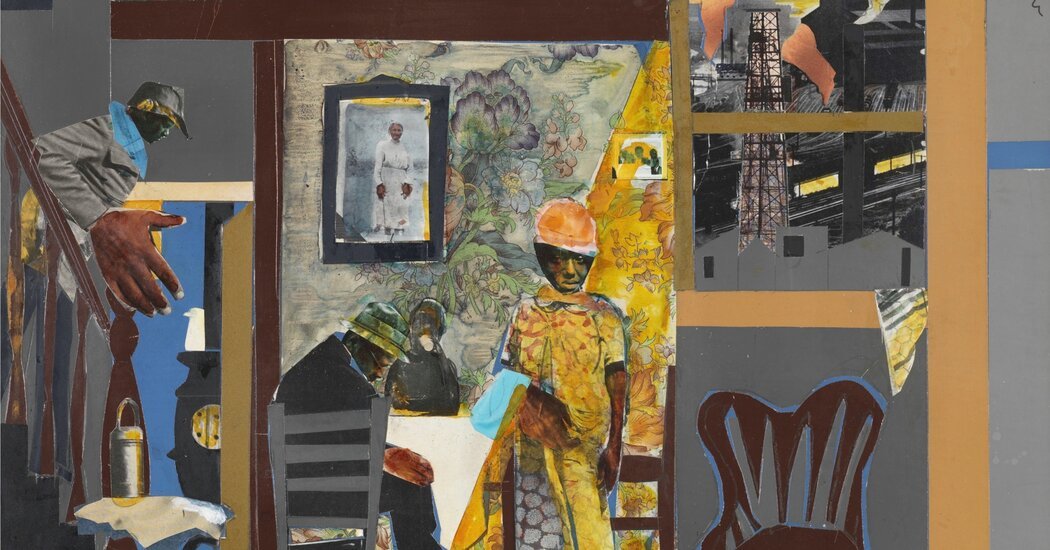
“What I saw was Black life presented on its own terms, on a grand and epic scale,” Wilson wrote. When he later saw “Mill Hand’s Lunch Bucket,” he envisioned the beginnings of a new work that drew from Bearden’s depiction. “Joe Turner’s Come and Gone” is what followed, a work that has been durable and relevant since its 1988 Broadway premiere, including the latest Tony-nominated Broadway revival.
Bearden wasn’t just an inspiration to Wilson in terms of the subjects in his work but also this style of composition. In The New York Times in 1991, in an article adapted from a talk given at the Poetry Center of the 92nd Street Y, Wilson wrote, “I admire Romare Bearden a lot; he’s a collagist, he pieces things together — I discovered that that’s part of my process, what I do. I piece it all together, and, hopefully, have it make sense, the way a collage would.”
In both Bearden and Wilson there’s a sense of collage being the most appropriate approach to depicting the complexity of the Black experience. The totality of Black American life includes slavery and emancipation, juba and jazz, root conjuring and church worship. And it includes the artists who use different means to express all of this, like Bearden and Wilson.
“I called to my courage and entered the world of Romare Bearden and found a world made in my image. A world of flesh and muscle and blood and bone and fire,” Wilson wrote in “Bearden: Black Life on its Own Terms.” “A world made of scraps of paper, of line and mass and form and shape and color, and all the melding of grace and birds and trains and guitars and women bathing and men with huge hands and hearts, pressing on life until it gave back something in kinship.”
The Mysterious Herald Loomis
In the latest revival of “Joe Turner’s Come and Gone,” directed by Debbie Allen, Joshua Boone plays a sullen Herald Loomis.
Wilson first saw Herald in “the haunting and brooding figure” at the center of “Mill Hand’s Lunch Bucket.”
Dressed in a long, black coat and looking from underneath a wide-brimmed hat, Herald resembles a shadow or devilish specter. He seems like something different from a flesh-and-blood man; a man “driven not by the hellhounds that seemingly bay at his heels, but by his search for a world that speaks to something about himself,” Wilson wrote in stage directions.
Compared with the worker at the left making his way out the door and the woman to the right dressed up to go out, this sad figure of a man seems completely lost. Wilson was drawn to this character and started to imagine his story.
At the time Wilson encountered Bearden’s painting he was working on a series of poems called “Restoring the House,” about a freed slave searching for his wife, who had been sold to another plantation owner. Wilson started to write a short story called “The Matter of Mill Hand’s Lunch Bucket,” about the dejected-looking man in Bearden’s painting, but after about a dozen pages he abandoned it and started writing a play instead.
The man became Herald Loomis, the wandering soul in search of his wife in “Joe Turner’s Come and Gone.”
The Working Hand
Perhaps the most prominent feature of “Mill Hand’s Lunch Bucket” are the oversize hands in the painting. The man descending the stairs to the left is dressed for work in his coat and hat, and an enormous hand reaches forward for his lunch bucket. He’s endowed with a purpose, that colossal hand a visual synecdoche meant to signify a working man.
Hands represent how various Black characters in the play employ themselves, and build their identity around their means of employment. Bynum, a freed slave, says he can tell when a man has hands that have picked cotton; Seth, who was born a free man up North, vehemently denies that he’s ever picked cotton.
Work then also becomes a signifier of how connected the characters are to the country’s history of enslavement. Who profits from these working hands? A white employer, a white slaver or oneself? Work isn’t just a matter of finances or economics; it’s inextricably tied to race.
Industry and Progress
To the right of the painting a window provides a glance of the outside world, the fire and smoke of the steel mill igniting the sky in shades of burnt yellow and orange. “The fires of the steel mill rage with a combined sense of industry and progress,” Wilson writes in the preface to “Joe Turner.”
The recent set of “Joe Turner,” designed by David Gallo, also evokes this time of growth and movement in Pittsburgh: A giant backdrop shows an iron bridge and the smoke stacks of steel mills.
Wilson set the play in the very early years of the Great Migration, when millions of Black Americans moved from the South to the Northeast, Midwest and West in search of jobs. Early in the play Seth scoffs at the idea that so many Black people have been traveling northward for jobs not knowing that “the white fellows looking too” and in no time start earning more than the Black workers.
So the steel mill may represent new jobs but it’s a false promise, another example of the American dream offering the very least to Black Americans.

