
Iran’s Strait of Hormuz blockade fuels global oil market concerns as Trump admin meets execs
Jonathan Hunt reports live from London on Iran’s aggressive actions in the Strait of Hormuz, leading to a 95% reduction in commercial shipping traffic. Mohamed El-Erian, Gramercy Funds Management Chair, analyzes the global oil market disruption, with crude oil prices soaring. The Trump administration meets with oil executives as international allies like Japan and European nations issue a joint statement, expressing readiness to ensure safe passage through the vital waterway.
NEWYou can now listen to Fox News articles!
The Strait of Hormuz crisis is driving nations’ efforts to develop alternative Gulf-to-Europe trade routes, with Iraq’s $24 billion “Development Road” project at the forefront, analyst says.
The route from Iraq’s Grand Faw Port to Turkey and on to Europe, is advancing “with discipline,” Middle East Council on Global Affairs analyst Muhanad Seloom told Fox News Digital, calling it a “permanent” and “transformative” wartime shift.
Seloom’s comments came as President Donald Trump warned Tehran against further escalation in the Gulf and signaled the U.S. is prepared to act to keep the strait open.
Iranian forces have laid mines and threatened commercial traffic in the narrow waterway. As of Sunday, the shipping route remains effectively closed.
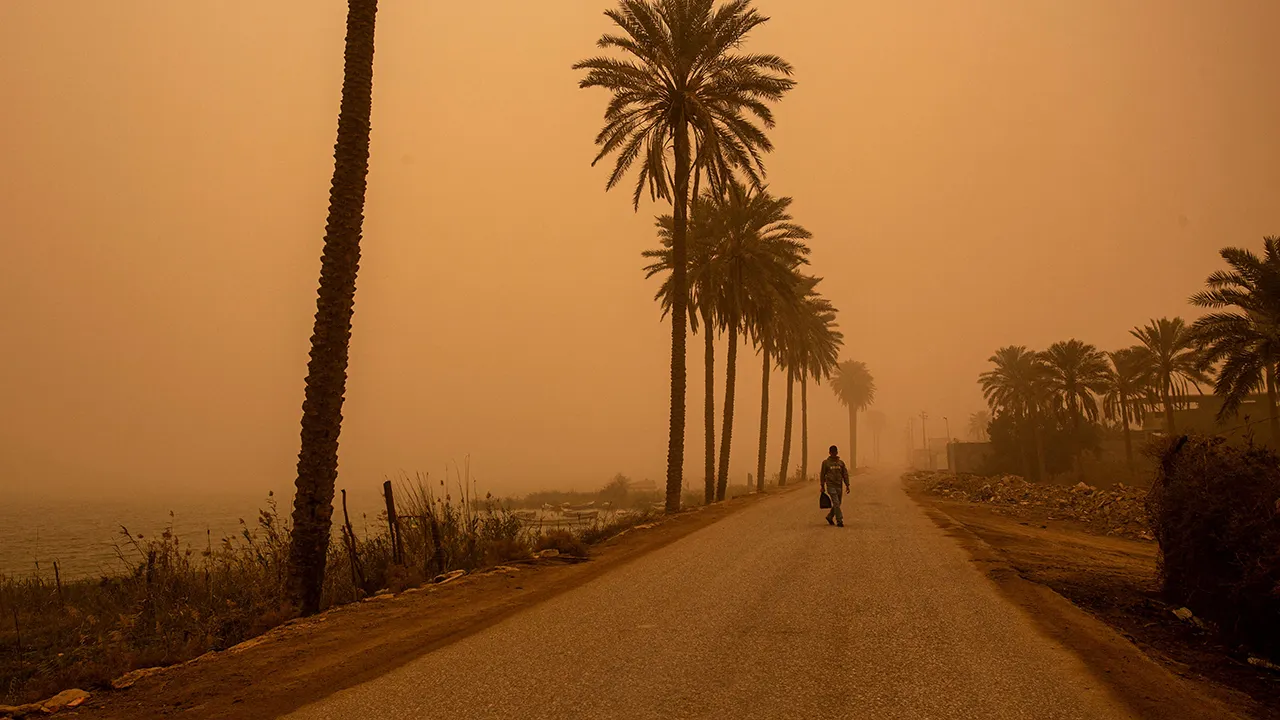
A man walks along a road during a sand storm in Basra, Iraq, on March 4, 2022. (Hussein Faleh/AFP)
“Iraq’s Development Road means every container moving through Basra instead of Iranian-controlled waters is a reduction in Tehran’s leverage over Iraq,” said Seloom.
“The real scale, independent estimates put the Development Road closer to $24 billion, and the project is now moving with discipline,” he said.
Iraq’s Prime Minister Mohammed Shia al-Sudani inaugurated the first 63-kilometer stretch of the Development Road in 2025. Phase 1 is due for completion by 2028.
“What was described by the Iraqi government as a flagship of Iraqi statecraft now has a regional rationale that governments and financiers treat as essential rather than aspirational,” Seloom, an assistant professor at the Doha Institute for Graduate Studies, explained.
“Sudani seems to be positioning Iraq exactly where he thinks its geography always suggested, as a connecting state between the Gulf, Turkey and Europe,” he said.
WATCH SHIPPING THROUGH THE STRAIT OF HORMUZ GRIND TO A HALT AMID IRAN CONFLICT
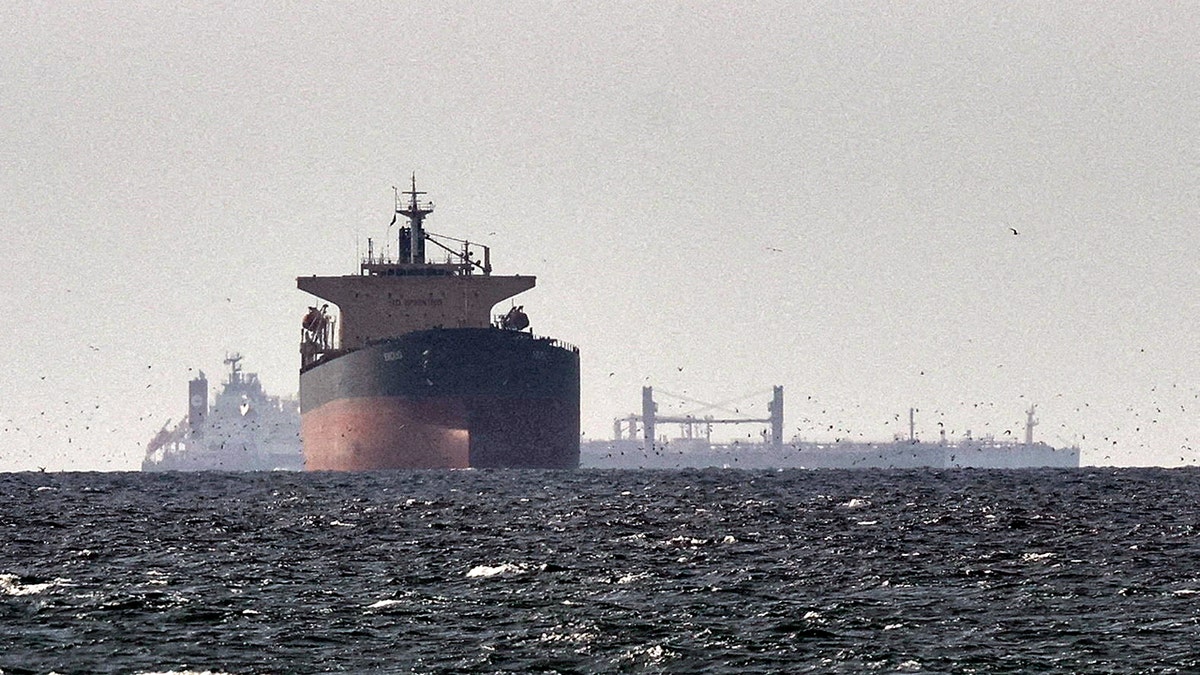
Cargo ships are anchored in the Gulf near the Strait of Hormuz as seen from northern Ras al-Khaimah, United Arab Emirates, on March 11, 2026. (REUTERS/Stringer/File Photo/File Photo)
But other regional infrastructure, Seloom says, is also being pushed forward in parallel.
Saudi Arabia’s East-West Petroline pipeline is operating near its 7 million-barrel-per-day capacity, with expansion plans under review.
The UAE’s ADCOP pipeline to Fujairah is also at maximum use, with a second line under discussion, he said. “Turkey’s Zangezur and Middle Corridors bypass Iran via the Caucasus and are four to five years out.”
He added: “Six Gulf-backed overland fiber projects are also underway through Syria, Iraq and the Horn of Africa.”
Iran reimposed closure measures on the Strait of Hormuz on April 18, reducing traffic to just a handful of vessels per day compared with a pre-war average of roughly 130 to 140.
The restrictions, including on ships, have come under fire in recent days, and interceptions trace back to the start of the war on Feb. 28, when Tehran first moved to block transit following U.S.-Israeli strikes.
IRAN WAR, 11 DAYS IN: US CONTROLS SKIES, OIL SURGES AND THE REGION BRACES FOR WHAT’S NEXT
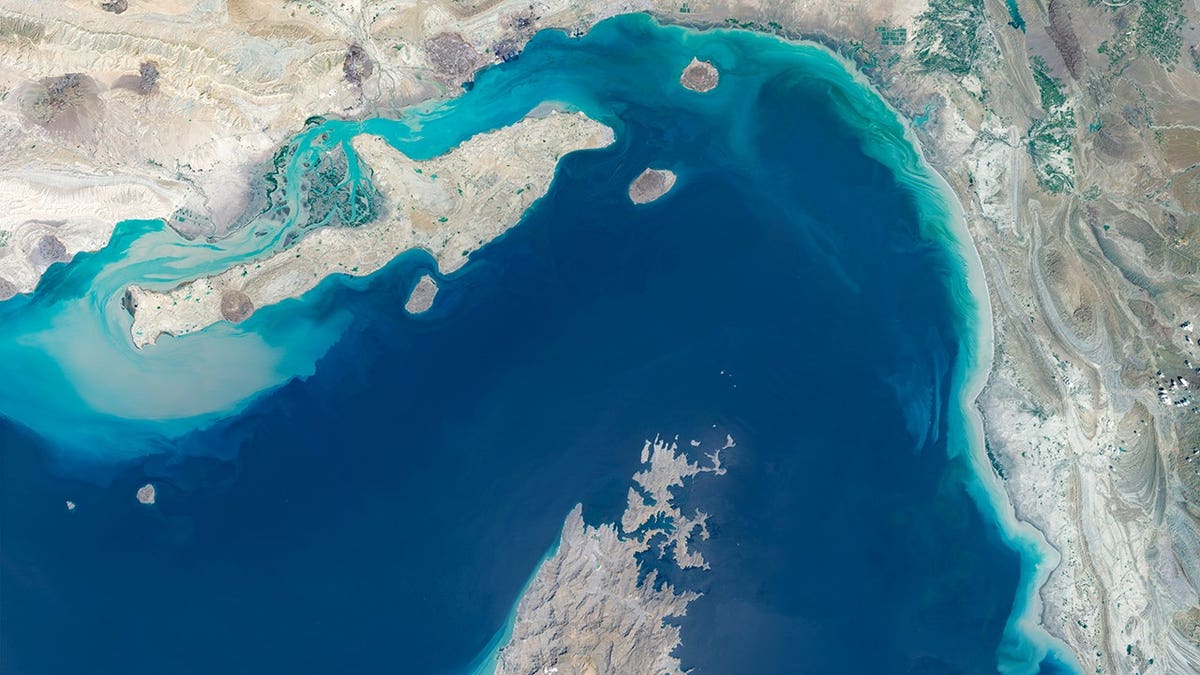
Maps4Media processed and enhanced Sentinel-2 satellite imagery shows a broad view of the Strait of Hormuz between southern Iran and Oman’s Musandam Peninsula, including surrounding islands, coastal terrain, and turquoise shallow-water zones at the entrance to the Persian Gulf. (Maps4media via Getty Images)
“Hormuz remains indispensable for energy, but it is no longer treated as a default. That shift is permanent given the war,” Seloom said.
For Iraq’s corridor, it is “potentially transformative,” Seloom said, with $4 billion per year in projected transit revenue and a repositioning from an oil rentier state to a logistics state.
CLICK HERE TO DOWNLOAD THE FOX NEWS APP
“Turkey will be the single largest beneficiary. Combined with the Zangezur and Middle Corridors, Ankara becomes the overland bridge between Asia and Europe,” he said. “Europe will have an additional overland option on a 2028-plus timeline, but nothing for the current crisis. It marginally reduces structural dependence on the unreliable Suez–Red Sea axis.”

