
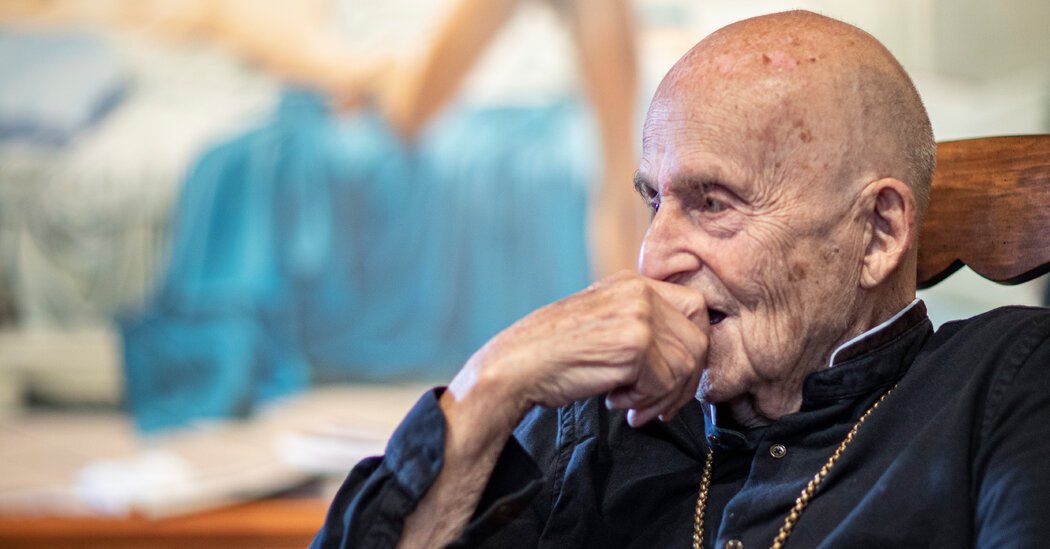
Herbert Lust’s career as an art collector began, as he put it, with a “cock and bull story.”
In 1949, Mr. Lust, a 22-year-old American in Paris, found himself at a luncheon filled with artists and intellectuals. Feeling out of his depth, he made up a story about being a Romanian Jew who had crossed the Carpathian Mountains — barefoot! — to escape the Nazis.
One of the other guests, the renowned sculptor and painter Alberto Giacometti, was intrigued and invited Mr. Lust to drop by his studio. When Mr. Lust confessed that the barefoot-refugee story was a fabrication, Giacometti was more amused than offended by the brazen young American.
It was the start of a close friendship, one of several that Mr. Lust made with artists while amassing an unusual and important collection defined by what he called lucky accidents, such as meeting Giacometti.
Mr. Lust was a notable character in the New York and Paris art worlds in the decades following World War II. He was a rich banker who acted like a bohemian; a onetime novelist who wrote exhibition catalogs; and a mischievous, witty conversationalist who might drop an F-word into a promotional video for Sotheby’s.
He died, at 99, on May 12 at his home in Greenwich, Conn. Michael Feldschuh, the executor of his estate, confirmed the death.
Raised on a farm in Indiana, Mr. Lust confessed to Sotheby’s in 2019 that he was a bit of a rube when he first went to Paris.
“I had no respect for art at all,” he said. “I thought it was decoration.”
Giacometti’s attenuated human figures struck him as “awful.” Then he did some reading.
“I realized,” he said, “if Sartre and people like that said he was the greatest living artist, there was something wrong with me.”
Mr. Lust, who remained friends with the artist until Giacometti’s death in 1966, had graduated from the University of Chicago with a master’s in mathematics and philosophy. He was in Paris for two years as a Fulbright scholar to study comparative literature at the Sorbonne. He also brought the manuscript of an unpublished novel.
He became a weekly dinner guest at the home of Alice B. Toklas, the partner of Gertrude Stein, who had died in 1946. It was Stein’s example, Mr. Lust would later say, that inspired him to collect art.
Using part of his Fulbright funds, he bought Giacometti prints, as well as drawings by another Surrealist, Hans Bellmer. (Mr. Lust eventually ended up with one of the world’s largest Bellmer collections.)
An exhibition of a selection from his large Giacometti collection in 2000 at the Portland Museum of Art in Maine included two portraits of Mr. Lust, one in pencil and the other in ballpoint pen, and he wrote an essay about their friendship for the catalog.
“It is a very affecting exhibition, and made all the more so by Mr. Lust’s beautiful memoir,” the critic Hilton Kramer wrote in The New York Observer.
After starting out teaching literature, Mr. Lust became a banker in New York in 1957, enabling him to collect much more seriously. But he continued to gravitate toward the work of artists he could also call friends.
Giacometti introduced him to Alexander Calder, whom Mr. Lust got to know on a 1961 trans-Atlantic voyage to the United States along with Mark Rothko. Neither Calder nor Rothko liked to dance, but their wives did, and Mr. Lust, who described himself in the 2019 interview as “a very powerful swing dancer,” partnered with both artists’ wives on the dance floor during the six-day voyage.
He went on to buy major pieces by Calder, but thought Rothko’s watery blocks of color were uninteresting. “Big mistake,” he told The New York Times in 2020, by which time Rothko paintings were often selling for tens of millions of dollars.
That year, Mr. Lust donated to the Hirshhorn Museum and Sculpture Garden in Washington a collection of black-and-white photographs by Berenice Abbott, Henri Cartier-Bresson, Eugène Atget and dozens of others.
He formed another decades-long friendship with the pioneering Pop artist Robert Indiana, whom he met at a Manhattan dinner party when the hostess introduced them as fellow Hoosiers.
At first, Mr. Lust did not see much in the works of Indiana, which were paintings of single words, like LOVE and HUG. “I said, ‘This is absurd,’” Mr. Lust recalled in the Sotheby’s interview. “And little by little it grew on me.”
He acquired dozens of Indiana’s pieces and bucked the artist up emotionally after Indiana’s gallery went out of business in 1975 and he struggled to find a new dealer.
“I love Indiana, but he’s the most difficult human being in history,” Mr. Lust recalled in the Sotheby’s interview, which took place at his home in Connecticut. “I remember he was on this couch. I said, ‘Well, what has destroyed your career?’ And he said, ‘My mouth.’”
When Sotheby’s exhibited Mr. Lust’s Indiana holdings in 2017, he wrote the catalog essay. He also produced reference works on others he collected, including the Italian artist Enrico Baj. In 1970 he compiled “Giacometti: The Complete Graphics.”
“I personally don’t know any other collectors who have written catalogues raisonnés on artists, which illustrates Herbert’s intellect and passion for art,” Alejandra Rossetti, a senior vice president at Sotheby’s, told The Times in 2020.
Herbert Confield Lust was born on Oct. 31, 1926, in Chicago, the oldest of three children. His mother, Jennie (Friedman) Lust, worked as a secretary for his father, also named Herbert Confield Lust, a lawyer at a publishing house.
The family soon moved to Fowler, Ind., to a farm where his parents preferred to raise their children. When Herbert was 9, his father was killed in an automobile accident. His mother supported the family by working as a stenographer.
Mr. Lust served in the Navy during World War II. During officer training, in 1944, a required literature course exposed him to the poetry of John Keats. He later called it life-changing, awakening him to aesthetic beauty.
His marriages to Frances Hutchins and Jean Marianne McDonald ended in divorce. In 1963, he married for a third time, to Virginia Wertheimer, and together they ran the Virginia Lust Gallery on Sullivan Street in Lower Manhattan in the 1980s and ’90s, exhibiting Frank Stella, Joel-Peter Witkin and others. The Lusts held salons in an apartment above the gallery. Virginia Lust died in 2014.
Mr. Lust is survived by a son from his first marriage, Herbert Lust III, and 10 grandchildren. Another son, Conrad, from his second marriage, died in 2024.
In later years, Mr. Lust liked to wear collarless shirts and, around his neck, a clunky gold medallion that Giacometti had made for the fashion designer Elsa Schiaparelli.
He was wearing it in 2017 when he was interviewed by Tablet magazine over lunch and retold the story of first meeting the artist. This time, though, he presented himself as far from a rube.
“It always amuses me when everyone says I was lucky that I met Giacometti,” he said. “Thousands of people met Giacometti and none of them pursued him. I pursued him.”

