
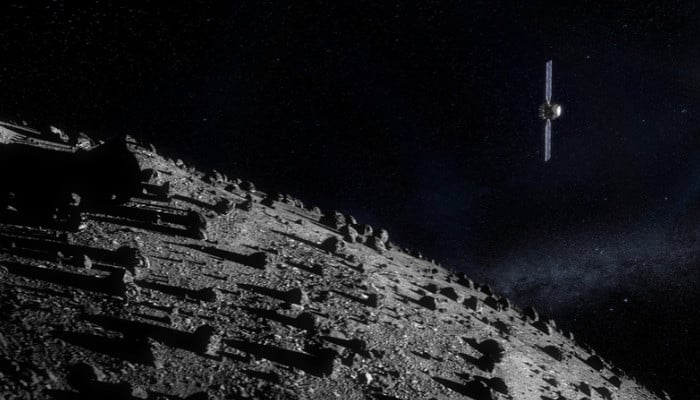
The first close-up images of the asteroid Dimorphos, taken by the European Space Agency’s Hera spacecraft, reveal a stadium-sized crater left by NASA’s deliberate 2022 collision.
NASA’s DART spacecraft slammed into Dimorphos at 14,000 mph on September 26, 2022, successfully shortening its orbit around the larger asteroid Didymos by about 33 minutes.
Four years later, Hera arrived at the asteroid pair to assess the aftermath.
Dr Sabina Raducan, a planetary scientist on the Hera science team: “The crater is almost as large as the body itself, which is really, really spectacular.” The impact flattened one face of Dimorphos into a crater spanning its entire width.
The collision also left Dimorphos tumbling chaotically rather than rotating neatly, and Hera discovered hundreds of previously unknown boulders orbiting both asteroids.
Raducan said: “Imagine a barrel that you throw down the stairs. That’s what Dimorphos does right now around Didymos.”
A key objective is measuring Dimorphos’s mass to determine how effective the spacecraft’s shove was, vital data if an asteroid were ever found on a collision course with Earth.
Prof. Simon Green said: “We need this mass of spacecraft, travelling at this speed, this early, to deflect it enough so that it misses the Earth.”
Hera will spend the next six months studying the pair from progressively closer range, deploying two shoebox-sized satellites, one using radar to peer inside Dimorphos. Scientists hope the mission transforms asteroid deflection from a one-off experiment into a reliable planetary defence tool.
Asteroids the size of Dimorphos could wipe out a city. Carolyn Ernst of Johns Hopkins Applied Physics Laboratory: “We all know what happened to the dinosaurs. We don’t want that to happen to us.”


