
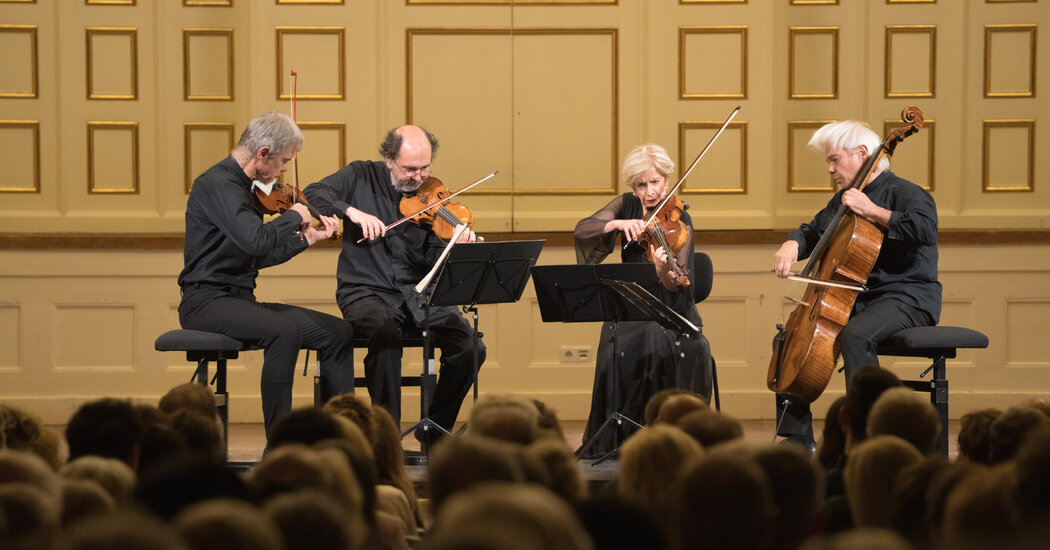
Chamber music requires an almost telepathic connection between its players, which most groups build over years of intense rehearsal. The members of the Hagen Quartet, the great Austrian string quartet that ends its 45-year career this summer, have seemed as if they were reading one another’s minds since they were children.
In 1975, the four Hagen siblings, Angelika, Lukas, Veronika and Clemens, made their unofficial quartet debut at a youth music competition. Angelika, the oldest and a violinist, was 15; Clemens, the youngest and the group’s cellist, was 9. The group went on to become one of the world’s most sensitive chamber music ensembles.
As a child, “I wasn’t thinking about a career path at all,” Veronika Hagen, the group’s violist, recalled in an interview this month before a concert in Dresden, Germany, as part of a farewell tour. “We were just playing quartets, and it developed from there.”
It certainly did. The Hagen Quartet, which officially began its career as a professional ensemble in 1981, has played at the world’s most important concert halls and made around 50 records. It has an unmistakable style, with a warm and transparent color, an impeccable instinct for balancing details with a bigger picture, and the ability to make even the simplest phrases interesting. Onstage, its members seem to communicate via music alone, barely glancing at one another to coordinate their playing.
The farewell tour, which ends July 7 in Tokyo, passed on Tuesday through Salzburg, Austria, where the Hagen siblings were raised and where the quartet’s members have long taught at Mozarteum University. In a season of lasts, the Salzburg concert was “definitely emotional,” Veronika Hagen said.
The group’s musical education began there, practically in the cradle. Their father, Oskar, was the principal violist of the Mozarteum Orchestra and their first teacher. But he was no harsh disciplinarian. He prioritized good practicing habits, like singing to hone the ear, over hours of drills.
“At the beginning, the children practiced 10 minutes a day,” he told the newspaper Süddeutsche Zeitung before his death in 2021. “Then we slowly increased to 20 minutes, 30 minutes, and, at some point, an hour.”
Many prodigious musical talents spent much of their childhoods in solitude; the Hagen siblings were together almost all the time. “We are all very connected, on many levels,” Angelika Hagen said in a phone interview, “and especially this unconscious musical level.”
Angelika was the only sibling to leave the quartet. Though she loved making music with the group, she said, as a young adult she was drawn to a different world. A tour to Japan with another ensemble inspired her to study anthropology. She left the Hagen Quartet in 1981 and stopped playing violin, though in 2004 she began again and formed an improvisation duo.
In May, Angelika was in the audience for the Hagen Quartet’s farewell concert in Vienna, where the cellist Julia Hagen, Clemens’s daughter, joined the players in Schubert’s String Quintet in C major. That convinced Angelika that the Hagen family would continue to make its musical mark after the quartet retired, she said.
“It was completely clear,” she added, “that the sound would go on.”
Angelika was replaced first by Annette Bik and then, in 1987, by the German violinist Rainer Schmidt, who has remained with the group since and become part of the musical family. The four players intuitively “find a flexibility without it getting out of rhythm,” Schmidt said. “That’s always hard: that four people play together without it becoming metronomic.”
Julia Hagen also joined the quartet for the farewell concerts in Berlin and Dresden in performances that showed the rare subtlety of the Hagen sound. In the Schubert quintet, each phrase sounded different and alive, while the overall form of the movements remained clear. The musicians revealed important details: In the middle of the second movement, Julia and Clemens highlighted a lusty cello phrase, giving the entire section the feel of a dance in an inn. And they played the final measure, which can sound brusque, with a generous, unforced sound. It felt like a casual goodbye.
At the group’s farewell concert in Salzburg on Tuesday, the quartet played alone, performing Schubert’s late String Quartets in D minor, D. 810, and in G major, D. 887. Its interpretation of the first, the “Death and the Maiden” quartet, had grace and abandon, with an ending that broke free of all constraints except the most important one — that they played together.
The performance of the other Schubert quartet had extreme rhythmic precision, even in the most delicate moments. In the final movement, the players brought out the music’s dizzying shifts between stormy and innocent, at times creating two completely different characters from moment to moment. The fleetness and confidence that come from a lifetime of work were on full display.
The hall was crowded with admiring students from Mozarteum University on whom the Hagen Quartet was a decisive influence. One of them, Lea Hausmann, a violinist, recalled a lesson with Lukas Hagen when she was 4. He tried to get her to phrase more elegantly as she sawed away at her instrument, she said.
In that way, too, the Hagen sound will go on.
Now that their onstage careers were almost behind them, the Hagen Quartet’s members said they were looking forward to a phase with less time on the road and fewer hours in the practice room. “I loved practicing with a passion,” Veronika Hagen said, “but the body has gotten tired.”
She said she felt gratitude mixed with melancholy — a combination of emotions few composers summoned better than Schubert in his final pieces.
“Now, during our last season, there are more and more works that we are playing for the last time,” she said. “It’s a continuous exercise in saying goodbye.”

