
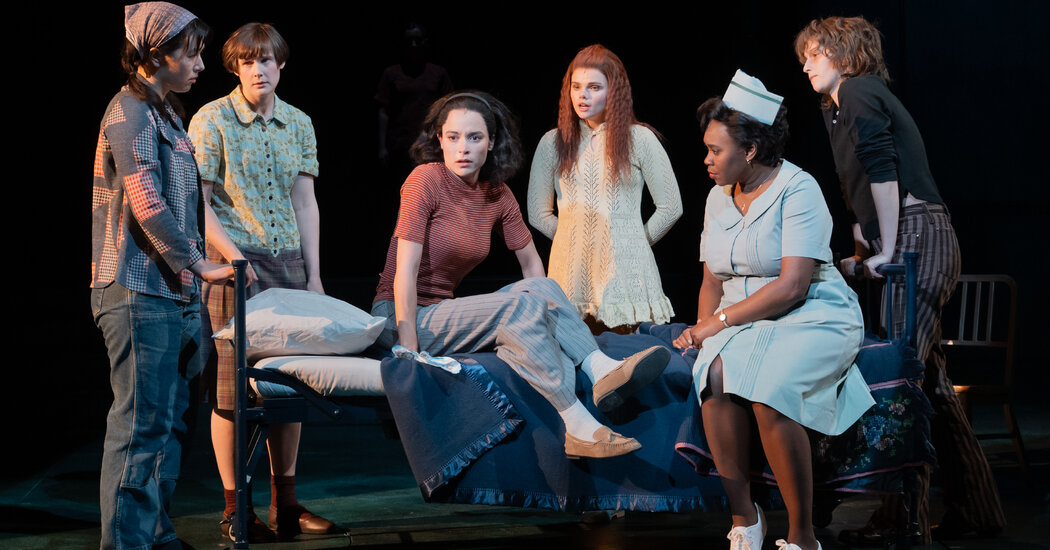
I always experience a bit of chronological confusion about “Girl, Interrupted.” Susanna Kaysen published her memoir in 1993, and it was made into a movie in 1999 — a super-melodramatic version starring Winona Ryder and Angelina Jolie — so it often feels to me like an emblem of the ’90s. When I call to mind its bleak portrait of the McLean psychiatric hospital, I think of that decade’s awful fondness for so-called “heroin chic”: chain-smoking girl-women, their shoulders bony in spaghetti-strap tank-tops.
But neither book nor movie was actually set in the ’90s. Kaysen was looking back from a distance, remembering an 18-month-long institutionalization that began in 1967, when she was still a teenager. The long-in-development musical adaptation of Kaysen’s autobiography — written by Martyna Majok, with songs by Aimee Mann — reorients us to the ’60s, avoiding the film’s feel-bad glamour and copying (with intermittent success) the memoir’s anthropological dispassion.
The young women in “Girl, Interrupted,” which opened on Thursday at the Public Theater, wear their hair in bouffant flips and feel themselves missing out on the Summer of Love, which they mostly watch on TV. Susanna (Juliana Canfield) is frustrated by her caretakers’ insistence that she won’t be able to have a writing career. The psychiatrists are meant to be treating her suicidal thoughts, but any time she tells them that she’ll work as she chooses, they take her will to live as evidence of madness.
There’s plenty of mental disorganization among the patients, but they’re being destabilized by the shift in generations too. The furious Lisa (King Princess) — Jolie won an Oscar for this role — might have anger and drug issues, but the doctors are pathologizing rebellion in a revolutionary time. The hospital resolves the dissonance with over-medication. The young women drift in a Thorazine haze, still under their parents’ faraway thumbs as the last vestiges of the ’50s fall away.
Kaysen’s memoir, impressionistically episodic in structure, resisted being made into a movie; the director James Mangold and the other screenwriters jettisoned her cool, evaluative tone and added an escape plot to turn it into something commercial. But even when adapters treat her memoir more faithfully, it fights like hell against them.
How do you musicalize this material? Mann’s richly detailed, piano-based songs, while themselves beautiful, seem shaped for a song cycle rather than for a narrative. You can certainly listen to them on her gorgeous 2021 album, “Queens of the Summer Hotel,” where they’re more at home than when being sung by actors playing characters.
Turning the book’s documentary-style observation into metaphorical lyrics can also have some ugly side effects. This is especially the case with the musical’s treatment of Polly (Sally Shaw), a girl on Susanna’s ward who has been hospitalized for setting fire to herself. Susanna describes Polly’s caul of scar tissue, which is thickest around her neck. “I think the gasoline had settled in her collarbones,” Susanna says, both in the book and Majok’s script. That matter-of-fact sentence is one of the most frightening I’ve ever read. So, in the show, when Polly sings in a Joni Mitchell warble that “I know the secrets that live in fire / I saw the promise that flames inspire,” I recoiled. The poetry works on an album, but on a stage, I did not want Polly’s horror to rhyme prettily, not at all.
In the director Jo Bonney’s production, events take place in a subterranean nowhere; even after characters depart (or die), they lurk in the background. The main stage feature, provided by the set design cooperative dots, is a huge verdigris-blue cylinder, which flies up and down, like a massive piston.
Sometimes this curved surface is a wall at the Frick museum, where Susanna sees Vermeer’s “Girl Interrupted at Her Music,” which enthralls her. The Dutch girl in the painting looks out at the viewer, as if, Susanna says, “She’d looked up from her work to warn me.” The fact that Susanna is at the Frick because her teacher (Manoel Felciano) has taken her there to seduce her is part of the musical’s argument that her illness is a symptom of male predation.
Canfield, with her gorgeous, husky alto, plays Susanna with the same blankness that Kaysen evinces on the page. Her air of ultra-reserve seems intentional. But trying to approximate Kaysen’s reportorial chill makes her onstage avatar theatrically inert. One moment Susanna is irritated that a doctor has diagnosed her for sexist reasons; another she seems to agree, reluctantly, that she’s in need of medical care. Neither option much moves her.
What is moving here, even in a murky production with too much stillness at its center, is the assembled talents — from Kaysen to Majok to Mann — all dedicated to describing a group of girls in a hospital nearly 60 years ago. Some didn’t survive, many of them weren’t cured, a few might not have even been sick. But at least, for a while, they do interrupt our lives. We pause, together, to remember them.
Girl, Interrupted
Through July 12 at the Public Theater, Manhattan; publictheater.org. Running time: 1 hour 50 minutes.

