Germany’s political establishment has spent years insisting that the far-right Alternative for Germany (AfD) should be kept out of positions of power.
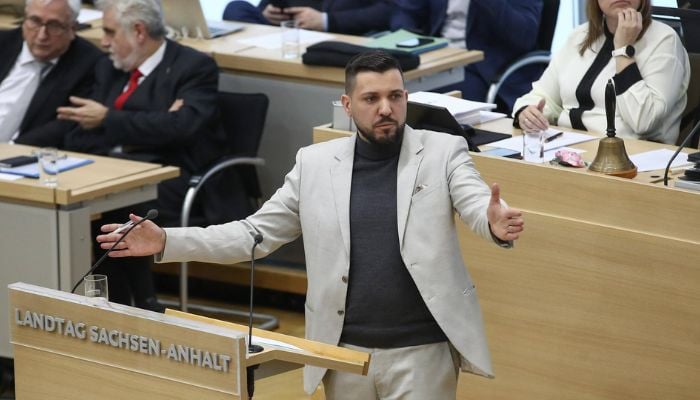
On Tuesday, that barrier weakened after Tobias Rausch, an AfD politician in Saxony-Anhalt, was elected president of the state parliament, becoming the first far-right politician to hold such a post in Germany since the Second World War.
Rausch won 48 of the 82 votes cast. The AfD holds 39 seats in the parliament, while five members of the left-wing BSW had already said they would support him.
Together, that accounts for 44 votes. Rausch still received four more. Because the ballot was secret, it is not known who those additional lawmakers were.
But their votes have immediately raised a much bigger question in German politics: is the informal “firewall” designed to isolate the AfD starting to collapse?
For years, Germany’s mainstream parties have largely refused to cooperate with the AfD, particularly because parts of the party have been classified as extremist by domestic intelligence agencies.
In Saxony-Anhalt, the AfD is classified as a confirmed right-wing extremist organisation by the state intelligence service. The party disputes such classifications.
The president of a state parliament is an important institutional role, responsible for overseeing debates and parliamentary proceedings.
The result shows that at least some lawmakers outside the AfD were willing to vote for one of its candidates despite years of efforts by mainstream parties to keep the party away from senior political offices.
BSW founder Sahra Wagenknecht had already argued that the strategy of isolating the AfD was no longer working. Her party openly supported Rausch, saying the votes of nearly 44% of Saxony-Anhalt’s electorate could not simply be ignored.
Rausch’s election comes only weeks after the AfD won nearly 44% of the vote in Saxony-Anhalt’s regional election, making it the largest party in the state parliament.
That result also badly weakened Chancellor Friedrich Merz’s center-right CDU.