
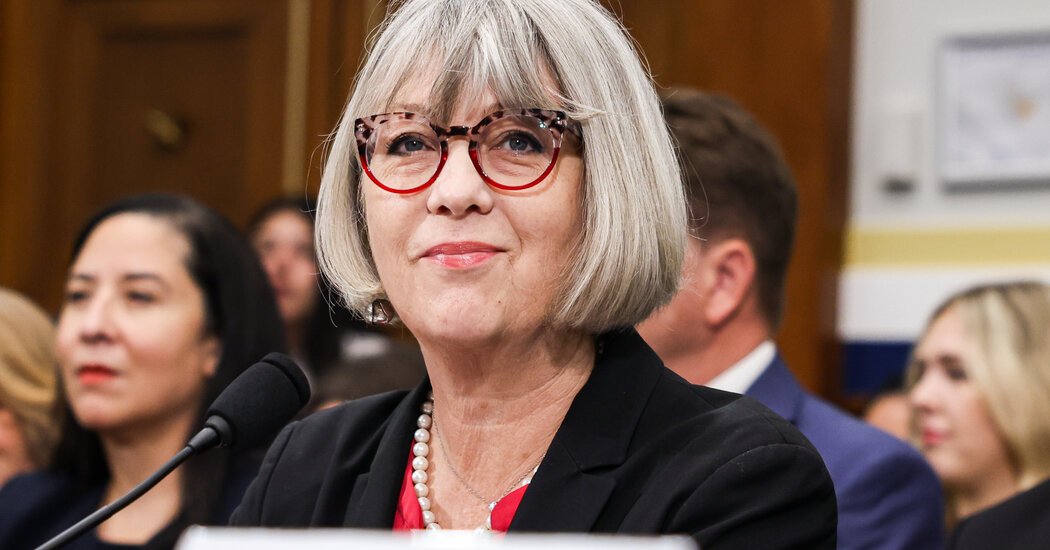
The director of the Smithsonian National Museum of American History, Anthea M. Hartig, came under fire on Tuesday at a congressional hearing over a recent White House report that accused her of “radical activist ideology” and the museum of undermining “faith in American institutions.”
The White House report, released on Independence Day, argued that the museum did not properly tell the story of the nation’s founders; too often cast the country in a negative light; and overemphasized slavery, immigration and transgender issues.
Representative Tim Burchett, a Tennessee Republican and chairman of the Subcommittee on Delivering on Government Efficiency, an arm of DOGE that held the hearing, focused on content in two recent exhibitions: “Entertainment Nation,” which explores the history of entertainment and “Girlhood (It’s complicated),” which discussed gender identity.
“You have pictures of bondage, you have some overtly sexual things up there, you have transgendered folks,” he said. “In another exhibit, a 6-year-old girl asked why she doesn’t have male genitalia. Do you really think that content is appropriate for children? I mean, do you think little girls have penises?”
Representative Nancy Mace of South Carolina asked Ms. Hartig to list how many genders there are and said, “When was your gender revealed to you?”
The museum director responded, “I don’t really think that’s relevant to the conversation” and generally answered in measured tones, explaining at one point that the “Girlhood” show “was not designed for children” and had a label informing parents about some of the topics.
Ms. Hartig contested the thrust of the recent White House report about the museum she leads.
“We unwaveringly attest that it does not fairly or accurately characterize the full body of work at the museum,” Ms. Hartig said at the hearing, “Rewriting American History: Examining the Smithsonian’s Efforts to Reshape the Past,” while acknowledging that “there is always room for improvement.”
“When historians talk about reframing a traditional narrative, we don’t mean erasing it,” she continued. “We mean adding the evidence, the voices, the objects that earlier tellings left out so that more Americans can see themselves reflected in the national story.
The hearing brought before Congress a conflict that has so far played out between the White House and the Smithsonian, which oversees 21 museums and has long been regarded as independent of the executive branch.
Since March 2025, when President Trump issued an executive order titled “Restoring Truth and Sanity to American History,” the White House has sought greater influence and control over the Smithsonian on the grounds that the institution — the order said — has sought “to undermine the remarkable achievements of the United States by casting its founding principles and historical milestones in a negative light.”
In addition to Ms. Hartig, those who testified included Mike Gonzalez, a senior fellow at the Heritage Foundation who has written critically about the Smithsonian; David Blight, a Yale professor; and Matthew Spalding, a professor at Hillsdale College, a Christian institution. Mr. Spalding was involved with Mr. Trump’s 1776 Commission, which has emphasized the centrality of religion to the country’s founding.
“A museum focused on claims of systematic oppression teaches national self-loathing,” Mr. Spalding told the panel. “Why should taxpayers subsidize a museum that teaches contempt for their country and frames its past to serve ideological purposes?”
Ms. Hartig had been a particular target of the July 4 White House report, which mentioned her more than 200 times and called out her comment to students about seeing history as a “prime tool of social justice.”
Historians have defended Ms. Hartig’s scholarship and sharply criticized Mr. Trump’s efforts to enforce his view of history. Mr. Blight at the hearing called the White House report “nothing less than a declaration of political war” that “breathed the rhetoric of Cold War triumphalism.”
“We do not write woke history, whatever that is,” he added of historians, “but we do try to awaken citizens.”
Ms. Hartig argued that the museum is not unpatriotic, citing the prominent display of artifacts such as the desk on which Thomas Jefferson drafted the Declaration of Independence, Horatio Greenough’s statue of Washington and Lincoln’s top hat.
“We honor the Declaration, the Revolution, the Constitution, our national symbols,” she said. “And we tell the truth about the times that the country fell short of its own founding ideals. Telling our story fully is a form of respect for the American people and a commitment to constantly being in pursuit of a more perfect union.”
Mr. Gonzalez in his remarks criticized the Smithsonian more broadly, as well as its chief, Lonnie G. Bunch III, the secretary of the Smithsonian. “Teaching lessons about American wickedness is now the mission of the Smithsonian,” he said, adding, “museum leaders have commandeered the world’s largest museum complex and admit that they intend to use it as a tool of societal transformation. This is not why Americans entrusted these institutions to them.”
“Lonnie Bunch put the Smithsonian’s reputation at serious risk, and director Hartig endorsed all of it, pledging to ‘work to reframe the traditional celebratory narrative of U.S. history,’ to force a ‘national reckoning,’” Mr. Gonzalez continued. “National reckoning from a history museum? This erasure of American culture must end now.”
Several Democrats on the panel who are Black said that they found what they viewed as the White House effort to de-emphasize the impacts of slavery to be offensive.
“Welcome to the Republicans White Pride Rally disguised as a congressional hearing,” said Representative Jasmine Crockett of Texas. “It might be uncomfortable for some people on this committee to hear about the true history of America, and I hate that for them, but facts are facts.”
Tuesday’s hearing was the first of two by the House this week to examine the operations at the Smithsonian in the aftermath of the president’s effort to realign it in accord with his own perspective. The Committee on House Administration will hold another one on Wednesday.
Representative Joe Morelle, the top Democrat on that Committee, released a statement decrying what he depicted as Mr. Trump’s abuse of power “to pressure one of America’s most respected cultural institutions into political obedience.”
“The Smithsonian was established as an independent institution,” his statement continued, “precisely so no president could dictate how our nation’s story is told.”
Representative Melanie Stansbury, Democrat of New Mexico, at the hearing introduced the Smithsonian Integrity and Historical Independence Act to bar any federal official “trying to interfere in the independent institutions of this country and the historic interpretation of our nation’s history.”
She also called the recent White House report “a political witch hunt.”
The report all but threatened to withdraw funds from the Smithsonian in citing Mr. Trump’s executive order that directed Vice President JD Vance to work with budget officials to “prohibit expenditure on exhibits or programs that degrade shared American values, divide Americans based on race or promote programs or ideologies inconsistent with federal law and policy.”
Some 62 percent of its annual $1 billion budget is derived from federal sources, including funds directly appropriated by Congress.
While the Trump administration proposed cutting the Smithsonian’s budget by about 12 percent in the 2026 fiscal year, Congress maintained the institution’s federal funding.
Several Republican lawmakers focused on the extent to which they said the museum was dedicated to presenting a vision of America that focused more on its faults than its achievements.
“Your museum has minimized or contextualized the founders primarily through slavery and exclusion while elevating narratives of conquest, systematic injustice and resistance,” said Representative Lauren Boebert of Colorado. “Is there any version of the American founding you consider worthy of uncomplicated celebration or is the entire project irredeemably tainted by your view?”
Ms. Hartig had addressed that perspective in her closing remarks, in which she invited the committee to visit the museum.
“Walk the building with me,” she said. “Stand in awe in front of the Star-Spangled Banner. I believe what you will find, madams and sirs, is not an institution that has forgotten its country, but one that loves it enough to tell the full sweep of history, our triumphs and our struggles.”

