
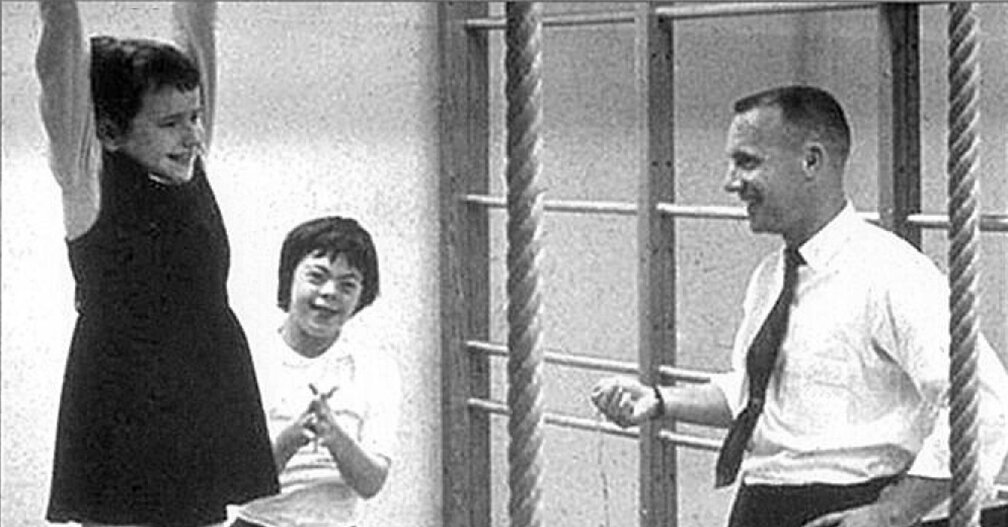
Frank J. Hayden, whose research showing that intellectually disabled children benefited from athletics led members of the Kennedy family to ask for his help staging the first Special Olympics, and who then contributed to the Games’ astounding growth into a global movement, died on May 16 in Oakville, Ontario, near Toronto. He was 96.
His death, in an assisted-living residence, was confirmed by his family.
The Special Olympics, now an international juggernaut that provides training and competition for more than five million athletes from 200 countries each year, has made a significant contribution to the struggle for human rights, helping to fight the stigma against people with disabilities.
The roots of the Games lie in Dr. Hayden’s groundbreaking work. A professor of physical education, he published research in 1964 showing that Toronto schoolchildren with intellectual disabilities got stronger and fitter with physical training. His findings knocked down common views that people with such disabilities were inherently weak, inactive and overweight.
“It was Frank who said, ‘Of course they can participate in sport and succeed at it and be physically fit. They just have to be given the chance,’” Sharon Bollenbach, then the chief executive of Special Olympics Canada, said in 2016, when Dr. Hayden was inducted into Canada’s Sports Hall of Fame.
Dr. Hayden’s work caught the attention of Eunice Kennedy Shriver, who brought him to Washington in 1965 to help plan the first Special Olympics. (A year earlier, he had proposed a similar competition in Canada that failed to get off the ground.)
Mrs. Shriver was a sister of President John F. Kennedy — and of Rosemary Kennedy, who in 1941, at the request of her father, was lobotomized after exhibiting learning disabilities and erratic behavior. The procedure left her, a 23-year-old woman, unable to speak or live independently.
At the helm of the Joseph P. Kennedy Jr. Foundation — named for another of her siblings, who was killed in action in World War II — Mrs. Shriver steered the charity to focus on the compassionate treatment of people with intellectual disabilities.
In 1962, she founded Camp Shriver at her Maryland farm, giving people with disabilities — who were then commonly housed in institutions — the opportunity to participate in sports and recreation. Dr. James N. Oliver of England, who in 1958 showed that offering physical activity to children with intellectual disabilities had positive effects, including in the classroom, had been brought in as a consultant.
Hired by the foundation in 1965, Dr. Hayden learned of a physical education instructor in Chicago, Anne McGlone, who was planning a citywide track meet for the intellectually disabled. Ms. McGlone had asked a charity for funding, only to be scolded by the organization for “putting these kinds of kids on display.”
The Kennedy Foundation had a different perspective. It provided $25,000 to expand the Chicago meet into a national, multisports event.
The first Special Olympics, with Dr. Hayden as executive director and Ms. McGlone as the local organizer, was held at Soldier Field in July 1968. Some 1,000 athletes from the United States and Canada competed in more than 200 events.
Mrs. Shriver announced that the Games would be a biennial event.
“Within two years,” Dr. Hayden recalled in a 2016 interview with The Canadian Encyclopedia, “I had state organizations and annual state games in all 50 states, and all 50 states sent teams to the second Special Olympic Games in Chicago in 1970.”
He remained executive director of the Games through 1972, then returned to academia before rejoining the Special Olympics in 1981 to lead its international expansion. He established an office of international development in Washington, and in just a few years more than 50 countries were sending athletes.
Dr. Hayden moved to Paris in 1988 to run the European office of Special Olympics International, and in 1990 he returned to Canada, where he was a consultant to the Canadian Special Olympics through 2000.
Francis Joseph Hayden was born on Jan. 11, 1930, in Windsor, Ontario, the younger of two sons of Joesph and Ethel (Castwood) Hayden. His father was an Irish immigrant who worked at a Ford factory, though he lost his job during the Depression and moved the family to nearby St. Catharines. His mother, who was born in England, worked as a custodian at a church.
Frank earned a bachelor’s degree in physical education from the University of Western Ontario in 1955, then, at the University of Illinois, earned a master’s in 1958 and a Ph.D. in 1962, with a program combining exercise science and psychology.
As a researcher at the School of Physical and Health Education (now Kinesiology and Physical Education) at the University of Toronto, his supervisor told him there was a grant available for research on the fitness and motor skills of children with intellectual disabilities.
Before seeking the grant, Dr. Hayden spent time in the library and learned that little had been published on the topic. “I figured that I would become an instant expert and that I had a blank sheet,” he told The Canadian Encyclopedia.
His 1964 research, published as a 48-page booklet, included exercise plans for teachers and parents. It sold 50,000 copies, according to Dr. Hayden’s personal archives, and found its way to Mrs. Shriver.
In 1957, he married Marion Bentham, who died in 2024. He is survived by his sons, Jamie and Sean; his daughters, Murn Meyrick and Laura Thomson; seven grandchildren; and five great-grandchildren.
When Dr. Hayden was first doing his research in Toronto in the 1960s, students with intellectual disabilities were not admitted to public schools. Some parents had founded their own school for these students, but there was no physical education on offer.
When Dr. Hayden tested the children, he found they had roughly half the strength and 35 percent more fat than their peers.
“Everybody said, ‘Well, what do you expect?’” Dr. Hayden recalled in 2016, adding, “And I’m saying geez, if you and I had a lifestyle like that, we wouldn’t be any more able and fit than they are.”
After athletic training, he found, the children in the study had cut the gap with their peers by half in a single year.

